Huawei Unveils AI-Centric Networks, 5G-A and SuperPoD Innovations at MWC 2026

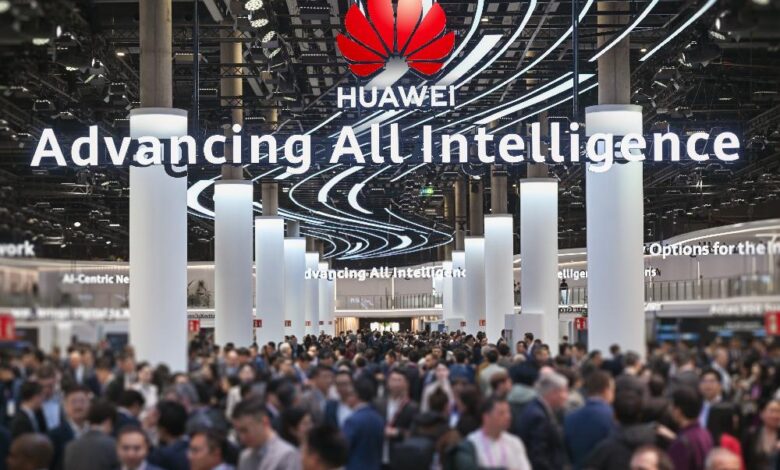
At Mobile World Congress Barcelona 2026, Huawei unveiled an integrated portfolio of AI-centric network innovations, 5G-Advanced (5G-A) solutions, next-generation mobile backhaul architecture, high-performance SuperPoD computing systems, and open-source agent frameworks aimed at accelerating digital transformation across the Middle East.
Under the theme “Advancing All Intelligence,” Huawei outlined a coordinated strategy combining AI-native telecom infrastructure, expanded Upper 6 GHz (U6G) spectrum capabilities, intelligent operations, and scalable AI computing to prepare operators for the emerging “agentic Internet” era.
AI-Centric Networks and the Agentic Internet Vision
Huawei positioned AI-Centric Networks and 5G-Advanced as foundational technologies for the next phase of digital growth.
Li Peng, Senior Vice President and President of Huawei ICT Sales & Service, said that networks are transitioning from connectivity platforms to intelligent service engines that support “hundreds of billions of agents”, with 5G-A and AI at the core of this evolution. His remarks emphasised the importance of new value creation beyond pure connectivity, including AI-enabled services such as real-time transcription, translation and context-aware networking, as carriers pivot to monetise mobile AI experiences. He specifically proposed a “5G-A x AI” model to help carriers move beyond traffic monetization toward becoming comprehensive AI service providers.
Yang Chaobin, President of Huawei ICT Products & Solutions Business Group, addressed the industry on advancing uplink and downlink capabilities, autonomous operations, and inclusive connectivity — priorities aligned with the Middle East’s digital agendas spanning smart cities, industrial digitisation, and AI-driven national strategies.
Six AI-Centric Innovations for Autonomous, Resilient Networks
Huawei introduced six AI-centric network innovations spanning core networks, operations, IP transport, optical infrastructure, data platforms, and digital power.
AgenticCore modernises voice and broadband networks by embedding AI-enhanced calling, intelligent personalised services, and agent communication capabilities directly into the core network.
An industry-first AI-Native framework for intelligent operations integrates digital twins, telecom-domain models, and agent-based workflows, supporting predictive operations and accelerating the shift toward Autonomous Network Level 4 (AN L4).
Huawei’s Next-Generation WAN (NG WAN) architecture strengthens IP bearer networks with encrypted traffic identification, lossless transmission for computing data, intrinsic security protections, and quantum-secure capabilities.
The newly launched AI Data Platform bridges AI models and business value by improving inference efficiency, reducing latency, and enabling faster deployment of AI-enabled telecom services.
In optical networks, Huawei advanced “AI for Networks” and “Networks for AI” through enhanced fiber sensing, intelligent operations, and millisecond-level latency performance.
Meanwhile, AI-Powered Green Site and GW-level AI Data Center (AIDC) solutions integrate intelligent energy management, enhanced reliability, and virtual power plant capabilities to support both zero-carbon ambitions and large-scale AI computing growth.
Launch of 5G-Advanced Mobile Backhaul Architecture
In addition to core and transport innovations, Huawei officially launched its new 5G-Advanced (5G-A) Mobile Backhaul (MBH) architecture, designed to support the next phase of intelligent mobile broadband (MBB).
As operators move beyond volume-based pricing toward experience monetization models built around guaranteed performance and premium connectivity, Huawei has redesigned the mobile backhaul layer — the network that connects base stations to the core — shifting from a traditional “best-effort” model to a predictable, performance-driven framework.
As 5G-A scales globally, traditional backhaul networks face three major bottlenecks:
- Capacity limitations as traffic per site exceeds 8Gbps due to Ultra-HD video, immersive XR, and AI-powered services
Network inflexibility caused by heavy reliance on Layer 2 switching, increasing latency and limiting real-time applications
Limited service differentiation for industries requiring guaranteed performance and reliability
To address these, Huawei introduced three core upgrades:
- 10GE/25GE to the Site: Upgrading access links to 10GE and 25GE unlocks full 10Gbps wireless capabilities, enabling premium services such as 8K video, immersive XR, AI-powered surveillance, and high-definition live streaming.
- Layer 3 (L3) routing to the site: Extending advanced routing to the network edge shortens traffic paths, reduces latency, and supports smart cities, industrial automation, edge computing, and next-generation mobility use cases.
- End-to-End SRv6: Enables intelligent real-time traffic optimisation across the network. Commercial deployments have increased data usage levels (DOU) by more than 20%.
The architecture has already entered large-scale commercial deployment globally. In China, upgrades from 10GE to 25GE have supported advanced 3D, XR, and AI-based services. In South Africa, deployment of Huawei’s SRv6 solution increased ARPU from $18 to $25.
In the UAE, operators are accelerating their 5G-Advanced transformation. e& UAE has collaborated with Huawei to integrate advanced AI capabilities into its 5G-Advanced core network, enabling predictive optimisation and automated management. Meanwhile, du deployed the world’s first 25Gbps E-band microwave link in a 5G-Advanced rollout, delivering fiber-equivalent backhaul performance and reinforcing the UAE’s leadership in 5G-A innovation.
SuperPoD AI Computing and Open Agent Collaboration
Complementing its network innovations, Huawei introduced its latest SuperPoD AI computing portfolio, including the Atlas 950 SuperPoD and TaiShan 950 SuperPoD, designed to support large-scale AI training and inference.
The Atlas 950 SuperPoD can connect up to 8,192 NPUs into a single logical system, delivering ultra-high bandwidth and low latency performance. The TaiShan 950 SuperPoD, positioned as the industry’s first general-purpose computing SuperPoD, supports hyperscale data centres and enterprise environments investing in sovereign cloud and AI infrastructure.
Huawei also launched its open-source A2A-T (Agent-to-Agent for Telecom) framework, aimed at standardising AI agent communication within telecom networks, simplifying integration, and accelerating the evolution toward autonomous networks.
Building the Foundation for the Intelligent Era
Huawei emphasised that sufficient licensed mid-band spectrum, particularly in the Upper 6 GHz band, will be critical to enabling 5G-Advanced and future 6G evolution.
By combining AI-native telecom networks, next-generation mobile backhaul, high-performance computing clusters, intelligent operations frameworks, and open collaboration standards, Huawei’s announcements at MWC 2026 present an integrated blueprint for intelligent, resilient, and future-ready digital infrastructure.
For Middle East operators — many already leading global 5G adoption — the transition to AI-centric networks and 5G-Advanced architectures provides a stronger foundation for differentiated service monetisation, enterprise innovation, and long-term economic transformation in the agentic Internet era.