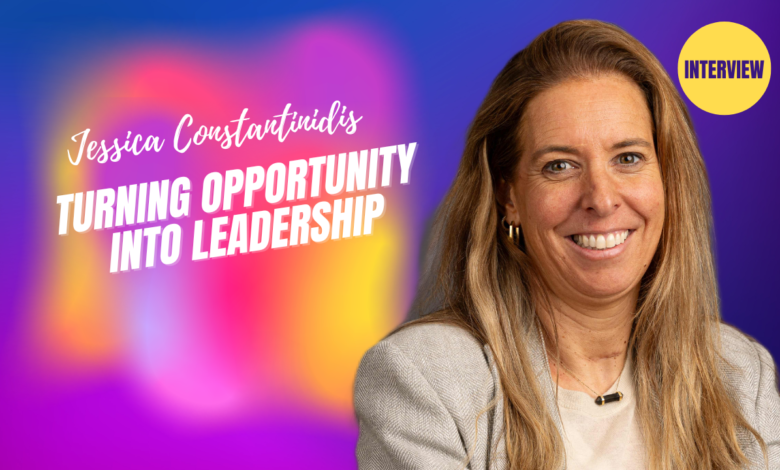
Jessica Constantinidis, Innovation Officer for EMEA at ServiceNow, shares how curiosity, risk-taking and strong sponsorship shaped her career in the technology sector. She reflects on building influence in male-dominated environments, the evolving expectations for leaders in an AI-driven world, and why mentorship, visibility and taking chances remain essential for women pursuing leadership in tech.
What defining moments or challenges most shaped your professional journey?
I’d say two forces shaped my journey. The first was my own “try it” attitude. I’ve always asked myself: What could possibly go wrong? If something didn’t work out, I knew I could return to where I was, and hopefully, just a little wiser. That mindset pushed me to accept bigger roles without knowing every detail, to try new things, and to leapfrog traditional career paths simply because I didn’t resist the opportunity.
The second was having a senior executive who truly believed in me — someone who mentioned my name behind closed doors and opened doors I couldn’t see yet. Mentors and coaches create possibility, but you have to be willing to step into it.
What barriers do women still face in leadership today that aren’t talked about enough?
One barrier we don’t talk about enough is the lack of visible, active sponsorship from senior leaders. Too often, women aren’t backed for the biggest roles. There’s still bias across the US, EU and APAC, and while I see strong efforts in the Middle East to elevate women, progress isn’t universal.
It also comes down to networking and being seen. Leadership shouldn’t be an exception for women, or treated as an anomaly. It should be normal to see both men and women leading organisations. Until that’s the default, there’s still work to do.
How have you built credibility and influence in environments where women are underrepresented?
I focus on showing value wherever I go. I don’t walk into a room asking what I can take but rather, I look at what I can give first. That means helping out, speaking up with potential solutions, and contributing in a practical way.
Visibility also matters. Being present across different networking environments helps you build real connections. Over time, people begin to associate you with the value you bring and the strength of your network. Credibility isn’t something you demand, but rather, something you earn by consistently contributing and connecting.
How is technology—especially AI and automation—changing leadership expectations in your industry?
Technology, especially AI and automation, has fundamentally raised the bar for leaders. Today, you’re forced to really know your business and use technology to make better decisions. It’s no longer about producing the best Excel spreadsheet. It’s about understanding what to improve based on the data in front of you.
A strong leader knows how to leverage technology to make their life, and their organisation, better. That requires shifting how we operate and how we approach day-to-day tasks. The expectation now is clear: use technology intelligently, or risk falling behind.
What skills or mindsets will be most critical for the next generation of women leaders?
I would suggest that it is the ability to reason with contextual data. I genuinely believe this is an area where many women actually thrive. If you think about how we often manage families, careers, schools and countless moving parts at once, that ability to process multiple inputs and make sense of them becomes a real leadership strength.
We also tend to look at challenges differently. I’ve had male colleagues tell me I approach problems in ways they wouldn’t have considered. That willingness to think outside the box and challenge from a different angle is powerful. The mindset that will matter most is embracing that difference, not diluting it, and using it as an edge.
What role have mentorship and sponsorship played in your career, and how do you support others today?
Massively important! You never fully see what you’re doing unconsciously — where you could improve, or even where you’re stronger than you think. An outside-in perspective on how you show up, how you answer questions, and where you need coaching is invaluable.
I always recommend three things: first, have a trustworthy friend at work. Someone you can rant with, laugh with, and get through tough days together. Second, have at least one coach — someone outside your reporting line, ideally even outside your organisation — who challenges your thinking and broadens your perspective. Third, have a mentor who guides your career steps and investments.
How can organizations move beyond policies to create cultures where women genuinely thrive?
It starts with leading by example. You can put as many programmes and policies in place as you like, but if there is only one woman in leadership, those initiatives are just an empty shell.
Organisations need to visibly promote women and hire them into senior roles. When employees see women progressing into leadership, it sends a far stronger message than any policy ever could. Those senior women will naturally mentor and guide the next generation into management structures.
Once leadership teams are genuinely balanced, people believe in the programmes. Culture changes when representation is real and visible; not when it’s written in a handbook.
What advice would you give young women considering careers in IT, security, or leadership roles?
At the risk of sounding like a Nike employee, just do it! There’s so much fear — Should I? Can I make it work? Can I still have a family? I’m not that technical. It’s a man’s world… But if every woman thinks that way, it will always stay male dominated.
I’ve been in IT since 1996 and was often the only female engineer in teams of 50–100 people. I was one of the guys and I was respected for sticking with it. IT isn’t scary. We are naturally logical thinkers; the fit is better than many realise.
If it doesn’t work out, you go back to your old job, just with more experience. So, take that risk and try it.
What does International Women’s Day mean to you, and what real change would you like to see beyond it?
It might sound a bit strange, but while International Women’s Day is a great moment for recognition, it shouldn’t have to be a special day.
We should always be supporting each other. Women need to stick together, promote one another, and actively open doors for each other. At the same time, men should be cheering us on, just as we should be cheering them on. Real progress isn’t about a single day of celebration; it’s about everyday behaviour.