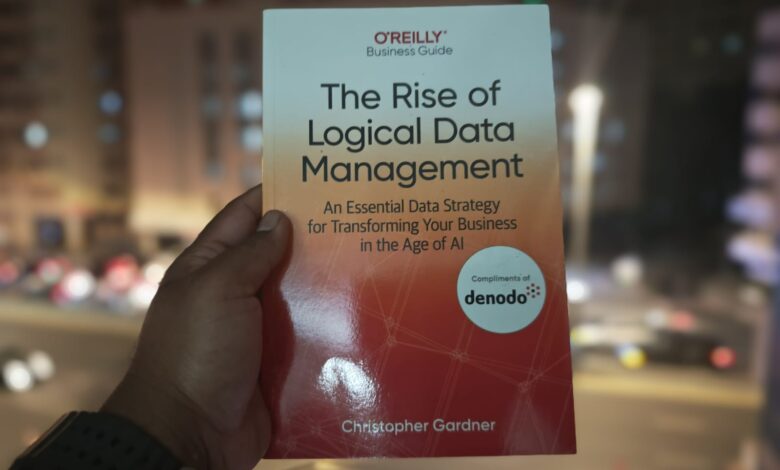
It is 1:30 in the morning on a Monday. The world outside is tense — the news cycle never sleeps, and global headlines rarely bring calm. In contrast, I found myself doing something surprisingly grounding: reading a 100+-page O’Reilly guide about data virtualization. Oddly enough, it turned out to be exactly the kind of thoughtful, focused reading that makes a late night productive rather than restless.
Christopher Gardner’s The Rise of Logical Data Management is the kind of book that proves technical topics don’t have to feel intimidating. Gardner writes with the calm clarity of a practitioner who has spent years explaining complex data concepts to people who simply want systems to work better. The result is a book that is approachable, structured, and genuinely engaging — even at 1:30 AM without a second cup of coffee.
The book arrives at an important moment for enterprises everywhere. Organizations today are dealing with enormous volumes of distributed data while also trying to feed AI systems with clean, reliable, real-time information. Gardner distills years of thinking around modern data architectures into a practical introduction to logical data management (LDM) and its core enabling technology: data virtualization.
Published in partnership with Denodo, the guide explores how organizations can move beyond traditional data consolidation approaches — warehouses, lakes, and lakehouses — by introducing a virtual, semantic layer that connects data across systems. Instead of endlessly copying and moving data through complex pipelines, companies can access and govern information through a logical layer that makes data easier to discover, understand, and use.
One of the book’s greatest strengths is its accessibility. Gardner consistently translates technical concepts into business language, making the material valuable not only for engineers but also for business leaders responsible for data strategy. Concepts like semantic layers and data fabrics are explained through relatable examples, including marketing teams personalizing campaigns or compliance teams monitoring regulatory posture in real time.
The book also shines in its explanation of how logical data management fits into modern data architecture frameworks like data mesh and data fabric. Through practical case studies, Gardner shows how organizations can connect dozens of systems while still empowering business users with self-service data access. These examples help readers understand not just the technology, but how it plays out in real organizations.
Another highlight is the discussion around performance and architecture. Gardner explains how specialized data virtualization engines can optimize queries across multiple systems, helping organizations access large distributed datasets efficiently without physically consolidating everything in one place. The explanations are clear, practical, and surprisingly approachable for readers who may not come from deep engineering backgrounds.
The book’s exploration of AI integration is also particularly timely. Gardner discusses how logical data layers can support modern AI architectures such as retrieval-augmented generation (RAG), helping large language models access reliable enterprise data. Rather than relying solely on vector databases, he shows how structured enterprise data can be integrated through semantic layers, opening new possibilities for AI-driven insights.
At just over 100 pages, the book is intentionally concise and focused. It works best as a strategic overview — giving readers a strong conceptual understanding of how logical data management fits into modern data strategy. For leaders navigating complex data environments, this clarity is valuable.
Who should read this book? It is especially useful for business and technology leaders exploring how to modernize their data infrastructure. Chief data officers, CTOs, enterprise architects, and platform leaders will find it a helpful guide for understanding how concepts like data mesh, data fabric, and data virtualization connect to real business outcomes.
For more technical readers, the book works well as a starting point — a clear introduction that helps frame the bigger picture before diving deeper into implementation details through specialized technical resources.
Ultimately, The Rise of Logical Data Management succeeds at what it sets out to do: provide a clear, practical, and engaging introduction to a rapidly evolving area of data architecture. Gardner’s writing is grounded in real experience, and his ability to translate complex ideas into accessible insights makes the book both informative and enjoyable to read.
For organizations trying to navigate the growing complexity of modern data ecosystems — particularly those preparing their infrastructure for AI-driven workloads — this book offers a thoughtful and encouraging starting point.
Overall Rating: ★★★★☆