From Storage to Streaming: Why Real-Time Data Is Powering the AI Era

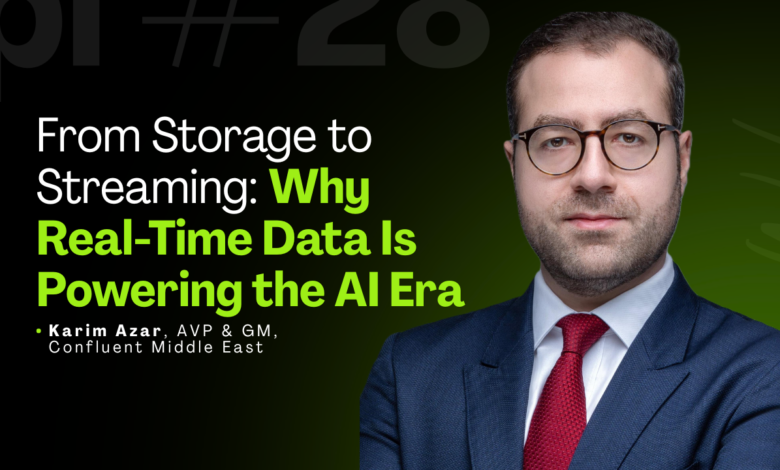
Karim Azar, AVP & GM, Confluent Middle East, explains how AI is reshaping enterprise data strategies—shifting the focus from static storage to real-time data in motion, where streaming architectures, low-latency access, and scalable infrastructure are becoming critical to unlocking the full value of AI.
How is AI changing enterprise storage needs and priorities?
AI is forcing organisations to rethink what storage is actually for. In the past it was largely about keeping records safely and cheaply. Today it has to support constant, high-speed data access because AI models are only as good as the data feeding them. That’s one reason we’re seeing flash increasingly become the default rather than a premium option. When models are training on massive datasets or responding to live inputs, latency quickly becomes the bottleneck.
There’s also a strategic shift underway. As AI models become more commoditised, the real competitive advantage lies in proprietary data. The organisations that can capture, store and curate large volumes of unique operational data will produce better outcomes from their models.
That said, storage is only part of the story. The real value increasingly sits in data in motion. AI systems don’t just rely on historical datasets; they depend on continuous streams of fresh information from applications, devices and digital interactions. The organisations that can move, process and contextualise that data in real time are the ones that will unlock the most value from AI.
What challenges arise when scaling storage for high-volume, fast-moving AI data?
The key phrase here is “fast-moving”. Many organisations assume the challenge is simply storing more data, but AI environments are increasingly defined by continuous data streams rather than static datasets.
Think about sectors like banking or aviation. Every transaction, sensor reading or customer interaction generates a live stream of events. AI models rely on those streams to detect fraud, optimise routes or personalise experiences in real time. Storing the data is important, but what matters even more is the ability to move and process it instantly.
This is where data streaming becomes critical. Modern platforms can coordinate AI agents, trigger automated responses and detect anomalies as data flows through the system. For example, multivariate anomaly detection can analyse several live metrics simultaneously and flag unusual patterns before they cascade into outages or operational issues.
At scale, the challenge isn’t simply capacity. It’s ensuring that AI systems have continuous, real-time access to reliable streams of data so they can adapt as conditions change.
How are high-capacity solutions evolving to support AI workloads and unstructured data?
High-capacity infrastructure across the region is evolving rapidly to support AI workloads. New data centers are designed for high-density compute environments and large volumes of unstructured data such as video, sensor feeds, and machine logs.
Countries like the UAE and Saudi Arabia are investing heavily in AI-ready infrastructure and working closely with hyperscale cloud providers to deliver low-latency capabilities. These facilities increasingly incorporate advanced cooling technologies, high-performance flash storage, and partnerships with global hyperscale providers. The focus is shifting from traditional storage expansion toward integrated infrastructure that can support high-performance computing, analytics, and AI workloads while maintaining reliability and regulatory compliance.
How do hybrid storage architectures balance cost, performance, and accessibility for AI?
Hybrid storage architectures are really about putting the right data in the right place at the right time. AI systems generate enormous streams of information, and keeping all of it on high-performance infrastructure simply isn’t practical from a cost perspective. Instead, organisations increasingly use tiered architectures that separate the data that needs immediate processing from the data that can be retained more economically for longer-term use.
In practice, that means recent data sits on high-performance infrastructure where applications and analytics engines can access it with minimal latency. As data ages, it can be automatically offloaded to scalable object storage. This frees up capacity on the primary systems while allowing organisations to retain far larger historical datasets.
What’s powerful about this model is that it doesn’t sacrifice accessibility. AI teams can still analyse historical event streams to train models or uncover patterns, while real-time systems continue to process live data. The result is an architecture that scales efficiently, maintains strong performance where it matters most, and keeps valuable data accessible for future insights.
What impact do AI-native or intelligent storage systems have on managing generative content?
One of the biggest inefficiencies in traditional data architectures is the tight coupling between compute and storage. When those two are linked, organisations often end up over-provisioning infrastructure simply to accommodate growing data volumes. That means running more servers, more disks, and ultimately consuming more power than the workload actually requires.
A more efficient approach is to separate compute from storage and allow each to scale independently. In practice, that means keeping a smaller subset of “hot” data on local infrastructure for immediate processing, while offloading the bulk of historical data to scalable object storage. The system automatically expands storage as needed, but organisations only pay for, and power, the resources they actually use.
This model eliminates the need to constantly add compute capacity just to store more data. It reduces operational overhead, avoids idle infrastructure, and allows teams to retain far more data without dramatically increasing energy consumption or costs.
What steps should IT leaders take to prepare storage for expanding AI-generated data?
The first step is removing storage as an operational constraint. Many organisations still spend an enormous amount of time managing capacity limits, negotiating retention policies with application teams, and throttling workloads to prevent clusters from running out of space. That’s not sustainable when AI systems are generating continuous streams of data.
A more future-ready strategy is to adopt architectures where storage can grow automatically as demand increases. Separating storage from compute allows organisations to retain far larger datasets without constantly provisioning additional infrastructure.
Equally important is thinking about data retention strategically. AI and analytics workloads become far more valuable when teams can access both real-time and historical event data. By enabling longer retention and eliminating strict storage limits, organisations create a persistent record of events that can power machine learning models, analytics, and new digital services over time.
Which emerging storage trend will most improve handling the AI data surge?
One of the most important shifts is the move towards effectively “infinite” storage models built on cloud object storage. Instead of treating storage as a fixed resource that constantly needs expansion, these architectures allow organisations to retain as much data as they need while paying only for what they actually store.
What makes this particularly powerful is the separation between real-time and historical workloads. Recent data can remain on local systems where streaming applications access it instantly, while older data is stored in object storage and retrieved when needed. Because these workloads use different resource pools, large historical reads don’t interfere with real-time processing.
The result is an architecture that scales almost without limit while maintaining strong performance. For AI systems that depend on both live event streams and long-term historical data, that combination is becoming essential.