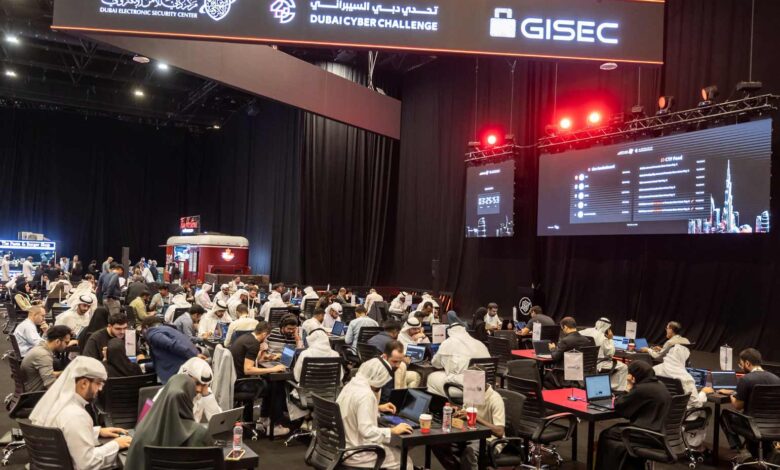
The second day of GISEC Global 2026 at the Dubai Exhibition Centre (DEC), Expo City Dubai, centered on the intersection of operational resilience, artificial intelligence, and global cybersecurity governance. Running under the theme “Cyber First: The New Digital Order,” the event brought together enterprise stakeholders, government leaders, and technology providers representing 182 countries.
Hosted by the UAE Cyber Security Council with the Dubai Electronic Security Center (DESC) serving as Government Cybersecurity Partner—and supported by the Ministry of Interior and Dubai Police—the summit’s second day addressed the operational exposures facing modern digital-first enterprises.
Discussions on critical infrastructure highlighted how vulnerability management is shifting from basic perimeter compliance to enterprise-wide operational risk mitigation. Industry sessions demonstrated vulnerabilities across programmable logic controllers (PLCs), human-machine interfaces (HMIs), and industrial safety networks, illustrating how operational technology (OT) lapses can disrupt physical workflows across energy and manufacturing.
Further demonstrations exposed attack paths in industrial digital twins, showing how poisoned sensor telemetry and corrupted data pipelines can warp operational decision-making across high-value installations. Highlighting the ecosystem response, event Diamond Sponsor du Tech outlined how the intersection of secure cloud architectures, high-speed connectivity, and enterprise AI provides the backbone for resilient public and private sector operations across the region.
With adversaries deploying automated reconnaissance and exploitation frameworks, enterprise defense workflows are transitioning toward autonomous security operations centers (SOCs). Demonstrations illustrated how continuous machine telemetry, AI-assisted triage, and real-time response mechanisms can contain attacks traversing corporate IT boundaries into OT environments.
“As AI and agentic AI accelerate innovation, they are also expanding the scale and complexity of cyber risk. Organisations must secure AI agents with the same rigour applied to people and applications, while using AI-driven defence to keep pace with threats operating at machine speed,” said Fady Younes, Managing Director for Cybersecurity, Cisco METAC.
A dedicated enterprise workshop expanded on the governance needed to manage autonomous business tools, focusing on identity verification, runtime guardrails, behavioral anomaly tracking, and automated quarantine measures. Addressing the persistent technical skills shortage, industry leaders stressed that automation must shoulder repetitive analytical workloads to allow senior talent to focus on governance and strategic risk.
“Human resources alone aren’t going to be enough. We will never be enough. Relying fully on human resources is not the way forward.” said Alex Attumalil, Global Chief Information Security Officer, Under Armour
Beyond enterprise architecture, Day 2 explored the geopolitical dimensions of international cyber governance, examining cross-border incident attribution, international security norms, and initiatives designed to amplify the unified voice of GCC member states in establishing global cybersecurity policies.
The 15th edition of GISEC Global concludes on September 18.