Huawei Unveils Next-Gen AI Compute and Fast-Tracks Ascend Chips

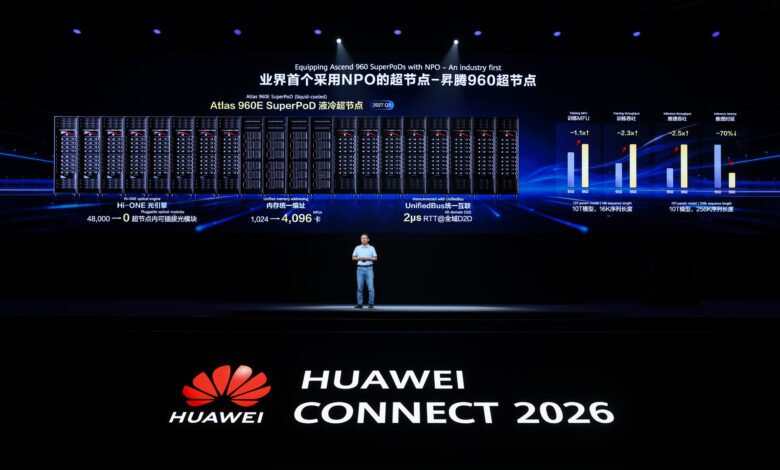
As Middle Eastern nations ramp up capital investment to move artificial intelligence from proof-of-concept projects to sovereign, industrial-scale deployment, Huawei has introduced a new suite of high-density AI computing systems engineered to support multi-trillion-parameter foundation models. Announced during Huawei Connect 2026 in Shanghai, the releases are led by the Atlas 960E—the industry’s first near-packaged optics (NPO)-based SuperPoD—and the Hi-ONE, a mass-production-ready NPO optical engine featuring an integrated on-chip light source.
Concurrently, the company confirmed that its next-generation Ascend AI silicon pipeline is running ahead of plan as it shifts to an annualized development cadence.Overcoming Interconnect Bottlenecks for 10-Trillion+ ModelsWith foundation model architectures rapidly converging on 10 trillion parameters—and industry projections pointing toward 100 trillion parameters by 2030—traditional copper and pluggable optical transceiver networks face severe thermal, power, and latency constraints.
Huawei’s Atlas 960E SuperPoD addresses these physical limitations through its UnifiedBus architecture combined with near-packaged optics:
- Compute Density: Scales up to 4,096 Neural Processing Units (NPUs), generating 8 EFLOPS of FP8 precision performance and 16 EFLOPS at FP4, backed by 1 PB of high-bandwidth memory (HBM).
- Optical Integration: Integrates 5,500 Hi-ONE NPO engines, directly displacing roughly 48,000 discrete 800G optical modules.
- Operational Efficiency: Slashes baseline power draw by over 550 kW, cuts signal transmission latency by roughly 90%, and elevates total system availability to 99.8% by doubling fault-free operational intervals.
- Optics Performance: The standalone Hi-ONE engine cuts optical interconnect power consumption by 66% while yielding a tenfold increase in hardware reliability relative to legacy transceivers.
“AI is advancing faster than any technological revolution we have seen before, and the demands it places on computing infrastructure are growing just as quickly,” said David Wang, Deputy Chairman of the Board and Rotating Chairman at Huawei. “While models become larger and more complex, we need to rethink how computing systems are designed, connected and scaled. At Huawei, we are addressing this through continued innovation in systems and architecture, from chips and interconnects to SuperPoDs and SuperClusters.”
Accelerated Silicon Roadmap: One Generation Per Year
To meet escalating compute requirements, Huawei has pulled forward its chip delivery schedules, transitioning to a strict one-generation-per-year release cycle:

Wang highlighted that performance gains across the Ascend roadmap will track the Tau Scaling Law, yielding consistent generational doublings across compute core throughput, memory bandwidth, and interconnect density.
Scaling to Megawatt Clusters and Open Software Ecosystems
For sovereign and hyperscale AI initiatives across the GCC and broader Middle East, Huawei confirmed that multiple Atlas 960E SuperPoDs can cluster into distributed compute arrays scaling up to one million NPUs. Supporting this infrastructure tier, the company also debuted:
- TaiShan 950 SuperPoD: Upgraded general-purpose computing nodes designed to coordinate complex workflow orchestration.
- OceanStor M900: A dedicated context-memory storage cluster engineered to handle real-time checkpointing and high-throughput data pipelines for extreme-scale LLM training.
On the software and developer front, Huawei’s Compute Architecture for Neural Networks (CANN) has transitioned into a fully community-driven open-source model. The Ascend ecosystem currently supports over 90 third-party open-source AI frameworks, while the broader Kunpeng and Ascend developer base has expanded to 4.16 million contributors and 7,200 commercial partners worldwide.