Dataiku Launches Agent Management to Monitor AI Agents Across Enterprise Platforms


Dataiku has launched Agent Management, a standalone product designed to help enterprises identify, monitor and manage AI agents operating across different technology platforms. Announced at Dataiku Succeed, the company’s annual conference, Agent Management is designed to provide organisations with visibility into AI agents regardless of the platform on which they were built. The product is generally available from October.
The launch comes as organisations deploy AI agents across a growing number of business and technology environments, while maintaining visibility and governance across those deployments remains a challenge. While enterprises typically maintain inventories of conventional software, including information about ownership, costs and renewals, AI agents are often managed separately across different platforms and teams. According to IBM’s “AI in Motion” research, fewer than one in five organisations maintain a complete and current inventory of their AI systems.
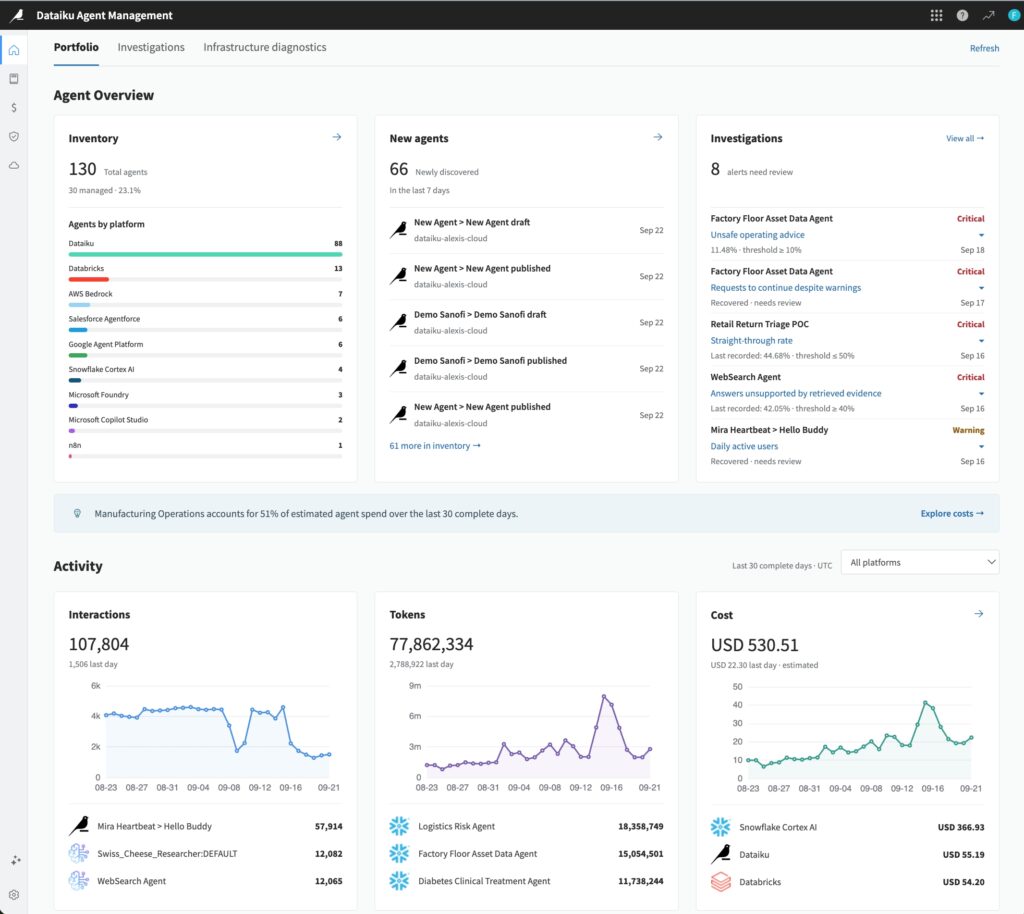
The fragmentation is partly linked to the way agent platforms operate, with many providing visibility primarily into agents built within their own environments. This can leave organisations without a consolidated view of agent ownership, purpose, risk and business outcomes.
“Ask a bank how many servers it runs, and you get an answer to the decimal. Ask how many AI agents it’s running, and you get a shrug or a guess,” said Florian Douetteau, co-founder and CEO of Dataiku. “Nobody set out to build it this way. Teams built agents faster than anyone could count them. Agent Management tells you what’s actually out there, and what it’s actually worth.”
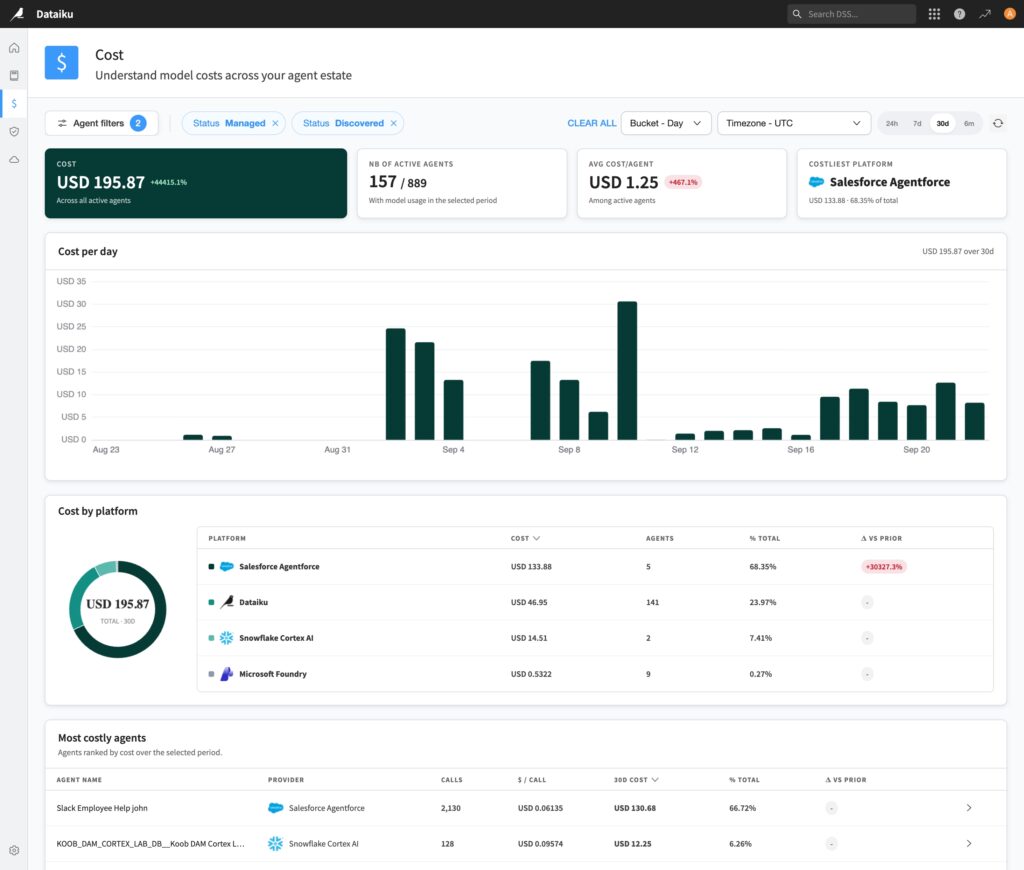
Agent Management connects with a range of platforms used by enterprise teams to build and operate AI agents, including AWS Bedrock, Databricks Agents, Google Vertex, Microsoft Copilot Studio and Azure Foundry, Salesforce Agentforce, Snowflake Cortex and Dataiku. It also supports custom environments through OpenTelemetry.
The product scans agents from these environments into a central inventory and identifies elements of their architecture, including the tools and models they use. This is intended to give teams greater visibility into how individual agents operate and the technologies supporting them.
For higher-risk agents, including those handling customers, sensitive information or live transactions, Agent Management maintains records covering certification status, identified risks and scheduled tests. This creates an ongoing record that can be used for internal reviews, audits and regulatory requirements.
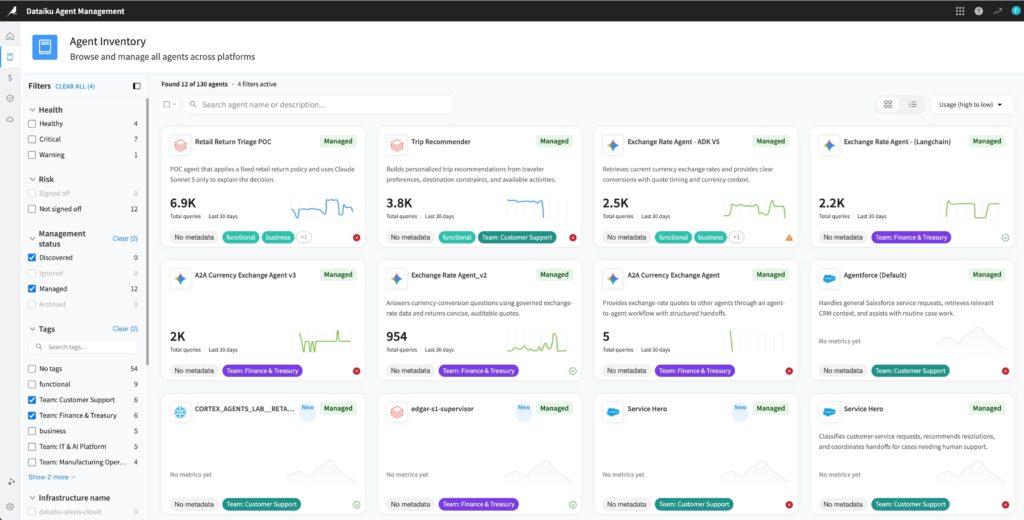
Dataiku said the platform is designed to operate independently of individual agent vendors rather than being limited to a single technology stack. By providing a layer across multiple platforms, it aims to give organisations a consolidated view of their AI agent estate, including agents that may not currently be monitored, areas where risk is concentrated and the business value generated by individual agents.
Teams can also use natural-language queries to analyse their agent portfolios and obtain information across multiple platforms.