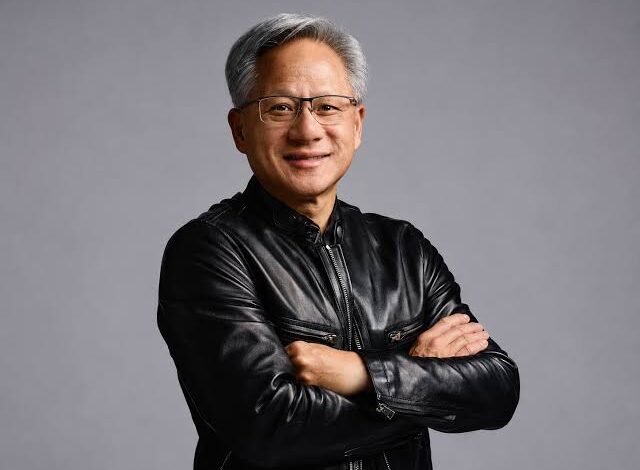
Nvidia has announced that co-founder Jensen Huang has resigned as president, chief executive officer and member of the board with immediate effect. The company has appointed executive vice president and chief financial officer Colette Kress as interim CEO while its board begins the search for a permanent successor.
Huang’s resignation, announced on November 12, brings an end to his 33-year leadership of the company he founded in 1993 alongside Chris Malachowsky and Curtis Priem. Nvidia has also appointed longtime director Harvey C. Jones as its first-ever board chair.
Kress will continue to oversee the company’s finance organisation while serving as interim CEO. Nvidia said the board would consider both internal and external candidates for the permanent position.
The transition follows several days of intense scrutiny surrounding reports about Huang’s personal relationships, including allegations that raised questions about potential foreign intelligence links and corporate governance. Huang acknowledged an extramarital affair in a message to employees and apologised to his family and colleagues.
Other media reports have alleged a separate relationship with an Nvidia executive. The claims involving a businesswoman reportedly suspected by US intelligence officials of having links to Chinese intelligence have also prompted scrutiny. The allegations have not established that Nvidia’s trade secrets or national security information were compromised.
The leadership change comes at a particularly important moment for the semiconductor industry. Nvidia has become one of the most influential suppliers of computing infrastructure, with its GPUs powering AI training and inference workloads across cloud providers, enterprises and research organisations.
Demand for accelerated computing has increased significantly since the emergence of generative AI applications. Technology companies and governments are investing in data centres and specialised computing infrastructure, with Nvidia’s hardware and software ecosystem playing a central role in many of these projects.
The company’s influence extends across the Middle East, where governments, telecommunications operators, cloud providers and technology companies are investing in AI infrastructure and digital transformation. Nvidia’s platforms are relevant to regional ambitions around sovereign AI capabilities, hyperscale data centres and enterprise adoption of generative AI.
For these markets, continuity in Nvidia’s product roadmap, supply relationships and partner ecosystem will be important. Any prolonged uncertainty around the company’s leadership could influence customer confidence and procurement decisions, particularly for organisations planning large-scale infrastructure deployments.
Kress joined Nvidia in September 2013 and has overseen its finances through a period of extraordinary expansion. Before joining the company, she held senior finance roles at Cisco and Microsoft, accumulating nearly 25 years of experience in technology-sector finance.
Her appointment provides an experienced internal executive to manage the immediate transition. However, Huang’s influence extended beyond financial and operational leadership. He was closely associated with Nvidia’s technology strategy, its relationships with major customers and its role in shaping the direction of accelerated computing.
Reuters has reported that investors are concerned about how the company will maintain the strategic influence and ecosystem relationships built under Huang. The leadership transition has also renewed attention on succession planning at companies that are closely associated with their founders.
Nvidia’s shares fell sharply amid the developments, reflecting uncertainty over the company’s future leadership. Reuters reported substantial pressure on the company’s market valuation during the week, while other market coverage noted gains among some semiconductor competitors as investors reassessed the sector.
The market reaction highlights the importance of Nvidia to the broader technology industry. Its performance influences not only the semiconductor sector but also investor sentiment towards cloud computing, AI infrastructure and companies building services on top of its platforms.
Nvidia is scheduled to announce its third-quarter fiscal 2027 results on November 17. The results and management commentary will be closely watched for indications that the leadership transition will not affect customer commitments, product development or the company’s growth strategy.
For enterprises and technology partners across the Middle East and Africa, the immediate concern is less about the change of name at the top and more about whether Nvidia can maintain the delivery, innovation and commercial continuity on which their AI infrastructure plans depend.