Riverbed Study: 90% of Saudi Organisations Say AI Has Met or Exceeded ROI Goals as Focus Shifts to Execution at Scale


Riverbed has announced findings from its latest Global Survey on ‘The State of Autonomous IT Operations’, highlighting how organisations are moving beyond AI experimentation towards broader adoption across IT operations.
The Saudi findings point to a strong focus on governance and human oversight as AI takes on a greater role in enterprise operations. More than half (54%) of Saudi respondents said they are extremely confident in their organisation’s AI governance and human-oversight capabilities, compared with 42% globally. Meanwhile, 93% believe that AI assurance, observability and governance will become a critical new IT domain to manage.
At the same time, 77% of respondents reported internal hesitation about allowing AI to make operational decisions without human approval. The findings suggest that Saudi organisations increasingly see governance as an important component of scaling AI rather than simply a compliance requirement. Greater visibility into AI performance, combined with appropriate human oversight, could help organisations expand automation while retaining control over operational decisions.
“Riverbed’s new research shows that AI is becoming fundamental to how IT operates, as organizations look to use it to create more resilient, efficient and proactive environments,” said Jim Gargan, Chief Marketing Officer, Riverbed. “The next phase of AI is not simply more automation, but AI that enterprises can understand, trust and govern. Riverbed is helping customers close these gaps with unified observability, trusted data, AI governance and intelligent automation, accelerating toward zero-disruption autonomous IT operations.”
Saudi organisations move from AI investment to execution
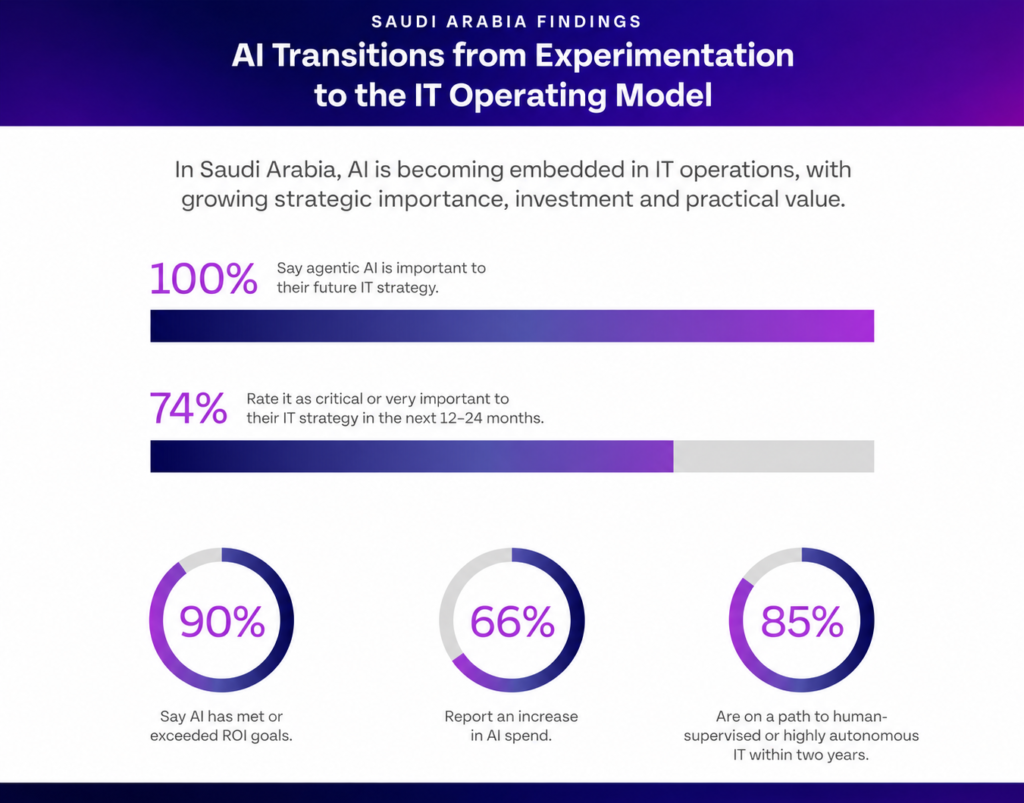
Investment in AI is continuing to increase among Saudi organisations, with many also reporting measurable returns. Two-thirds (66%) said they increased their AI investment over the past year, while 90% reported that their AI initiatives had met or exceeded their original return-on-investment goals.
Looking ahead, 85% said they want to progress towards human-supervised or highly autonomous IT operations within the next two years.
The figures point to a shift in priorities, from determining whether to adopt AI to establishing how it can be deployed effectively and at scale. For organisations pursuing greater autonomy, the focus is increasingly likely to centre on operational resilience, efficiency and the ability to translate AI investments into measurable outcomes.
Employee experience becomes a measure of autonomous IT
Saudi organisations are also reporting progress in applying AI to IT operations and reducing disruption for employees. According to the survey, 44% said their IT operations teams are extremely effective at using AI to identify and resolve issues before employees notice a disruption, compared with 34% globally.
In addition, 96% expect AI-powered operational intelligence to have at least a moderate impact on frontline IT and service-desk capabilities over the next two years. More than a third (36%) expect the service desk to shift from reactive support towards proactive prevention.
The findings indicate that the impact of autonomous IT will increasingly be measured not only by the number of processes automated, but also by the ability to identify potential problems earlier, prevent disruption and maintain a consistent digital experience for employees.
Unified visibility remains a challenge
As Saudi organisations move towards more autonomous IT environments, unified visibility across increasingly complex technology estates is likely to become more important. While 95% of Saudi respondents consider multi-domain visibility at least somewhat important for successful AI-driven IT operations, only 22% currently report having fully unified visibility across networks, applications, endpoints and cloud environments.
At the same time, 94% believe that tool consolidation can reduce operational friction, while the same proportion agree that a unified platform can simplify problem identification and resolution. The gap between the importance organisations place on unified visibility and their current capabilities highlights an area of continued investment. Consolidating fragmented tools, improving access to trusted data and establishing visibility across IT environments could provide AI systems with the operational context needed to support decision-making and greater automation.
“Saudi Arabia has built tremendous momentum around AI, supported by ambitious national programmes and organisations focused on translating innovation into measurable outcomes,” said Salman Ali, Senior Manager – Solution Engineering, GCC, at Riverbed. “The next stage will be defined by how effectively enterprises can govern AI and apply it to improve everyday operations. By unifying their data and observability capabilities, Saudi organisations can progress towards autonomous IT while maintaining appropriate human oversight, strengthening digital experiences and ensuring their AI investments deliver lasting business value.”
The survey findings point to a more operational phase of enterprise AI adoption in Saudi Arabia. As organisations continue their digital transformation efforts, the ability to combine AI investment with governance, trusted data, observability and human oversight will become increasingly important to scaling autonomous IT.