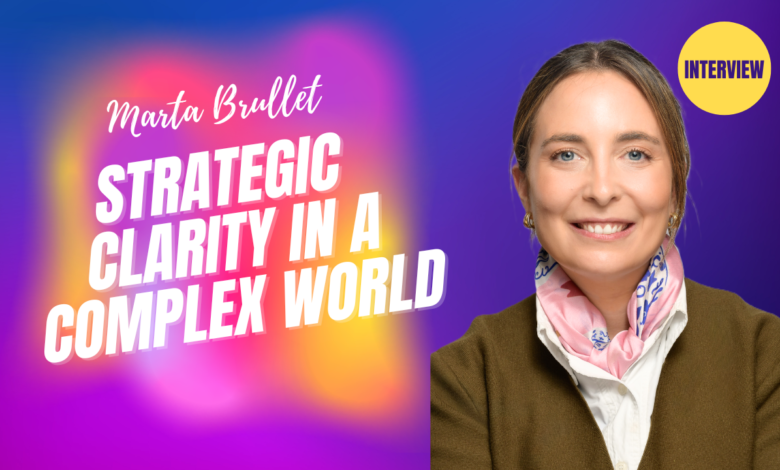
Marta Brullet, Head of Strategy for the Middle East, Turkey and Africa at Submer, reflects on the pivotal shifts that shaped her career from EU institutions to C-suite advisory, and why systems thinking, sponsorship, and execution will define the next generation of women leaders in technology and infrastructure.
What defining moments or challenges most shaped your professional journey?
There were three moments that really shifted the direction of my career. The first came early on, when I entered the highly competitive environment of EU institutions and international organizations. I was surrounded by incredibly accomplished people from all over the world. What stayed with me was not just the level of expertise in the room, but the realization that the people who stood out were not always the most brilliant.
They were the most prepared and the most genuinely invested in contributing. That lesson shaped how I show up to this day. The second turning point was moving from the public sector into consulting. It completely changed how I think about impact. Influence alone is not enough. What matters is whether something actually changes as a result of your work. That shift rewired how I approach meetings, recommendations, and deliverables.
The third was leading government and corporate affairs advisory for major enterprises and working closely with C-suite leaders navigating regulatory and operational complexity. That is where I understood the value of turning ambiguity into clear, actionable decisions. Not analysis for its own sake, but clarity that moves things forward.
Across all three experiences, I keep finding myself in the role of the strategic generalist in highly specialized rooms. The person who connects the dots and makes the whole system executable. As Head of Strategy, that is exactly what I do every day, and it genuinely energizes me.
What barriers do women still face in leadership today that are not talked about enough?
One issue that does not get enough attention is the sponsorship gap. It has real commercial consequences. Employees with sponsors are promoted at much higher rates, yet women are consistently less likely to have one. This is less about pipeline and more about advocacy. Women are often promoted based on proven results, while men are advanced on perceived potential. Over time, that difference compounds.
There is also what I would call the assertiveness paradox. Research shows that many senior women are very comfortable challenging the status quo. But getting there often requires navigating years where that same assertiveness can be penalized. Organizations lose strong leadership potential because of that filter. The encouraging part is that companies investing seriously in sponsorship and fair promotion practices are seeing measurable results. This is solvable, but only if it is treated as an operational priority rather than a statement of intent.
How have you built credibility and influence in environments where women are underrepresented?
I focused first on making the quality of my work undeniable before seeking visibility. When your output consistently carries weight, credibility builds on its own. Over time, people stop focusing on your title or tenure and start anticipating your contribution. In complex, multi stakeholder environments like the MEA region, influence does not come only from hierarchy.
It comes from understanding the full picture, identifying tensions early, and helping leadership move without creating friction. As Head of Strategy, much of my role is designing frameworks and governance structures that allow the organization to operate coherently across very different markets. The environment matters as well. Our management team includes women leading Transformation, People, Marketing, and European Operations. When leadership diversity is visible at the top, it expands what feels possible across the organization.
How is technology, especially AI and automation, changing leadership expectations in your industry?
The infrastructure behind AI, from data centers to cooling systems and energy requirements, is growing at a pace most people underestimate. That acceleration is changing what leadership requires. Decisions that once had long runways now need to be made faster. Where to build, which markets to prioritize, how to structure partnerships.
Leaders need to read the landscape quickly and act even when information is incomplete. On the client side, organizations have more data than ever, but data alone does not create clarity. What they need is strategic interpretation. Someone who can say what this information actually means for their infrastructure roadmap, partnerships, or investment sequencing. Advisory in that context becomes a leadership function, not just a consulting exercise.
Internally, we now expect more synthesis, not simply more output. The ability to connect market signals to technical and regulatory realities and bring a clear point of view. AI can surface information, but it cannot replace judgment. The broader strategic picture remains a human responsibility.
What skills or mindsets will be most critical for the next generation of women leaders?
Three stand out to me. First, systems thinking. The most impactful roles require the ability to hold commercial, regulatory, and operational complexity at the same time without oversimplifying it. Second, execution. Moving from insight to action is rare and incredibly valuable. Strategy without implementation is just theory. Leaders who close the loop earn trust quickly.
Third, a governance instinct. Designing decision frameworks, anticipating misalignment, and building structures that outlast individuals. That is what distinguishes a strategic operator from a strong contributor.
What role have mentorship and sponsorship played in your career, and how do you support others today?
Mentorship gave me perspective. Sponsorship gave me access. They are different, and understanding that difference mattered. The sponsors who influenced my career put my name forward before I asked, because they trusted the quality of my work. At Submer, leaders like Khalid Aljamed and Valeria Perez have actively created space for talent to step forward. That kind of visible sponsorship makes a real difference.
Today, I am intentional about doing the same. I make contributions visible, credit people publicly, and recommend them for specific opportunities. In my current role, I also build governance and communication structures that make work visible beyond direct reporting lines. Inclusion should be embedded in how the organization operates, not limited to a values statement.
How can organizations move beyond policies to create cultures where women genuinely thrive?
Policies set the baseline. Culture is shaped by what leaders do consistently, especially when it is not being measured. In organizations where women thrive, senior leaders actively sponsor talent, correct moments where credit is misallocated, and make advancement pathways transparent. Not because a program requires it, but because they have decided it matters.
Training, employee networks, and targets all help, but they only work when leadership behavior aligns with them. You can have the most advanced inclusion framework on paper and still lose talented women if daily behavior does not support it. Culture is what people experience in meetings, in decisions, and in whether their voice genuinely carries weight. That is where inclusion either exists or it does not.
What advice would you give young women considering careers in IT, security, or infrastructure roles?
Approach the field with a systems mindset rather than a narrow job description. The strongest careers in tech and infrastructure are built by people who understand how commercial, technical, regulatory, and human elements connect. That breadth is where long term value sits.
Do not wait until you feel perfectly ready. Many women set a higher readiness threshold for themselves than necessary. Calibrate your ambition to your trajectory, not your current title. And build things. Own projects. Deliver results. A reputation for execution compounds faster than credentials.
If the MEA region interests you, it is one of the most dynamic transformation stories globally. Arriving early, developing cross cultural fluency, and combining it with commercial sharpness can create extraordinary opportunity.
What does International Women’s Day mean to you, and what real change would you like to see beyond it?
For me, it is about accountability. Companies that treat gender inclusion with operational rigor see measurable results. Representation improves where commitment is real. Beyond the symbolic, I would like to see more leaders commit to sponsorship, not only mentorship.
And I would like to see deliberate inclusion of women in the digital and infrastructure transformation happening right now. The economic architecture of the next decade is being built in real time. Leadership pipelines shaping that future should reflect the full spectrum of available talent. That is worth far more than a single day of recognition.