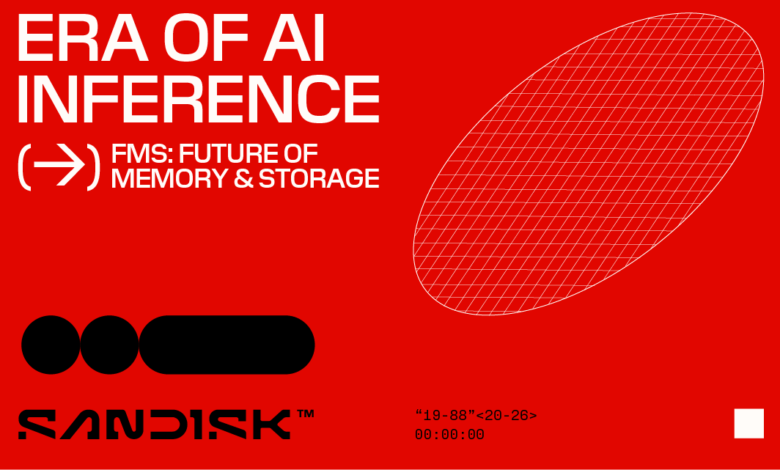
Sandisk is using Future of Memory and Storage (FMS) 2026 to demonstrate how advances in NAND technology are helping meet the growing demands of AI inference workloads. As AI models become larger and more complex, requiring longer context windows and supporting agentic applications, memory and storage are playing an increasingly critical role in overall AI infrastructure.
At Booth #607 in the Santa Clara Convention Center, the company is showcasing technologies designed to improve storage capacity, bandwidth and power efficiency for AI deployments across data centres and cloud environments.
“AI infrastructure has entered a new phase where the ability to store, move and access data efficiently has become as important as compute itself,” said Khurram Ismail, Chief Product Officer at Sandisk. “As inference workloads continue to grow, customers require memory and storage technologies that deliver high performance, greater capacity and improved power efficiency without increasing system complexity. Building on decades of flash innovation, Sandisk is advancing next-generation NAND and emerging technologies such as HBF to support the industry’s evolving AI requirements.”
The company’s latest innovations target AI workloads including fast data lakes, model storage, retrieval-augmented generation (RAG) and KV cache applications. Demonstrations at FMS 2026 include:
- BiCS10 QLC NAND – A next-generation 3D NAND architecture designed to improve storage density, performance and power efficiency for AI, cloud and enterprise data centre environments.
- AI Data Cycle Framework – An updated version of Sandisk’s framework that maps storage requirements across the AI lifecycle, from data ingestion and training to inference and generated-content repositories.
- HBF (High Bandwidth Flash) – A NAND-based memory technology developed to address the increasing bandwidth and capacity requirements of AI inference at scale.
- Enterprise SSD Portfolio – High-endurance SSD configurations for KV cache workloads, support for future PCIe Gen 6 technology and ultra-high-capacity E3.S designs with optimised DRAM placement.
Sandisk is also hosting a keynote titled “NAND: The Versatile & Scalable Foundation of the AI Era,” exploring how high-context AI models and agentic workflows are reshaping memory and storage architectures. The session examines the growing importance of NAND as AI infrastructure challenges extend beyond compute to encompass memory capacity, bandwidth, power efficiency and overall system optimisation.
In addition, the company is participating in a panel discussion, “Breaking the Memory Wall with High Bandwidth Flash,” alongside Google and SK hynix, where industry experts will discuss the development of the HBF ecosystem and the role of emerging memory technologies in enabling future AI infrastructure.