Reporting from Tashkent, Uzbekistan: The inaugural Silk Road Finance & Technology Forum moves into its third and final day today, 26 August 2026, with the agenda shifting from the broader digital-finance transformation of Central Asia to a more focused question: how can Uzbekistan build an Islamic digital economy that connects capital, technology and financial services across borders?
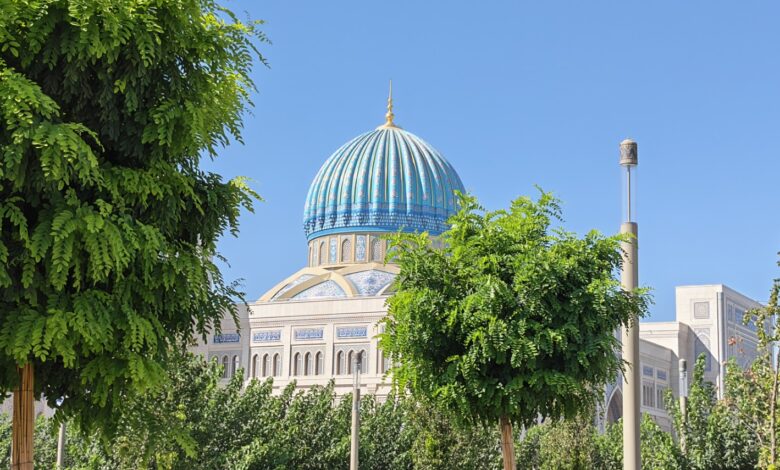
Day Three is being held at the Islamic Civilisation Centre in Tashkent, rather than the Central Asian Expo where the first two days were staged. The programme, branded “The Azimuth”, combines Islamic finance, digital infrastructure, financial inclusion, Shariah compliance, investment and fintech entrepreneurship.
The timing is particularly significant for Uzbekistan. The country’s new Islamic banking framework took effect on 29 June 2026, following the signing of Law ZRU-1126 on 27 March. The framework establishes a dual banking system in which Islamic financial institutions can operate alongside conventional banks, with a dedicated licensing regime and a Council for Islamic Finance at the Central Bank. The legislation also provides tax treatment intended to support Islamic financial products, including VAT exemptions for sukuk and Islamic leasing.
From Islamic banking law to digital infrastructure
The third day opens at 10:00am with “Setting the Azimuth: Why Tashkent, Why Now”. The session frames the day’s central question around what Uzbekistan needs to build next following the introduction of its Islamic banking legislation.
The forum then moves directly into the national policy case. At 10:10am, “The Sovereign Case: Islamic Finance as National Strategy” examines Islamic finance as part of Uzbekistan’s broader economic strategy. The session features Abrorkhuja Turdaliyev, Deputy Chairman and Board Member of the Central Bank of Uzbekistan.
The discussion then becomes more practical
At 10:20am, “Building the Rails: What Has to Exist Before Anything Scales” examines the financial infrastructure required for Islamic fintech to expand. The organisers point to a significant concentration in the global Islamic fintech market: there are 484 Islamic fintech firms across 41 countries, but 80% are concentrated in just 10 countries.
The session argues that the challenge is not necessarily a lack of demand but a lack of infrastructure — including payment rails, local-currency markets and liquidity. Speakers include senior representatives from the Bangko Sentral ng Pilipinas, Bank Negara Malaysia, Easypaisa Digital Bank and DANA, with Arthur D. Little moderating.
1.3 billion unbanked adults become a technology opportunity
One of the most consequential sessions of the morning begins at 11:35am, focusing on financial inclusion. “The Last Mile Already Has a Phone – Shariah-Compliant Finance for the Unbanked” looks at how mobile technology and AI could help extend Islamic financial services to people outside the formal banking system.
The agenda cites the World Bank’s Global Findex 2025, which estimates that 1.3 billion adults globally remain without a financial account. Around 900 million of those people have access to a mobile phone, while approximately 530 million have smartphones.
That creates an unusual situation: distribution may no longer be the primary obstacle. The harder problem is underwriting customers who may have no credit history, collateral or formal income, while designing products that comply with Shariah principles.
The session brings together executives from Maybank Islamic Banking, SinarMas Group, Muslim Pro, Ant International and Bangko Sentral ng Pilipinas, with GFTN Solutions CEO Maha El Dimachki as moderator.
Can Shariah compliance be coded?
After a networking lunch, the forum turns to one of the more unconventional questions on the agenda. At 1:15pm, “Can You Code Shariah Compliance?” asks whether elements of Islamic financial compliance can be embedded directly into digital financial infrastructure.
The discussion highlights a fundamental challenge for fintech developers: software requires precise specifications, while interpretations of Shariah principles can vary between jurisdictions and scholars.
The agenda notes that AAOIFI Shariah Standard No. 62, concerning sukuk, has been under consultation since 2023 and is not yet final. It also points out that AAOIFI standards are adopted differently across jurisdictions. The result is a question increasingly relevant to digital finance: which aspects of Shariah compliance can be automated, and where must human scholarly judgement remain?
Is Islamic finance really a $6 trillion market?
The following session tackles an even bigger question — the actual size of the Islamic finance industry. At 1:55pm, “A $6 Trillion Corridor? The Industry Can’t Yet Agree on Its Own Size” will compare conflicting estimates of global Islamic finance assets.
According to the forum’s agenda, DinarStandard estimates global Islamic finance assets at US$5.99 trillion for 2024, projecting growth to US$9.72 trillion by 2029. For Uzbekistan, the opportunity is therefore not simply to develop a domestic Islamic banking market but potentially to position itself within a wider corridor linking Central Asia, the Gulf and South and Southeast Asia.
From Islamic finance to venture capital
The agenda then shifts from financial institutions to entrepreneurs. At 2:35pm, The Founders Peak begins with a series of short founder stories designed to provide practical lessons from entrepreneurs in Central Asia and beyond.
At 3:35pm, the focus moves firmly towards investment with “Show Me the Money – What It Actually Takes to Get Capital Into Central Asia.” This session addresses one of Uzbekistan’s biggest fintech ambitions: attracting international capital.
The forum highlights the US$50 million Central Bank venture fund and the government’s target of increasing the country’s licensed fintech companies from 103 to 200 by 2030. Uzbekistan is also targeting US$1 billion in foreign investment in fintech and the training of more than 5,000 fintech professionals by 2030.
The investor panel includes representatives from Big Sky Capital, the European Bank for Reconstruction and Development, Sturgeon Capital, EMVC and 500 Global. The central question is blunt: what does a Central Asian startup need to demonstrate before an international investor is prepared to issue a term sheet?
Can Central Asian Islamic fintech break beyond its home markets?
The final substantive discussion, beginning at 4:15pm, is “Capital Meets Builders: What It Takes to Scale Islamic Fintech Beyond the Top Ten.” The session will examine why 80% of Islamic fintech companies remain concentrated in just 10 countries, and whether the constraints preventing wider growth are regulation, capital, talent, distribution or customer trust.
Rather than treating Islamic fintech purely as a regulatory issue, the session brings investors and founders together to examine what it takes to build products that can win customers, attract institutional capital and scale across borders.
Participants include Michael Lints of Golden Gate Ventures, Shota Lomtadze of BR Capital and Zuhursho Rahmatulloev of Alif & Ayan Capital.
Five commitments to close the forum
The final session at 4:55pm could ultimately prove the most significant. “A Final Fix on True North: The Azimuth Intent” is scheduled to conclude the three-day event with the announcement of an Azimuth Commitment — a proposed shared statement of intent from the Islamic finance community.
The commitment is built around five areas:
- Mutual recognition of startups across jurisdictions
- Common taxonomies for Shariah-compliant financial instruments
- Portable capital between participating markets
- A cross-border regulatory sandbox
- Co-ordinated customer education
The session is scheduled to feature Central Bank of Uzbekistan Governor Timur Ishmetov and Sopnendu Mohanty, Group CEO of GFTN.
The bigger significance for Uzbekistan
The third day therefore goes beyond the promotion of Islamic banking. It presents Islamic finance as a potential digital infrastructure and regional-connectivity play.
That is particularly relevant to Uzbekistan’s wider fintech strategy. The Central Bank and GFTN have positioned the forum around the goal of making Uzbekistan a regional anchor for financial innovation, with priorities spanning open banking, digital assets and stablecoins, cross-border payments, Islamic finance, investment and talent.
The country’s opportunity is considerable. The forum estimates a US$40 trillion GDP-linked trade corridor associated with the markets connected by the modern Silk Road, while Uzbekistan’s own fintech ecosystem recorded US$58 million in early-stage investment in 2024, reportedly 230 times the level recorded in 2020. Its first unicorn, Uzum, is valued at approximately US$2.3 billion.
The challenge now is converting policy into infrastructure, and infrastructure into scale. For Uzbekistan, Day Three’s agenda effectively asks whether the country can use its new Islamic banking framework, young population, growing fintech sector and geographical position to become more than a domestic financial market — and instead emerge as a digital Islamic-finance bridge between Central Asia and global capital.