AI Infrastructure Race Shifts from Chips to Supply Chains: GlobalData

The global AI infrastructure boom is entering a new phase, where supply chain resilience, power availability and memory capacity are becoming more critical than raw computing performance, according to GlobalData. The research firm says the latest earnings season highlights a significant shift in the AI landscape, with capital investment, geopolitics and manufacturing capacity increasingly dictating the pace of AI deployment.
Analysis from GlobalData’s Company Reports Database shows that demand for AI infrastructure continues to outstrip supply across the semiconductor ecosystem. Memory manufacturers have emerged as some of the biggest beneficiaries, with SK Hynix reporting a 397.5% year-on-year increase in net income and Samsung posting an even stronger 486.7% rise. Both companies continue to benefit from a severe shortage of high-bandwidth memory (HBM), with DRAM production reportedly sold out through 2026.
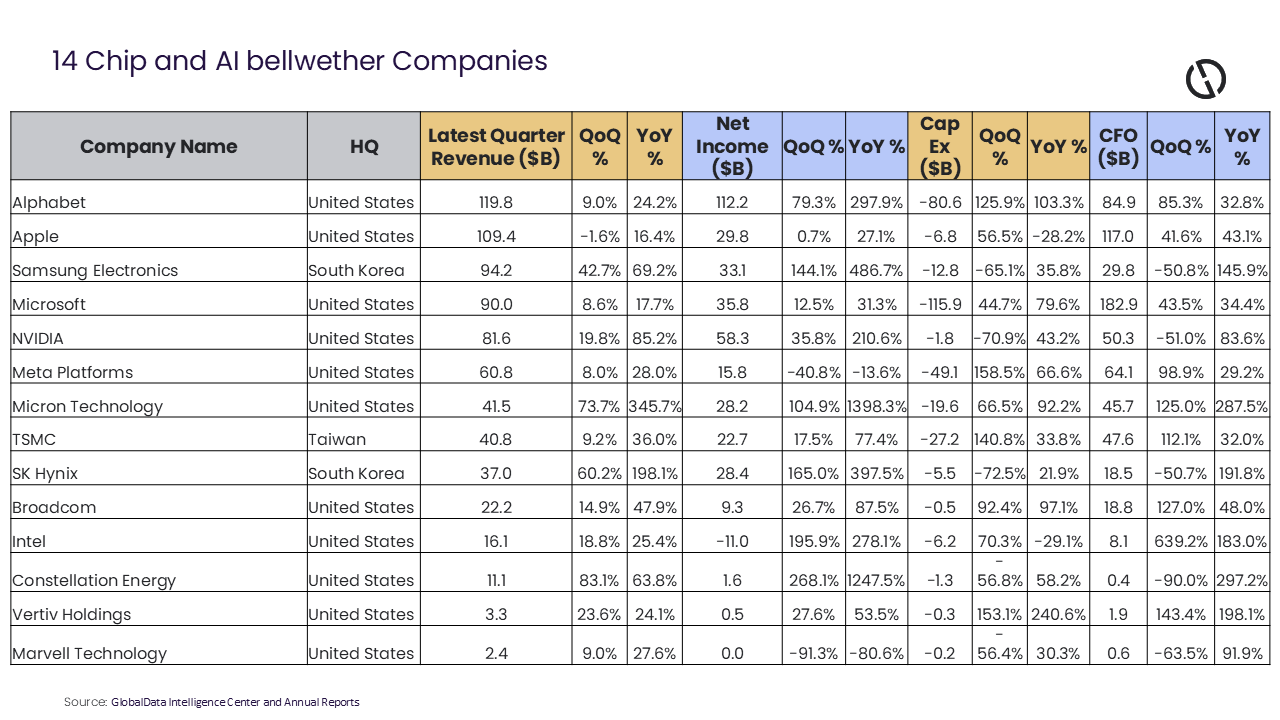
Micron delivered one of the strongest performances in the sector, recording a 1,398.3% surge in net income alongside 345.7% revenue growth. The results reinforce the growing importance of memory in AI systems, where accelerators require vast amounts of high-speed memory in addition to computing power.
NVIDIA also continued its strong momentum, with net income rising 210.6% on the back of sustained demand for AI data centre hardware. However, operating cash flow increased by 83.6%, trailing the company’s capital expenditure, which was up 43.2% year on year despite falling 70.9% sequentially. GlobalData says this reflects NVIDIA’s aggressive investment in securing manufacturing capacity, including additional production at TSMC for its H200 AI processors.
“TSMC’s 77.4% net income growth against a 33.8% increase in capital expenditure illustrates how aggressively the company is expanding advanced manufacturing capacity to meet AI demand,” said Murthy Grandhi, Company Profiles Analyst at GlobalData. “Meanwhile, Constellation Energy’s remarkable 1,247.5% increase in net income highlights that electricity generation, rather than semiconductor availability, is increasingly becoming the primary constraint on AI expansion.”
While most semiconductor companies benefited from the AI spending boom, GlobalData identified two notable exceptions.
Intel continued its turnaround, narrowing its net loss by 278.1% year on year following the successful launch of its 18A manufacturing process into high-volume production in January 2026. Yield improvements, appreciation in its CHIPS Act equity investment and foundry discussions with companies including NVIDIA, Microsoft, Amazon and Apple have strengthened confidence in its long-term prospects, although meaningful foundry revenue is not expected before 2027.
Marvell, meanwhile, reported an 80.6% decline in net income despite revenue growing 27.6%, demonstrating how custom silicon suppliers can still experience significant margin pressure during rapid production ramp-ups.
The report also highlights hyperscale cloud providers as the primary drivers of AI infrastructure investment. Microsoft, Alphabet and Meta each increased capital expenditure by more than 65% year on year, aligning with previously announced spending plans. Alphabet now expects to invest between $175 billion and $190 billion during 2026, Meta has guided between $125 billion and $145 billion, while Microsoft’s investment is projected to reach between $120 billion and $190 billion.
Collectively, the world’s four largest hyperscalers are expected to spend approximately $700 billion to $725 billion on capital investments this year, representing a 77% increase over 2025 and marking what GlobalData describes as the largest peacetime corporate investment cycle in history.
Grandhi noted that geopolitical developments are becoming deeply embedded within AI infrastructure economics. “In January 2026, the Trump administration introduced a 25% tariff on selected advanced AI chips under Section 232, alongside a phased strategy that could further increase tariffs while encouraging domestic manufacturing,” he said. “At the same time, export controls for NVIDIA’s H200 and AMD’s MI325X destined for China shifted from blanket restrictions to case-by-case approvals, although export volumes remain capped at roughly half of previous US sales.”
He added that TSMC, Samsung and SK Hynix also lost their blanket Validated End-User exemptions at the start of 2026, requiring annual US licences to supply equipment to their manufacturing facilities in China.
GlobalData also points to the strategic significance of Pax Silica, the US-led semiconductor partnership signed by more than two dozen countries in late 2025. The initiative is designed to establish trusted semiconductor and critical mineral supply chains among allied nations, including India, Japan, South Korea and the Philippines, reducing dependence on China.
India stands to benefit significantly from these shifts. Micron’s assembly and testing facility in Sanand, Gujarat, inaugurated in February 2026, is now packaging DRAM and NAND products for the company’s global operations at a time when DRAM prices have risen by approximately 90% during the first quarter of 2026. Meanwhile, the Tata Electronics-PSMC semiconductor fabrication plant in Dholera has crossed the halfway stage of construction and is targeting trial production of 28nm chips by the end of the year, strengthening India’s domestic semiconductor manufacturing capabilities.
According to Grandhi, AI infrastructure investment is no longer discretionary. “HBM and advanced semiconductor manufacturing capacity are effectively sold out, while tariffs, export controls and licensing requirements have become permanent cost factors. Pax Silica signals that regional self-reliance, rather than free trade, will increasingly shape semiconductor supply chains throughout the remainder of the decade. The challenge facing the AI industry is no longer demand, but whether sufficient power, memory and manufacturing capacity can be brought online quickly enough to sustain deployment.”