At COMPUTEX 2026, Qualcomm Bets on a Future Built Around AI Agents

Reporting from Taipei, Taiwan: The next phase of artificial intelligence will not revolve around applications or chatbots—it will revolve around agents.
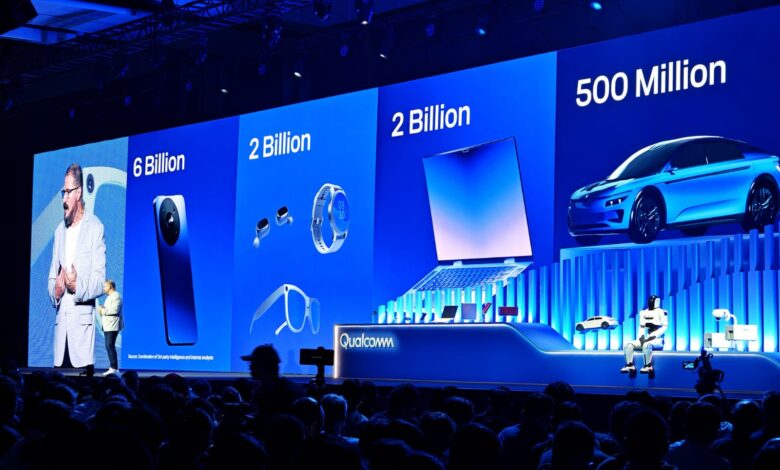
That was the central message from Qualcomm President and CEO Cristiano Amon during the opening keynote of COMPUTEX 2026, where he outlined a future in which AI agents operate continuously across phones, PCs, wearables, vehicles, robots, and cloud infrastructure.
Delivering his keynote, “Year of the Agents,” at Nangang Exhibition Center Hall 2, Amon described agentic AI as a major shift in computing, one that places autonomous digital assistants at the center of the user experience.
Before Amon took the stage, James C.F. Huang, Chairman of the Taiwan External Trade Development Council (TAITRA), praised Qualcomm’s ongoing participation in the event, noting that Amon “has chosen COMPUETX as the stage to share Qualcomm’s vision with the world.”
The presentation began with a vision of AI evolving from a tool into a trusted teammate—an always-available assistant capable of understanding context, anticipating needs, and supporting users across work and daily life. Qualcomm’s concept imagines AI systems that can listen, observe, learn, and respond continuously, creating a more seamless computing experience.
Amon emphasized that such progress would not happen in isolation. He credited Taiwan’s technology ecosystem and Qualcomm’s manufacturing and supply-chain partners for helping advance the next generation of computing platforms.
The keynote’s core message centered on the rise of agentic AI at the edge. Rather than waiting for instructions through prompts, future AI systems will be able to act independently, coordinate tasks, and personalize experiences across devices.
In Qualcomm’s vision, every connected device becomes an endpoint for an AI agent. Smartphones, PCs, smart glasses, wearables, and automobiles will all serve as access points to the same intelligent assistant, capable of managing calendars, communications, and daily workflows.
Making that vision possible, however, requires significant advances in computing architecture. Amon explained that today’s devices were built primarily for user-driven interactions rather than persistent AI workloads. Supporting continuously active agents demands powerful combinations of CPUs, GPUs, and NPUs while minimizing latency and energy consumption.
The company’s ambitions extend beyond consumer electronics. Amon described future vehicles where AI agents enhance both driver experiences and autonomous functions, while robotics systems combine perception, reasoning, and movement capabilities. These machines would be capable of “sensing, thinking and acting,” allowing them to interact more naturally with the physical world.
Another major theme was wireless connectivity. Amon positioned 6G as a foundational technology for the AI era, integrating computing and sensing directly into communications networks. Such networks, he argued, could continuously gather and exchange information between devices and cloud systems while helping create digital representations of real-world environments.
This convergence of AI, connectivity, and sensing could provide agents with real-time contextual awareness, enabling them to better understand and respond to users and their surroundings.
“Agents are defining the architecture and economics of AI,” Amon said.
He predicted that AI agents will drive a dramatic increase in token consumption, referring to tokens as “the currency of AI.” As AI systems take on increasingly sophisticated tasks, demand for compute resources will grow sharply. Qualcomm’s strategy, he said, is to balance workloads between cloud infrastructure and edge devices to improve efficiency and reduce costs.
The keynote concluded with a strategic announcement: Qualcomm is expanding beyond edge computing and into data-center infrastructure through a new product brand called “Dragonfly.” The move signals the company’s intent to compete across the full AI stack, from devices to cloud systems.
Additional details are expected later this month at Qualcomm’s Investor Day in New York, where the company plans to outline its broader data-center strategy.