Reporting from Taipei, Taiwan: The “Robotics, Autonomous Machines & Physical AI” forum at COMPUTEX 2026 featured NVIDIA, Qualcomm, ABB Robotics, NXP — and even a full-sized humanoid robot walking on stage. The COMPUTEX 2026 forum highlighted rapid advancements in robotics, bringing together industry leaders to demonstrate how AI-driven machines are moving from concept to real-world deployment.
Opening the session, NVIDIA’s Deepu Talla emphasized the scale of the opportunity ahead, calling robots “the single largest opportunity in front of humanity.” Looking back at last year’s event, Talla recalled describing how “the future was coming to the present.” At this year’s forum, he said that future has effectively arrived.
Breakthroughs in physical and agentic AI are now enabling embodied AI systems to operate in retail, industrial and domestic environments. Taiwan is playing a central role in this shift, with AI-powered robotics being deployed across its manufacturing sector. Companies such as Foxconn and TSMC are leading adoption, reinforcing the region’s position as “the land of manufacturing,” Talla said.
Despite this progress, the industry remains in its early stages. Fewer than one million robots are currently in use worldwide, but that figure could grow to billions or even tens of billions in the years ahead. Talla predicted that within the next one to two years, everyone attending the forum would interact with robotics in some capacity.
NVIDIA, while not a robot manufacturer, provides the foundational technologies that power robotic systems, including tools for training, simulation and deployment. Its NVIDIA Isaac GROOT Robotics Development Platform significantly accelerates development timelines, with Talla noting that “what would take nine months to a year would now take less than a day.”
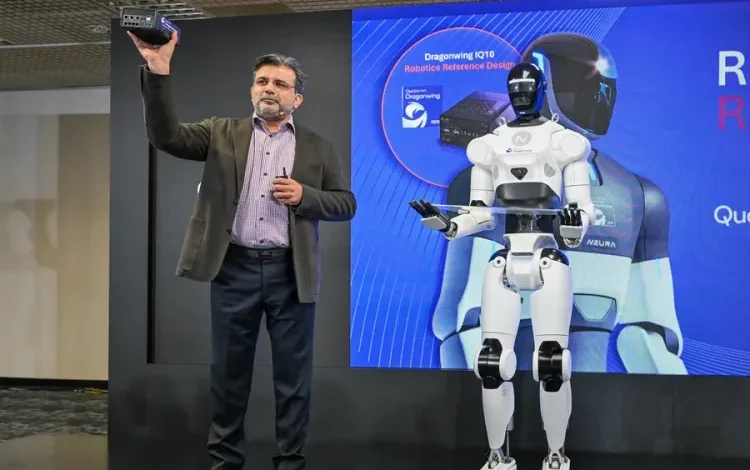
Qualcomm’s Nakul Duggal followed with a live demonstration featuring a full-sized humanoid robot and introduced the Dragonwing IQ10 Robotics Reference Design.
The platform combines hardware, software and AI capabilities into a single, ready-to-deploy system aimed at accelerating robotics adoption. Highlighting the pace of transformation, Duggal said, “We have never lived in a world that has this incredible amount of change in front of us.”
ABB Robotics’ Craig McDonnell then presented the company’s latest innovations, building on a legacy that dates back to its introduction of the first commercial all-electric microprocessor-controlled robot in 1974. Today, ABB produces more than 1,000 types of robots and is advancing capabilities in vision, manipulation and autonomous operation.
Through a partnership with NVIDIA, ABB is leveraging synthetic data to improve real-world performance, narrowing the “sim-to-real” gap and achieving up to 99 percent accuracy between virtual models and physical environments.
McDonnell noted that the industry is facing “exploding complexity perhaps not anywhere near the same level as just five years ago,” as manufacturing expands geographically and development cycles accelerate.
Ajith Mekkoth of NXP concluded the session by outlining how edge AI is enabling a wide range of applications, from healthcare devices to home robotics.
The company is prioritizing scalable, energy-efficient systems with flexible upgrade paths to support long-term deployment. “We are at the precipice of ubiquitous AI,” he said, pointing to a future where robotics becomes embedded across everyday life.