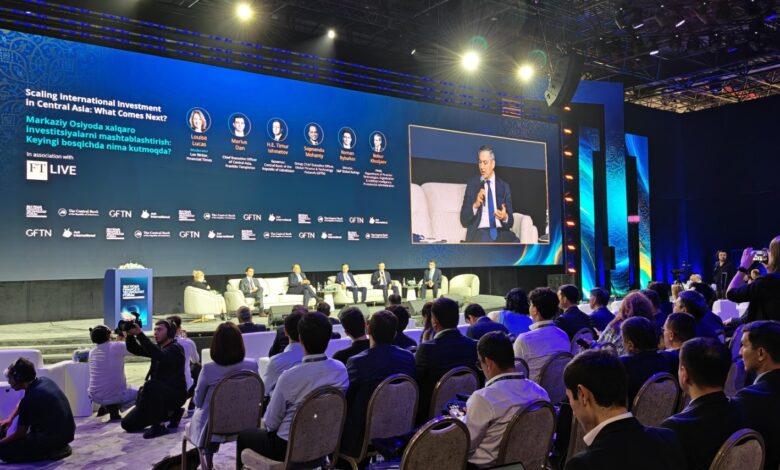
Reporting from Tashkent, Uzbekistan: Uzbekistan is showcasing its financial reform agenda to a global audience as more than 6,000 participants from 74 countries gather in Tashkent for the Silk Road Finance & Technology Forum 2026, highlighting the country’s ambitions to become a gateway for capital, technology and financial connectivity across Central Asia.
Convened by the Central Bank of the Republic of Uzbekistan and Singapore-headquartered Global Finance & Technology Network (GFTN), and co-hosted by Ant International, the forum brings together nearly 200 speakers and more than 25 investors representing US$4 billion in assets under management.
The event brings policymakers, regulators, investors and founders together around five key themes: digital payments and infrastructure; Islamic finance and new financial corridors; AI and emerging technologies; tokenisation and digital assets; and cross-border finance and regulation.
Held at CAEx on 24–25 August, the forum moves to the Islamic Civilisation Centre on 26 August for The Azimuth, a dedicated programme focused on Islamic finance and entrepreneurship.
Opening the forum, H.E. Jamshid Kuchkarov, Deputy Prime Minister and Minister of Economy and Finance of Uzbekistan, and H.E. Timur Ishmetov, Governor of the Central Bank of the Republic of Uzbekistan, outlined the next phase of Uzbekistan’s financial transformation, including attracting long-term capital, developing Islamic finance and building interoperable cross-border financial infrastructure.
Uzbekistan’s Reform Push Targets Global Capital
In his opening address, The Silk Road Initiative: Turning a Socio-Economic Heritage into Central Asia’s Financial Innovation Corridor, H.E. Timur Ishmetov invited global investors and innovators to engage with Uzbekistan.
“Uzbekistan is open to investment, technology, expertise and long-term partnership. Build here. Test new solutions here. Invest here. Develop talent here. With the right partnerships, Central Asia can become a more connected, competitive and internationally integrated financial region.”
Uzbekistan enters the forum amid strong economic and reform momentum. GDP grew 8.5% in the first half of 2026, while foreign investment reached US$8.3 billion in the first quarter. Moody’s also upgraded the country’s sovereign rating to Ba2 in June.
Presidential Decree PQ-359 and the National FinTech Strategy are advancing open banking, digital payments and financial innovation, with a target of US$1 billion in fintech investment by 2030. Digital-payment adoption has increased from 39% in 2021 to 71% in 2025.
The challenge now is to translate this momentum into deeper financial markets, greater institutional investment and sustained international capital flows.
“Uzbekistan has the ingredients to become Central Asia’s digital finance gateway: strong political commitment, bold regulatory reform, growing digital adoption and a clear ambition to attract global capital. The next step is to turn those foundations into investment, international partnerships and financial corridors that connect Central Asia to the world. That is what the Silk Road Finance & Technology Forum is designed to accelerate,” said Sopnendu Mohanty, Group CEO, Global Finance & Technology Network.
Building New Financial Rails Across Central Asia
The forum is focusing on several priorities shaping the region’s next phase of financial development:
- Turning reform into investable markets by converting regulatory progress into sustained domestic and international capital.
- Positioning Islamic finance as a growth corridor linking Central Asia with the Gulf, Türkiye, South Asia and Southeast Asia.
- Building next-generation financial infrastructure through interoperable payments, digital identity, open APIs, tokenisation and digital money.
- Connecting payments across borders to reduce the cost and friction of remittances and settlement.
- Converting investor interest into long-term capital through stronger governance, liquidity, market depth and clearer exit pathways.
New Islamic Banking Law Opens Access to Global Islamic Finance
Uzbekistan’s new Islamic banking law, which took effect in June 2026, establishes the country’s first legal framework for Shariah-compliant banking and creates a potential new channel to global Islamic capital.
With global Islamic finance assets approaching US$6 trillion, Uzbekistan could use the new framework to strengthen financial links with markets across the Gulf, Türkiye, South Asia and Southeast Asia.
The Forum will conclude on 26 August with The Azimuth, focusing on the standards, Shariah governance, liquidity, digital infrastructure and cross-border capital required to scale Islamic finance.
Cross-Border Payments Key to Regional Connectivity
Central Asia’s relatively young financial infrastructure also presents an opportunity to develop interoperable financial networks without replicating legacy systems.
For Uzbekistan and its neighbours, the next frontier is cross-border connectivity, including lower remittance costs, faster settlement and infrastructure capable of connecting national financial systems.
Building a broader financial Silk Road, however, will require more than technology. Predictable regulation, deeper markets, institutional capital, cybersecurity and trusted governance will be critical to ensuring that new financial infrastructure can scale across borders.