Egypt Emerges as a Growing Hub for AI Development as African Compute Capacity Expands

Egypt’s artificial intelligence ecosystem is expanding as startups, developers, researchers and enterprises move towards deploying AI applications at production scale, supported by growing investment in local computing infrastructure and talent.
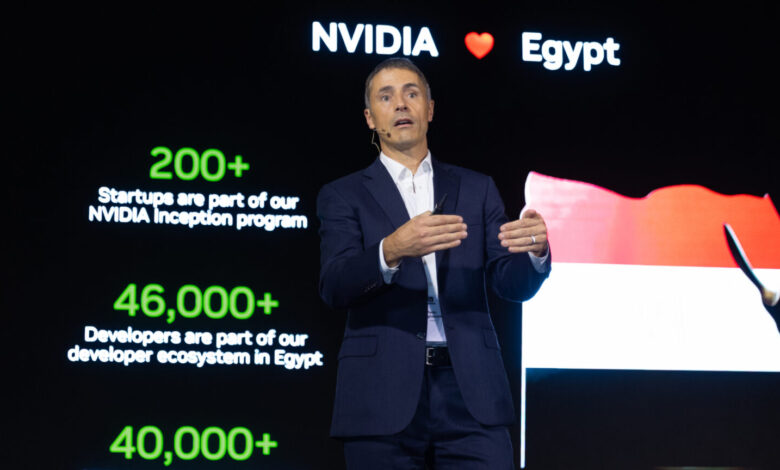
The development was highlighted at an AI ecosystem gathering at the Grand Egyptian Museum, where NVIDIA brought together members of Egypt’s technology and startup communities. The event showcased AI applications spanning healthcare, cybersecurity, robotics, financial services and enterprise technology.
NVIDIA said its Deep Learning Institute learner base in Egypt has grown more than tenfold in a year. More than 200 Egyptian startups are also enrolled in the company’s Inception programme, while Egypt’s developer community has grown to more than 46,000, according to reporting on the event.
Building the infrastructure for AI
Access to computing infrastructure remains one of the key challenges for AI development across Africa. The continent accounts for around 18% of the world’s population but has less than 1% of global data centre capacity, according to NVIDIA.
That gap is beginning to narrow, with four AI factories announced or brought online across Africa within the past year and another 656MW of capacity in the pipeline.
In Egypt, Hassan Allam Data Centers received a licence from the National Telecommunications Regulatory Authority in June to build and operate data centres. Hassan Allam Utilities and investment firm A15 subsequently agreed to develop a data centre project estimated at around $400 million.
Cassava Technologies is also expanding its AI infrastructure footprint across Africa. The company, described by NVIDIA as the continent’s first NVIDIA Cloud Partner, is investing in AI factory deployments across Egypt, Kenya, Nigeria and Morocco, with the wider investment potentially reaching $720 million.
In Egypt, Cassava and Vodafone Egypt have announced an AI factory initiative designed to provide businesses and government organisations with locally hosted AI infrastructure through GPU-as-a-service.
The objective is to give developers, enterprises and researchers access to accelerated computing closer to where their data is generated, while supporting locally hosted AI development and deployment.
Startups put AI into practice
The growing infrastructure base is being accompanied by an expanding startup ecosystem. Egyptian companies participating in NVIDIA’s Inception programme include Intella, which develops Arabic speech intelligence technologies; Marses Robotics, focused on autonomous robotics and industrial automation; Proteinea, which combines AI with protein design and laboratory research; and Stakpak, which is developing an autonomous developer-operations AI agent.
Other companies are applying AI to financial services, enterprise intelligence and healthcare, reflecting a shift towards domain-specific applications rather than AI development focused solely on general-purpose models. The ecosystem is also attracting greater investor participation. A15 and M Empire have joined NVIDIA’s VC Alliance, connecting Egyptian investors with NVIDIA’s wider global startup network.
AI growth extends beyond Egypt
The developments in Egypt form part of a broader expansion of AI infrastructure across Africa. South Africa, Morocco and Nigeria are among the markets seeing new AI infrastructure investment. South African AI cloud provider Stratos Lab, for example, is partnering with ECOBLOX and Digital Parks Africa on an AI cloud deployment using more than 50 NVIDIA HGX B300 systems, which NVIDIA says will deliver more than 7 exaflops of performance.
The infrastructure push also addresses one of Africa’s distinctive AI challenges: language diversity. The continent is home to roughly a third of the world’s languages, many of which have limited representation in mainstream AI models. South African AI company Lelapa AI has been developing language technologies including InkubaLM and the Vulavula speech service for languages such as isiZulu and Sesotho.
Meanwhile, demand for data centre capacity is expected to grow significantly. NVIDIA cites McKinsey estimates that African data centre demand could increase from around 0.4GW today to between 1.5GW and 2.2GW by 2030, requiring an estimated $10 billion to $20 billion in construction investment.
The combination of local computing infrastructure, growing developer communities and an expanding startup base is creating the foundations for African companies to develop and deploy AI applications closer to their markets and data.
For Egypt, the shift represents a move from building AI capability to putting that capability into production across an increasingly broad range of industries.