ServiceNow has announced new capabilities for ServiceNow EmployeeWorks, enabling employees to create and customise AI agents for their roles, automate recurring tasks and access AI-powered assistance across business applications.
The updates introduce Productivity Assistants for contextual, role-based work, Productivity Routines for repeatable tasks and ToolSmith, an agentic development environment designed to help developers build tools for enterprise AI assistants. A new Conversations API will also allow organisations to integrate EmployeeWorks capabilities into applications and channels already used by their employees.
The features are built on the third generation of ServiceNow’s employee-centric AI harness, which combines employee context, decision-making capabilities and governed enterprise actions to support AI-driven workflows.
ServiceNow said the new capabilities address barriers that often prevent employees from building AI tools for their own work, including IT backlogs, developer constraints, fragmented applications and restrictions around access to enterprise systems.
EmployeeWorks allows non-technical employees to create AI assistants using natural-language instructions, within guardrails defined by administrators. They can customise an assistant’s behaviour, content, tools and access permissions to suit specific responsibilities.
“AI’s real promise is to close the gap between intention and action,” said Jacqui Canney, chief people and AI enablement officer, ServiceNow. “This era demands that business leaders redesign work around their customers’ needs. When your technology supports that goal, your employees spend less time on coordination and more time solving customer problems that require human judgement. ServiceNow EmployeeWorks makes that shift possible.”
“ServiceNow combines agentic planning with governed and auditable workflows for any employee use case with intelligent employee context as the foundation,” said Bhavin Shah, senior vice president, employee experience group, ServiceNow. “The result is an operating system for the employee experience, connecting employees to the full power of the ServiceNow AI platform across any business application or channel, in any language, which can be ready for the enterprise on day one.”
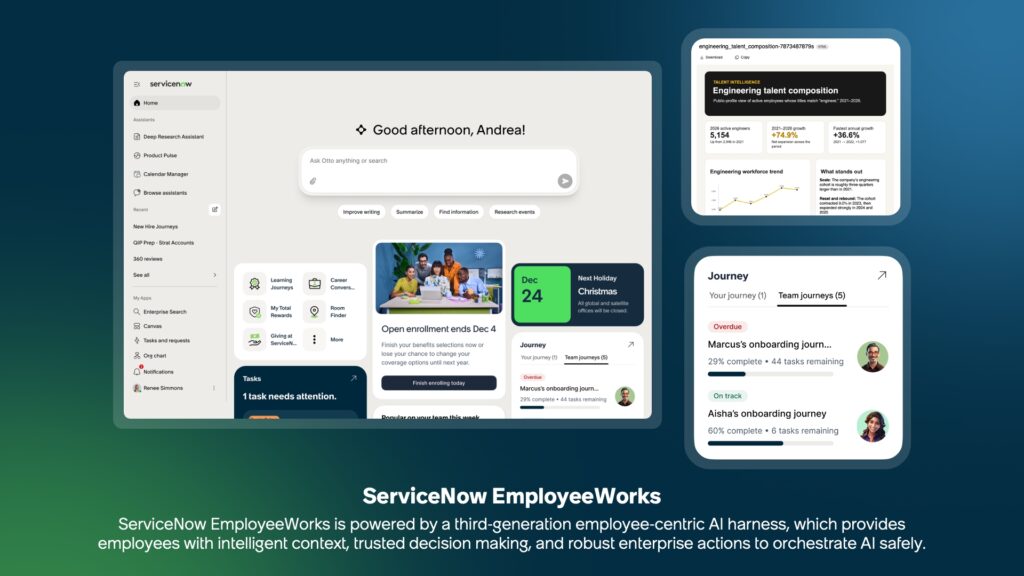
Productivity Assistants are designed for work requiring contextual understanding, research and coordination across systems. Built on the employee-centric AI harness, they combine reasoning, memory and tool interoperability to handle longer-running tasks and multi-step activities.
ServiceNow is introducing these assistants across its product portfolio, beginning with HR Service Delivery. The initial capabilities include:
- Talent Insights Assistant: Provides managers with information on candidate suitability, recruitment and organisational talent through integrations with Findem and Phenom.
- HR Business Partner Assistant: Supports HR activities such as approvals, case management and employee programmes through conversational interactions. It is designed to help HR teams manage requests at scale.
- Manager Assistant: Gives managers access to coaching, team performance information and insights that would otherwise require engagement with HR processes and personnel.
EmployeeWorks will also include two general-purpose assistants. The Research Assistant can investigate questions using internal and external sources, producing role- and access-based responses in formats such as documents, presentations and other structured outputs.
The Calendaring Assistant connects to calendar systems to manage scheduling, resolve conflicts, reserve meeting rooms and add conferencing links. It can also handle more complex requests, such as arranging recurring team meetings while minimising disruption to ongoing work.
For predictable tasks, employees can create Productivity Routines that run in the background and carry out defined steps without requiring repeated manual input.
One example is a prospecting agent configured by a sales leader. It could review upcoming account meetings, research prospective customers using internal and external information, and prepare a tailored presentation or sales asset before the meeting.
Employees can describe the task they want to automate, select the required tools and deploy the routine without needing to understand backend systems, API integrations or data models. Administrators can apply governance controls to these workflows.
ToolSmith is an agentic development environment intended to simplify the creation of tools used by EmployeeWorks assistants. Developers describe the required functionality in natural language, after which the system helps plan, build and test the integration.
ServiceNow said ToolSmith is trained on more than 75,000 APIs. It works with developers to establish an implementation plan, build integrations according to established practices and optimise tools for token efficiency and reliability.
The environment can also retrieve relevant logs when an issue occurs and suggest fixes. In addition, it analyses logs to identify potential improvements or new workflow opportunities. The Conversations API will allow organisations to integrate EmployeeWorks capabilities, including Productivity Assistants, Productivity Routines and ToolSmith, into existing employee-facing environments.
These can include custom internal applications, kiosks and other AI applications, allowing employees to access the capabilities through channels they already use. Productivity Assistants, Productivity Routines, the third-generation employee-centric AI harness, ToolSmith and the Conversations API are currently in controlled availability.