Nutanix Sets its Sights on Enterprise AI and Hybrid Multicloud Growth Across the Middle East and Africa

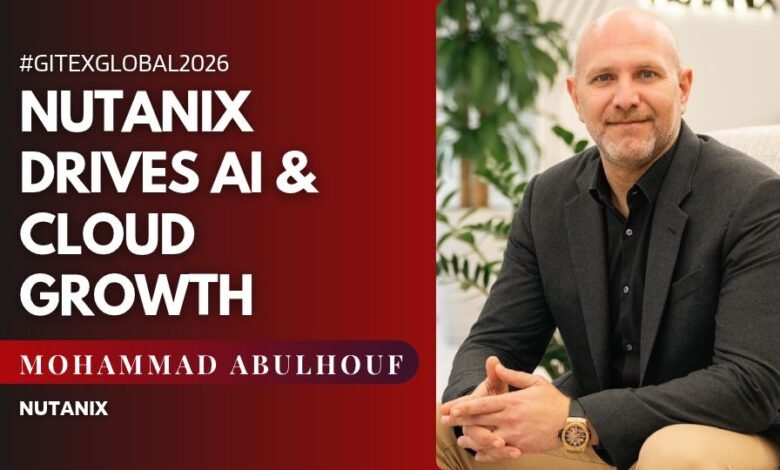
As the Middle East accelerates investment in AI, sovereign infrastructure and digital transformation, Nutanix is positioning its hybrid multicloud platform as a foundation for the next phase of enterprise technology adoption. Mohammad Abulhouf, Vice President and General Manager for the Middle East and Africa at Nutanix, discusses the region’s growth opportunities, the shift towards production-ready AI, infrastructure modernisation and the importance of a strong channel ecosystem.
What does GITEX Global 2026 represent for your organisation, and what are your key objectives for this year’s event? How important has the Middle East become to your global growth strategy, and what opportunities do you see emerging across the UAE, Saudi Arabia and the wider MEA region?
This year is particularly significant for Nutanix as we mark our tenth year participating at GITEX Global. Over that decade, we have witnessed the Middle East evolve into one of the world’s most dynamic technology markets, and we are proud to have been part of that journey. Today, the region is not simply adopting global technology trends; it is increasingly helping shape the direction of innovation, particularly in AI, cloud infrastructure and digital transformation.
Our focus at GITEX 2026 is built around our vision of One Platform, One Consistent Experience that enable organisations to run their data, applications and AI anywhere. We want to demonstrate how our unified cloud platform can help organisations simplify IT operations, modernise infrastructure and accelerate enterprise AI adoption, while retaining the flexibility, security and control they need.
The Middle East has become a strategically important region for Nutanix. The UAE and Saudi Arabia, in particular, are making significant investments in national AI strategies, sovereign infrastructure, smart cities and digital government services. These initiatives are creating opportunities for organisations to rethink how they build and operate their technology environments.
We see considerable potential across government, financial services, healthcare, telecommunications, energy and other sectors where organisations need to modernise existing infrastructure while supporting new AI-driven workloads. Our opportunity is to help them do both through a consistent operating model that reduces complexity and gives them the freedom to run applications, data and AI wherever it makes the most business sense.
GITEX is therefore much more than an exhibition for us. It is an opportunity to strengthen relationships with customers and partners, demonstrate our latest innovations and reinforce our long-term commitment to the region.
The Middle East is rapidly positioning itself as a global technology hub, with major investments in AI, cloud infrastructure, smart cities, cybersecurity and digital transformation. How do you see the regional technology landscape evolving over the next three to five years, and where do you believe the biggest opportunities will emerge?
Over the next three to five years, I expect the Middle East to become an increasingly important centre for enterprise AI innovation, supported by substantial investments in digital infrastructure, cloud platforms and national technology programmes. What makes this region particularly interesting is the combination of ambitious government strategies, strong investment capacity and a willingness to adopt transformative technologies at scale.
We are already seeing a shift from AI experimentation towards practical enterprise deployment. Organisations are moving beyond individual proofs of concept and looking at how they can operationalise AI across business functions, build AI factories and introduce intelligent agents into everyday workflows. This will require a new generation of infrastructure capable of supporting traditional applications, modern containerised workloads and increasingly demanding AI environments.
At the same time, hybrid multicloud will remain central to enterprise IT strategies. Organisations will not necessarily move everything to a single public cloud or bring everything back on-premises. Instead, they will need the flexibility to operate workloads across private infrastructure, public clouds, edge environments and sovereign cloud platforms, while maintaining a consistent operational experience.
I also believe infrastructure modernisation will become a major priority. Organisations are reassessing virtualisation strategies, licensing models and technology dependencies, creating demand for more flexible, cost-effective platforms that provide greater freedom of choice.
For Nutanix, these developments align directly with our strategy. Our platform is designed to simplify the management of applications, data and AI across distributed environments, helping organisations reduce complexity, optimise resources and accelerate innovation.
Ultimately, the biggest opportunity will be enabling enterprises to build technology environments that are not only AI-ready, but also adaptable, secure and economically sustainable as their requirements evolve.
AI is increasingly moving from experimentation to practical enterprise deployment. How is your organisation incorporating AI into its products, services and internal operations? What tangible business outcomes are you seeing, and what challenges are customers in the region facing when moving AI initiatives from pilots into production?
AI is one of the most significant opportunities shaping Nutanix’s strategy, and we are focused on helping organisations move from AI experimentation to secure, scalable and production-ready deployments.
Our approach is centred on providing the infrastructure and platform services required to build, operate and govern enterprise AI environments.
At GITEX this year, we will showcase our Agentic AI offering, a full-stack software solution designed to help enterprises build and operate AI factories. It brings together infrastructure operations and AI platform services, enabling organisations to develop and run agentic AI applications while maintaining the governance, security and operational control required in enterprise environments.
Through Nutanix Enterprise AI and our latest AI Gateway capabilities, organisations can access public and private AI models through a centralised framework, intelligently route models to optimise cost and performance, and develop secure enterprise knowledge assistants that connect approved AI models to organisational information through retrieval-augmented generation (RAG) workflows.
The tangible business benefits include accelerating AI application development, simplifying deployment and management, improving resource utilisation and giving organisations greater control over the cost and governance of AI workloads. Our own AI agent, Nyla, which will be introduced as a virtual receptionist at our GITEX stand, is another practical demonstration of how agentic AI can support everyday business interactions.
However, moving AI into production requires more than access to models or computing power. Organisations must address data quality, infrastructure scalability, security, governance, skills and the cost of running AI workloads. In this region, data sovereignty is an additional consideration, particularly for government entities and regulated industries that need to retain control over sensitive information.
We believe enterprises need an integrated approach that brings together infrastructure, AI platforms and governance. Our objective is to make AI adoption simpler and more manageable, giving organisations the flexibility to deploy workloads where they make the most operational, economic and regulatory sense.
Global supply chains continue to face uncertainty, from geopolitical tensions and trade restrictions to shipping disruptions, component shortages and changing logistics costs. How are these challenges affecting your operations and ability to serve customers in the Middle East and Africa? What steps are you taking to strengthen supply chain resilience, regional distribution and local availability?
Supply chain uncertainty has reinforced the importance of flexibility and choice in enterprise technology. Organisations increasingly want to avoid being overly dependent on individual hardware vendors, infrastructure providers or technology platforms, particularly when external factors can affect availability, pricing and long-term investment decisions.
Nutanix’s software-defined approach is designed to address some of these concerns by separating the software platform from the underlying hardware. Our solutions support a range of qualified server platforms and infrastructure configurations, giving customers greater flexibility in how they build and modernise their environments. This also allows organisations to make infrastructure decisions based on availability, performance, economics and business requirements rather than being tied to a single hardware configuration.
Our hybrid multicloud strategy provides another dimension of flexibility. With solutions such as Nutanix Cloud Clusters (NC2), organisations can extend their Nutanix environments into public cloud infrastructure, creating additional options for workload placement and capacity management.
Across the Middle East and Africa, our channel-first approach is equally important. We work closely with distributors, technology partners, system integrators and service providers to support customers across diverse markets. By investing in partner technical capabilities, enablement and services expertise, we aim to ensure customers have access to the skills and support required to deploy and manage their environments effectively.
Ultimately, resilience is not just about having alternative suppliers or infrastructure options. It is about building technology environments that can adapt to changing circumstances without disrupting business operations. That flexibility is central to the value Nutanix brings to customers.
As governments and enterprises accelerate digital transformation, concerns around data sovereignty, cybersecurity, regulatory compliance and infrastructure resilience are becoming increasingly important. How is your organisation addressing these priorities, particularly in markets with evolving regulatory requirements and growing expectations around local data management?
Data sovereignty has become a central consideration in technology decisions across the Middle East, particularly as governments and regulated industries accelerate their digital and AI ambitions. Organisations want to benefit from cloud and AI innovation while retaining control over where their data resides, how it is accessed and how their applications are managed.
At Nutanix, we believe organisations should have the freedom to determine where their applications, data and AI workloads run, without sacrificing operational consistency. Our hybrid multicloud platform enables customers to operate across on-premises infrastructure, private and public clouds, edge environments and sovereign cloud platforms through a consistent operating model.
This flexibility is particularly important for government, healthcare, financial services and defence organisations, where data residency, access controls and regulatory compliance can influence infrastructure decisions. We also support sovereign and air-gapped AI deployments, allowing sensitive workloads to operate within controlled environments while enabling organisations to take advantage of AI technologies.
Through Nutanix Enterprise AI and AI Gateway, customers can establish governed access to public and private models, manage model interactions and connect AI applications to approved enterprise information. This helps organisations introduce AI while maintaining greater control over their data and how AI services are accessed.
Cybersecurity and infrastructure resilience are equally important. Our platform provides an integrated foundation for running virtual machines, containers and AI workloads across different environments, helping simplify operations and maintain consistency in how infrastructure is managed.
Our philosophy is that sovereignty should not come at the expense of innovation. Organisations should be able to meet their regulatory and operational requirements while retaining the flexibility to modernise infrastructure, adopt AI and pursue their digital transformation objectives.
Looking beyond GITEX 2026, what are your organisation’s biggest priorities for the Middle East and Africa over the next 12–24 months? Are there plans for new investments, partnerships, product launches, local talent development or expansion into additional markets?
Over the next 12–24 months, our priorities will centre on three key areas: accelerating enterprise AI adoption, helping customers modernise their infrastructure and continuing to strengthen our regional partner ecosystem.
First, we will continue investing in our AI strategy, particularly around Nutanix Agentic AI and Enterprise AI.
We want to help organisations move beyond isolated AI projects and build production-ready AI environments that are secure, governed, scalable and economically sustainable. As AI becomes more deeply embedded in enterprise operations, the ability to run and manage these workloads across different environments will become increasingly important.
Second, infrastructure modernisation will remain a major focus. Many organisations are reassessing their virtualisation and cloud strategies and looking for greater flexibility, simpler operations and more predictable economics. We will continue demonstrating the value of our Nutanix Cloud Platform, including AHV, Nutanix Kubernetes Platform and Nutanix Cloud Clusters, in helping customers modernise their environments while retaining freedom of choice.
Third, our partners will remain fundamental to our regional growth strategy. We are committed to a channel-first approach and will continue investing in partner enablement, technical certifications, services capabilities and joint customer engagement. Our FY27 Elevate Partner Program reflects this commitment, with a stronger emphasis on measurable growth, platform expansion, customer adoption, renewals and services.
Initiatives such as Powered by Nutanix: Verified Services will also help partners demonstrate their technical expertise and differentiate their offerings. We will continue working closely with our technology ecosystem to deliver integrated solutions that address the region’s evolving requirements around AI, hybrid multicloud and sovereign infrastructure.
The Middle East and Africa represent a market with enormous potential, and our ambition is to grow alongside our customers and partners. As organisations move into the next phase of digital transformation, we want Nutanix to be the platform that gives them the flexibility to innovate, the simplicity to operate efficiently and the confidence to run their applications, data and AI anywhere.