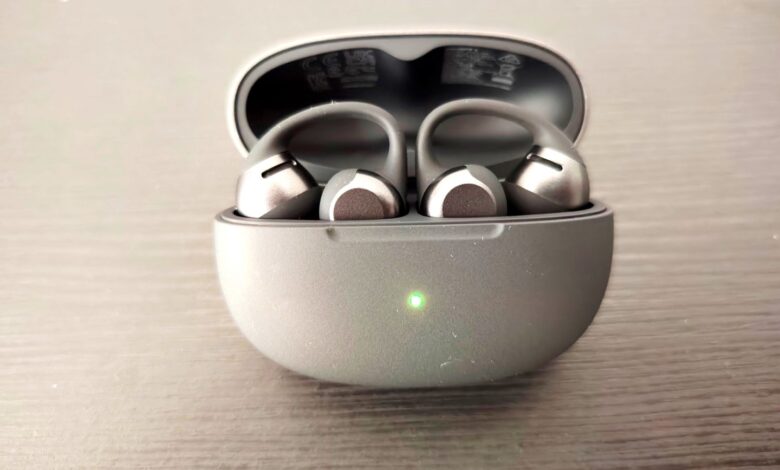
There is a reason open-ear earbuds have gradually become more popular beyond the running track and gym. Not everyone wants to shut themselves off from the world every time they put on a pair of earbuds. Whether you are working at your desk, walking through a busy street, exercising or simply listening to music around the house, being able to hear what is happening around you has its advantages.
The challenge, however, has always been sound quality. Open-ear earbuds have traditionally struggled to reproduce the kind of bass, depth and overall richness associated with conventional in-ear earbuds. Shokz believes it has made considerable progress in addressing this limitation with its latest flagship clip-on earbuds, the OpenDots 2.
Priced at AED 699, the OpenDots 2 build on the original OpenDots One with improvements to audio reproduction, a redesigned acoustic system, upgraded Dolby Audio, better controls and enhanced durability. They also retain the defining characteristic of the series: a lightweight clip-on design that leaves your ear canals unobstructed.
On paper, these are among the more interesting open-ear earbuds currently available. The question is whether their combination of comfort, sound quality and everyday practicality makes them worth the premium.

Design And Comfort: Almost Forget You’re Wearing Them
The first thing that makes the OpenDots 2 interesting is their physical design. Unlike conventional earbuds that sit inside the ear canal or open-ear models that wrap around the back of the ear, these use a compact clip-on arrangement.
Each earbud consists of two sections connected by Shokz’s flexible JointArc structure. One section houses the speaker and sits towards the front of the ear, while the other contains the battery and control components. The flexible connection holds both sections in position without requiring an uncomfortable grip.
Each earbud weighs just 6.4g, making them exceptionally lightweight. The contact areas are covered in soft, contoured silicone, while the JointArc incorporates a flexible nickel-titanium structure that adapts to different ear shapes.
This combination is important because comfort is arguably the biggest reason to consider this category of earbuds in the first place. Traditional in-ear earbuds can become uncomfortable after several hours, particularly when using silicone tips that create pressure inside the ear canal. The OpenDots 2 avoid that problem altogether.
The clip-on construction also makes them convenient for people who wear glasses, since there is no conventional ear hook competing for space around the ear. Another useful feature is interchangeable left and right earbuds. Dynamic ear detection automatically identifies which ear each unit is being worn on and adjusts the audio channels accordingly. You therefore do not have to spend time identifying which earbud belongs on which side.
The design is particularly suitable for commuting, office work, walking and exercise. You can listen to music while remaining aware of conversations, announcements and traffic. There is one consideration, though. Although the clip mechanism is flexible, individual ear shapes differ. It is worth trying them on before purchasing if you are particularly sensitive to pressure around the outer ear.

Audio Performance: Bass Is Finally Getting Some Attention
Sound quality is where Shokz has concentrated much of its effort with the OpenDots 2. The earbuds incorporate Bassphere 2.0, MirrorPitch technology and upgraded Dolby Audio. Rather than simply increasing volume, these technologies are intended to improve the way sound is delivered towards the ear, particularly in the lower frequencies.
Bassphere 2.0 uses a dual-driver arrangement, with two opposing 11.8mm drivers inside each earbud. Shokz says the arrangement delivers performance comparable to a single 16mm driver while improving volume and reducing distortion. MirrorPitch takes a different approach to sound delivery. It uses internal acoustic reflectors to direct sound towards the ear canal, helping improve perceived bass response and reduce sound dispersion.
The result is a more substantial audio presentation than one might normally expect from an open-ear design. Bass reproduction is particularly important here. Conventional open-ear earbuds often struggle to reproduce low frequencies convincingly because they cannot create the same sealed acoustic environment as in-ear models. The OpenDots 2 do not completely overcome that physical limitation, but they make a noticeable effort to narrow the gap.
In our tests, we found that the basslines had better definition and presence than those of many conventional open-ear alternatives. Bass instruments remain discernible, and electronic music and rhythm-heavy tracks benefit from the additional low-frequency weight. You are not going to get the deep, physically engaging bass of a good pair of sealed in-ear earbuds. The OpenDots 2 delivered a fuller presentation for their category, rather than attempting to replicate the sound of a completely different earbud design.
The midrange was reasonably detailed, making vocals, podcasts and spoken content enjoyable. There is sufficient clarity to distinguish individual instruments, although the default tuning can sometimes leave vocals sounding slightly recessed when several instruments compete for attention.
The treble was reasonably clear, although certain higher-frequency sounds occasionally became prominent. This was particularly noticeable with some vocal recordings and tracks that contained pronounced cymbals or sharp consonants. Stereo separation was another positive aspect. Music does not feel excessively compressed into a narrow central image, and the presentation has a reasonably spacious character for such a compact pair of earbuds.
For everyday listening, the OpenDots 2 are particularly well suited to pop, electronic music, podcasts, acoustic recordings and general streaming content. They are not intended to replace dedicated audiophile earbuds, but they deliver an enjoyable listening experience without blocking the ears.

Dolby Audio: A More Spacious Listening Experience
Dolby Audio is one of the more interesting additions to the OpenDots 2. Available through the Shokz companion application, the feature changes the overall presentation by creating a wider, more expansive soundstage. It also adds perceived bass weight and makes music sound fuller.
The difference is noticeable, particularly with electronic music, modern pop and tracks that benefit from additional low-frequency energy. However, Dolby Audio is not necessarily the best setting for everything. Some recordings sound more natural with the standard audio profile, while the enhanced processing can make delicate instrumental arrangements feel slightly heavier than intended.
This is where the application becomes useful. Rather than forcing everyone to listen to one particular sound signature, Shokz provides several equaliser options and customisation tools. The important thing is to experiment. Standard mode is a sensible starting point, while Dolby Audio is worth enabling when you want a bigger, more energetic presentation.
Everyday Listening And Environmental Awareness
The biggest advantage of the OpenDots 2 is that they do not isolate you from your surroundings. You can listen to a podcast while working and still hear someone approaching your desk. You can walk outdoors while listening to music and remain aware of nearby traffic. At home, you can enjoy music without completely disconnecting from conversations.
This makes them particularly useful in environments where situational awareness matters. There is, however, a trade-off. The absence of active noise cancellation means that external sounds remain audible. In a quiet office, this is an advantage. On a crowded train or aircraft, it becomes a limitation. They are therefore best viewed as everyday open-ear earbuds rather than noise-isolating travel companions.
Sound leakage is another consideration. Although Shokz uses its sound-directing technologies to focus audio towards the ears, open-ear earbuds cannot offer the same degree of privacy as sealed earbuds. At moderate listening levels, this should not be particularly problematic in most everyday environments, but people sitting very close to you may hear some audio.

Microphone And Call Quality
The OpenDots 2 feature an interesting microphone arrangement consisting of two air-conduction microphones and a dedicated bone-conduction microphone in each earbud. The system works alongside adaptive beamforming and AI noise reduction to improve voice pickup and minimise background distractions.
The addition of the bone-conduction microphone is particularly interesting because it helps the earbuds capture information associated with the user’s voice rather than relying exclusively on conventional microphones exposed to surrounding noise. In practical terms, this makes the OpenDots 2 suitable for everyday phone calls, online meetings and voice conversations.
In our tests, voices generally remained intelligible, even when there was some background noise. The microphone system can reduce persistent sounds such as ventilation and ambient office noise, although loud and sudden environmental sounds can still interfere with conversations. For occasional business calls, video meetings and conversations while walking, the microphone arrangement is a welcome addition.
Controls And Connectivity
Shokz has introduced force-sensor controls to the OpenDots 2, replacing the more conventional approach associated with many wireless earbuds. The controls combine tapping and pinching gestures. You can manage playback, answer calls, adjust volume and activate other functions without reaching for your smartphone.
The force-sensor approach is intended to reduce accidental inputs, particularly when adjusting the earbuds or wearing them during exercise. The Shokz application also allows you to customise the available gestures, giving you some flexibility over how the controls behave.
Connectivity is handled through Bluetooth 6.1, with multipoint pairing allowing two devices to remain connected simultaneously. This is particularly useful when working with a laptop and smartphone. You can listen to something on your computer and switch to an incoming phone call without having to repeatedly disconnect and reconnect the earbuds.
The earbuds also support dynamic ear detection, allowing either unit to be worn on either ear. One area worth mentioning is that the OpenDots 2 are not designed for low-latency gaming. Their open-ear architecture and conventional Bluetooth audio connection are better suited to music, video consumption, calls and everyday use.

The Shokz App: More Than Just A Companion Application
The Shokz application is an important part of the OpenDots 2 experience. While the earbuds work without it for basic Bluetooth audio, installing the application unlocks much of their functionality. Available for Android and iOS, the application provides access to audio settings, equaliser profiles, control customisation, battery information and firmware updates.
The equaliser options include Standard, Bass, Vocal and Private presets. These provide different listening profiles depending on whether you prefer a balanced presentation, stronger bass, clearer vocals or a listening profile intended to reduce sound leakage. There is also a custom equaliser that allows you to adjust the sound to your preferences. A Smart EQ feature provides a more personalised approach by asking you to compare different audio profiles and select the versions you prefer.
Dolby Audio can also be enabled or disabled directly through the application. Beyond audio, the application provides multipoint connection management, battery monitoring, firmware updates and a Find My Earbuds feature that plays a sound to help locate misplaced earbuds.
Wear detection can automatically pause playback when the earbuds are removed. Drop alerts are another useful addition, with the companion earbud able to alert you if one unit falls away. The application is therefore more than a basic configuration utility. It gives you meaningful control over how the OpenDots 2 behave, particularly if you regularly switch between different listening environments.
Battery Life: An Impressive 40-Hour Proposition
Battery life is another area where the OpenDots 2 perform well. Shokz advertises up to 10 hours of listening time from the earbuds themselves, with the charging case extending total endurance to approximately 40 hours. This means the case provides roughly three additional full charges beyond the earbuds’ own battery capacity.
The Shokz application also displays battery information, making it easier to monitor the remaining charge. The charging case supports both USB-C and Qi-certified wireless charging. Wireless charging is particularly convenient if you already have a compatible charging pad on your desk or bedside table. You simply place the case on the charging surface rather than connecting a cable.
For quicker top-ups, a five-minute charge provides up to two hours of playback. This is a useful feature when you discover that the earbuds are running low just before heading out. The case is compact enough to carry in a pocket or bag, and its additional battery capacity makes it a practical companion for longer working days and travel.
Durability: Ready For Workouts And Everyday Use
The OpenDots 2 carry an IP57 dust and water resistance rating for the earbuds, while the charging case has an IP54 rating. The IP57 rating means the earbuds are protected against dust ingress and can withstand temporary immersion in fresh water under specified laboratory conditions.
For everyday use, this translates into better protection against sweat, rain and the occasional accidental splash. The case’s IP54 rating provides protection against dust and splashing water, although it should not be treated as waterproof. The earbuds are consequently suitable for gym sessions, running, walking and other light sporting activities. They are not intended for swimming or prolonged underwater use.
Verdict: A More Complete Open-Ear Listening Experience
The Shokz OpenDots 2 demonstrate how far open-ear audio has progressed. They address several of the limitations traditionally associated with this category, particularly comfort, bass reproduction and everyday usability. The clip-on design is lightweight and practical, the flexible JointArc construction provides a secure fit, and the improved acoustic arrangement delivers a fuller listening experience than one might expect from earbuds that do not seal the ear canal.
Dolby Audio adds another dimension to the listening experience, while the Shokz application provides useful equaliser adjustments, gesture customisation and device management. Battery life is another strong point, with up to 10 hours from the earbuds and 40 hours when the charging case is included. Quick charging and Qi wireless charging make the package even more convenient.
There are limitations. They cannot isolate you from noisy surroundings, their bass response still has physical limitations compared with sealed earbuds, and call quality, while adequate, is not exceptional. The premium AED 699 price also makes them a considered purchase rather than an impulse buy.
Ultimately, the OpenDots 2 are not trying to replace every pair of earbuds you own. They are designed for people who want comfortable, convenient audio without disconnecting themselves from the environment around them. For that particular audience, Shokz has delivered a compelling product. The OpenDots 2 are among the more convincing examples of how open-ear earbuds can become genuine everyday listening companions rather than devices reserved exclusively for exercise.
Price: AED 699
Shokz OpenDots 2 AED 699
-
Final Rating
Summary
The Shokz OpenDots 2 demonstrate how far open-ear audio has progressed. They address several of the limitations traditionally associated with this category, particularly comfort, bass reproduction and everyday usability.