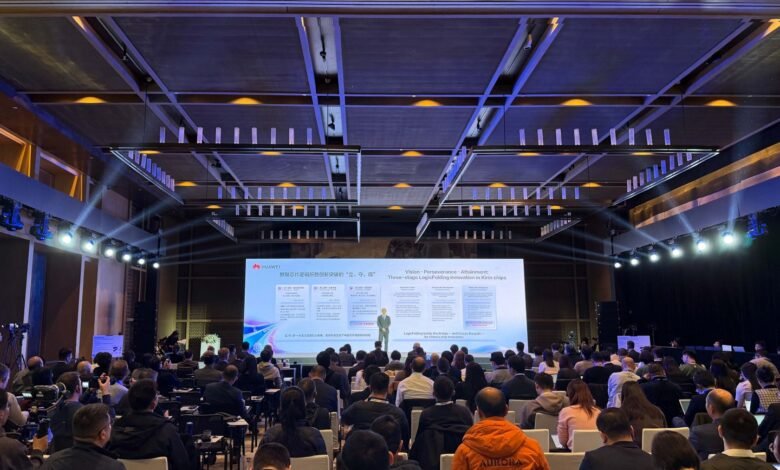
Huawei has reported that the cumulative value of its outbound patent licensing agreements has exceeded US$6.9 billion, with licensing revenue reaching approximately US$800 million in 2025. The figures were announced at the company’s seventh Innovation and Intellectual Property (IP) Forum, held in Beijing under the theme “Invent to Excel, Open to Empower”.
The forum brought together intellectual property experts, technology innovators and industry partners to discuss the relationship between patent protection, technology development and collaboration as artificial intelligence reshapes the technology landscape.
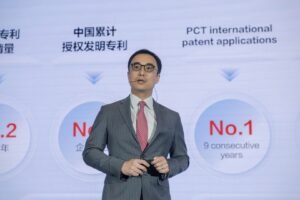
In 2025, Huawei signed 20 new patent licensees across network and communications equipment, consumer electronics and computing, IoT, automotive, streaming and semiconductors. By the end of the year, its patented technologies were being used in more than 3.2 billion 5G devices, over 1.6 billion Wi-Fi consumer electronics devices and more than 4.1 billion multimedia devices.
Wireless communications accounted for 41% of Huawei’s active granted patents, followed by terminal hardware at 16%, and AI and computing at 13%.
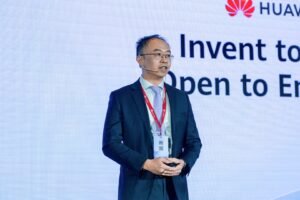
“At Huawei, a patent represents more than a legal right. It represents an innovative achievement and a source of pride for the people behind it,” said Alan Fan, Vice President and Chief Intellectual Property Officer of Huawei. The discussions also examined the role of intellectual property frameworks in enabling technology companies to license innovations and collaborate across industry boundaries.
“Global IP institutions set the shared, balanced rules of the road to reward inventors for their investment. Innovative enterprises, for their part, turn those rules into real-world practice: through voluntary licensing, open collaboration and responsible technology diffusion,” said Francis Gurry, Former Director General of the World Intellectual Property Organization (WIPO). “Together, they can uphold the core bargain of intellectual property – rewarding excellence in invention, while opening pathways for broader innovation empowerment, for the benefit of the whole global ecosystem.”
Sir Robin Jacob, Former Judge of the Court of Appeal of England and Wales, said Huawei had become one of the world’s leading holders of standard-essential patents (SEPs). He noted that the SEP licensing system supports open collaboration, encourages competition and stimulates innovation.
“A neutral, fair and predictable SEP licensing environment benefits both patent holders and implementers,” said Aleš Zalar, Director of the Patent Mediation and Arbitration Centre (PMAC) of the Unified Patent Court (UPC). “It protects the value of innovation while reducing barriers to the development and commercialisation of new technologies.”
Huawei also used the forum to present developments in several technology areas, with the inventors behind the Tau (τ) Scaling Law, UnifiedBus, near-packaged optics (NPO) and 6G sharing their research and development experiences. The Tau (τ) Scaling Law incorporates LogicFolding, a technology inspired by traditional Chinese mortise-and-tenon construction. It uses hybrid bonding to enable ultra-short-distance interconnects with near-zero spacing.
UnifiedBus represents an effort to redesign technologies used in multi-chip interconnect, PCIe (Peripheral Component Interconnect Express), high-performance networking and storage networking. The development spans chip-level technologies as well as hardware and software, building on Huawei’s experience in network infrastructure.
The company also highlighted the commercial deployment of Hi-ONE, an NPO optical engine, as an application of its more than 30 years of experience in optical technologies. “The quality of a patent comes from the genuine technology breakthroughs behind it. And a company’s standing in intellectual property comes from its sustained investment in research and the accumulation of knowledge and innovation over time,” said Peiying Zhu, Huawei Fellow and IEEE Fellow.
Emil Zhang, Head of Huawei’s IP Strategic Planning & Key Project Department, said continuous innovation was necessary to advance technology, while the value of innovation depended on enabling others to build on it through fair, reasonable and non-discriminatory terms.
The forum also featured industry perspectives on collaboration. Qing He, Chairman of Phlexing Technology, and Toshiyasu Ito, Fellow of Yamaichi Electronics, discussed their joint innovation and engagement with Huawei in Tau (τ) electronic design automation (EDA) and NPO.
Jamie Ribman, President and COO of Avanci, and Mattia Fogliacco, President and CEO of Sisvel, also shared perspectives on innovation and openness in their respective fields. Looking ahead, Fan reaffirmed Huawei’s commitment to research, intellectual property protection and collaboration with industry partners. “We look forward to working with partners across every sector to advance technology and industry, and to bring the benefits of innovation to everyone,” concluded Fan.