Vertiv Expands 800 VDC Portfolio for Next-Generation AI Data Centres

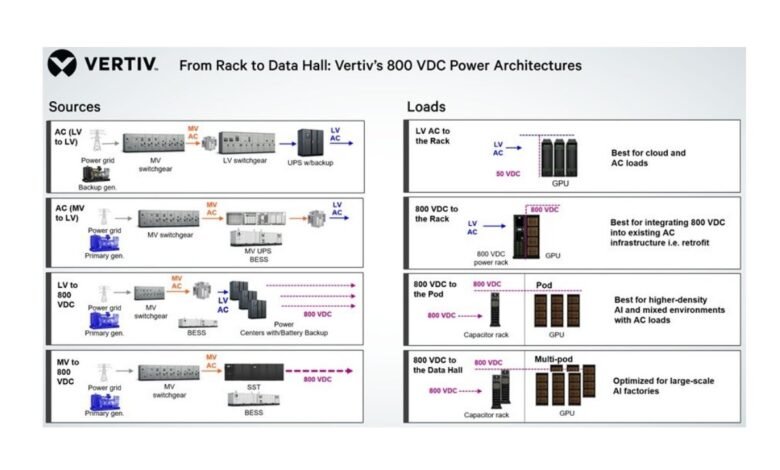
Vertiv has expanded its 800 VDC power portfolio to cover three levels of AI data centre deployment: the rack, compute pod and data hall. The development is aimed at addressing the increasing power requirements of next-generation AI infrastructure while allowing operators to introduce new architectures without necessarily redesigning their entire facilities.
Announced on 27 November 2026, the expanded portfolio builds on the company’s May 2026 introduction of the Vertiv PowerDirect 5000 Power Rack. The latest additions extend its capabilities to larger deployment environments, with solutions spanning power conversion, energy storage, distribution and protection.
The expansion comes as data centre operators assess how to accommodate increasingly power-intensive AI workloads. While 800 VDC is emerging as a potential architecture for high-density computing environments, the transition is unlikely to happen at the same pace across all facilities. AC and DC systems are expected to coexist, making deployment flexibility an important consideration for operators.
Vertiv’s approach allows organisations to introduce 800 VDC at different points in the power train, depending on their existing infrastructure, workloads, investment priorities and operational requirements. “The 800 VDC power train is not just a new power product or conversion methodology; it is a set of architectures and system designs,” said Scott Armul, Chief Product and Technology Officer at Vertiv. “Delivering it takes a comprehensive portfolio that brings together power conversion, energy storage, distribution, protection, controls and safety.”
Armul added, “To meet these evolving demands, Vertiv has built a system-level 800 VDC portfolio that gives customers the flexibility to implement 800 VDC across different data center configurations. Every layer, from the medium-voltage grid to the compute tray, is designed to work together, with safety built for DC operation.”
Power Architectures for Three Deployment Levels
At the rack level, the Vertiv PowerDirect 5000 (±400 / 800 VDC) Power Rack is designed to sit alongside the IT rack. Configurable for up to 800 kW, it accepts 480 VAC facility power and delivers 800 VDC or ±400 VDC. It houses 30 hot-pluggable 30 kW power supply units and an integrated battery backup unit designed to provide at least 50 seconds of hold-up time.
Complementing it is the Vertiv PowerDirect 3000, a 90 kW, 19-inch 800 VDC power shelf designed for installation inside the compute rack. The 1U DC-DC converter transforms 800 VDC into 54 VDC for compute trays, with peak efficiency of up to 98.5% and support for 180% pulse power for 0.5 milliseconds.
This architecture is intended for operators adding high-density AI computing to existing facilities. By locating power conversion and energy storage outside the IT rack, it can free between eight and 16 rack units for additional computing equipment while allowing operators to retain their existing upstream AC infrastructure.
A single power rack can support one or two IT racks, helping isolate faults and simplify maintenance. The platform also supports both 800 VDC and ±400 VDC through minimal hardware configuration changes, offering flexibility as silicon partners’ voltage requirements evolve.
Scaling Power Across AI Compute Pods
For larger deployments, the Vertiv PowerDirect 9000 is a 1.5 MW 800 VDC Power Centre designed to convert 480 VAC into 800 VDC for an entire row or compute pod. Power is distributed through the Vertiv PowerBar Track DC busway and tap-off boxes to PowerDirect 3000 power shelves installed in individual racks. The system scales in 60 kW increments using 27 hot-pluggable power supply units.
Energy storage is provided by the Vertiv EnergyCore Li5 800 VDC battery cabinet, which connects directly to the DC bus. Each cabinet delivers 200 kW of continuous backup at up to 98% conversion efficiency, with as many as six cabinets able to operate in parallel through active current sharing.
The pod-level architecture consolidates power conversion ahead of the row, reducing component count and removing the need for individual power racks alongside each IT rack. It is designed for megawatt-class AI deployments and can accommodate mixed AC and DC loads within the same facility. This could be relevant to colocation providers supporting customers with different workload requirements and GPU generations.
Data Hall-Level Power Conversion
At the data hall level, Vertiv is introducing the PowerNexus MV SST, a 5 MW 800 VDC solid-state transformer. The system converts medium-voltage AC directly into 800 VDC in a single conversion stage, feeding into the Vertiv DC busway. According to Vertiv, the architecture eliminates two to three intermediate conversion steps found in conventional power trains and provides a stable DC output with galvanic isolation. Its outdoor, liquid-cooled and containerised design is intended to reduce indoor space requirements while delivering up to 98% AC-to-DC efficiency.
When connected to external energy storage through a DC/DC converter coupled to the 800 VDC bus, the system can provide fault ride-through and AI power smoothing. A single unit can support a 4.8 MW super pod reference architecture without chaining. Bidirectional power flow also enables improved grid power quality and active power support.
The solution is aimed at operators developing purpose-built AI factories at campus scale. Moving power conversion outdoors can free indoor space for computing infrastructure, while reducing conversion stages can help limit cumulative power losses. Battery communication ports also enable coordination with energy storage systems to manage the rapid load fluctuations associated with AI workloads.
Flexibility and Safety Across the Power Train
Vertiv identifies architecture optionality, a comprehensive portfolio and safety by design as the three main differentiators of its expanded 800 VDC offering. The architecture options are intended to accommodate different deployment scenarios, from hyperscalers building dedicated AI facilities to colocation providers supporting multiple customers. The portfolio covers power conversion, energy storage, distribution, protection, controls and monitoring rather than focusing on individual components.
Safety is another consideration as operators move towards high-voltage DC environments. Vertiv’s architectures incorporate touch-proof busbars, high-voltage isolation, midpoint grounding, ground-fault detection and arc-flash prevention. The company also offers services developed for DC operating environments.
Kyle Keeper, Senior Vice President of Vertiv’s Power Management Business Unit, said, “Different operators have different requirements, whether they’re building new AI facilities, upgrading existing sites, or supporting a mix of tenants and workloads,” said Kyle Keeper, Senior Vice President of Vertiv’s Power Management Business Unit. “The Vertiv 800 VDC portfolio gives each of them an architecture that fits their needs. Whether deploying at the rack, compute pod or data hall level, customers have the optionality to choose an approach that aligns with their existing infrastructure, deployment goals and power requirements. This flexibility helps them meet today’s demands while creating a path to scale as their AI infrastructure evolves.”
Vertiv said pilot programmes, technical validation activities and collaborative development initiatives tailored to customer deployment requirements are currently underway. The company is engaging with customers on potential implementation approaches as the industry evaluates the role of 800 VDC in future AI data centre designs.