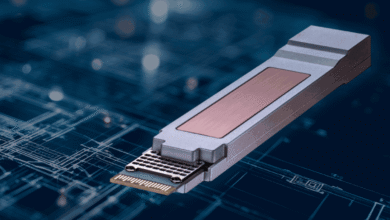
Honeywell Aerospace Deploys Thermal Response Module at Equinix AI Data Centre


Honeywell Aerospace has announced that Equinix has tested and installed its Thermal Response Module (TRM) at the Equinix Co-Innovation Facility (CIF) in Ashburn, Virginia. The technology is designed to help maintain cooling continuity in liquid-cooled AI data centres during power disturbances and fluctuations in computing demand.
As AI infrastructure moves towards higher-density deployments, cooling systems face increasing pressure to maintain stable operating temperatures. Even brief interruptions or fluctuations can affect graphics processing unit (GPU) performance and expose high-value hardware to potential damage.
The TRM acts as a thermal buffer, helping maintain coolant temperatures during power disturbances, sudden changes in computing demand and fluctuations elsewhere in the cooling system. According to Omdia, liquid cooling is currently deployed in fewer than half of data centres, with the market expected to record annual growth of 20% over the next five years.
The TRM is designed as a turnkey, drop-in solution that integrates into existing cooling loops between the coolant distribution unit (CDU) and servers. It does not require a system redesign and is compatible with different CDU vendors and architectures, potentially simplifying deployment for operators adopting liquid-cooled AI infrastructure.
The module uses proprietary phase-change materials to store and release thermal energy when required. Honeywell says the technology delivers 7.6 times more cooling power than chilled water and can stabilise the cooling loop within seconds. Its configuration can also be extended to provide several minutes of thermal buffering.
This response is intended to limit temperature excursions, reduce performance throttling and lower the risk of equipment damage while the wider cooling system adjusts. The additional thermal margin can also help operators support higher technical cooling-loop temperatures, reduce service-level agreement risks and redirect power from cooling towards revenue-generating computing workloads.
Pawel Wlodarczak, Design Innovation Director, Global Design, at Equinix, said: “We are pleased to have collaborated with Honeywell Aerospace on the development and testing of the Thermal Response Module. Testing at our Ashburn Co-Innovation Facility demonstrated the technology’s capability to manage rapid GPU cooling load fluctuations while requiring a smaller footprint in comparison to buffer tanks. As AI deployments continue to scale, innovations such as this will help address critical cooling and infrastructure challenges.”
The collaboration reflects Honeywell Aerospace’s approach to extending thermal management technologies across different industries. While aerospace and data centre environments have distinct operating requirements, both depend on precise temperature control to protect critical systems and sustain performance.
The TRM builds on phase-change material technology developed for aerospace and defence applications, where thermal stability is essential to mission-critical systems. Its design combines engineered phase-change materials, heat exchangers capable of supporting rapid or sustained cooling, and onboard state-of-charge sensing.
Together, these capabilities are intended to stabilise temperatures and improve the consistency and efficiency of chillers, CDUs and other upstream cooling equipment. The modular system can be tailored and scaled for deployments ranging from edge infrastructure to large AI clusters.
“AI workloads are pushing data center thermal systems harder than they were designed to run,” said Rich DeGraff, President and CEO of Control Systems for Honeywell Aerospace. “We have taken phase-change material technology developed to protect mission-critical aerospace and defense systems and applied it to a similar challenge in AI infrastructure. Our work with Equinix shows how proven aerospace technology can help data center operators protect critical hardware, sustain performance and reduce the risk of disruption.”
As operators increasingly adopt direct-to-chip liquid cooling to support more powerful AI processors, technologies such as the TRM are intended to provide an additional layer of thermal protection. By responding to short-term disruptions and rapid changes in cooling demand, the module aims to help maintain server availability while protecting critical infrastructure.