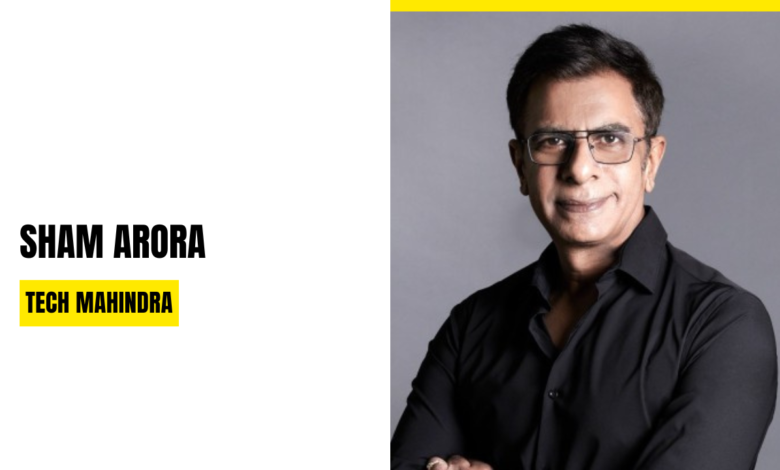
Sham Arora, Chief Technology Officer at Tech Mahindra, discusses how AI is driving the convergence of cloud, networking, security and digital twins to create a new generation of resilient, software-defined infrastructure.
How is the rise of AI workloads changing the design and architecture of modern data centres?
AI workloads are changing data centre architecture fundamentally. Enterprises are moving beyond conventional CPU-centric environments toward AI-ready infrastructure that can support higher compute density, faster data movement, stronger observability, and more dynamic workload orchestration. This also creates an opportunity to rethink data centre operations themselves, using AI to automate monitoring, prediction, remediation, and capacity planning at a level not possible in traditional infrastructure models.
For clients, the implication is clear: the data centre must now be treated as part of a broader AI infrastructure ecosystem where compute, cloud, networks, data platforms, security, and intelligent operations work together rather than as isolated layers.
We are also seeing a shift from static infrastructure management to intelligent, adaptive operating models. AI workloads can be highly variable, so the infrastructure supporting them needs real-time visibility into capacity, performance, risk, and utilization, with the ability to make decisions before issues affect service quality.
Tech Mahindra’s work on an AI-driven 5G Network Digital Twin illustrates this shift. The solution creates a real-time, AI-ready data environment that can simulate and predict network behaviour and support more autonomous decision-making.
What are the biggest challenges in scaling infrastructure to support high-density AI compute environments?
As AI environments grow, organizations must coordinate compute capacity with data availability, network performance, storage, security, observability, and operational expertise. A high-performance AI environment can still underperform if data cannot move efficiently, if workloads cannot be monitored end to end, or if teams lack the automation required to manage infrastructure at scale. This is why the scaling challenge is not only about adding more compute; it is about building an integrated operating model across hybrid infrastructure, cloud platforms, data pipelines, and security controls.
Tech Mahindra’s partnership with StackGen brings together cloud infrastructure automation, AI-driven site reliability engineering, managed observability, governance, and compliance within a single operating model. The objective is to reduce manual provisioning and operational overhead while making cloud infrastructure more responsive and scalable. This kind of automation will be critical as organizations move from AI experimentation to enterprise-scale AI operations.
Geopolitical risk, regulatory requirements, and the need for uninterrupted digital services are also becoming core considerations in infrastructure design. Enterprises must be prepared for the loss of sites, regions, or availability zones without materially disrupting business operations. This is driving stronger resilience architectures with best-in-class recovery point objectives and recovery time objectives, supported by automated failover, observability, and tested continuity plans.
How are power, cooling, and networking requirements evolving with AI-driven infrastructure?
AI is changing the economics and engineering of infrastructure because high-performance workloads place materially greater demands on the underlying environment. As organizations deploy more accelerated computing, infrastructure planning must account for higher power density, more advanced cooling models, greater energy efficiency, and faster movement of large volumes of data across compute, storage, and applications.
Networking, in particular, becomes increasingly important because AI workloads depend on the rapid movement of data between compute resources, storage, and applications. This is one reason we are seeing infrastructure and networking increasingly treated as a unified architecture rather than separate domains.
Tech Mahindra’s work with NVIDIA on AI-powered autonomous network operations illustrates this direction from the network operations side. The Telco Network Operations Reasoning Agent is designed to help communications service providers move toward Level 4+ autonomous networks by transforming traditional network operations centres into intelligent, closed-loop environments.
The broader lesson is that as infrastructure becomes more complex and dynamic, organizations will need automation and intelligence to continuously optimize performance, reliability, and resilience across the environment, rather than managing individual components in isolation.
Where do you see the convergence between physical infrastructure management and cybersecurity today?
The convergence is happening because infrastructure is increasingly software-defined, connected, and remotely managed. The traditional distinction between physical security and IT security is becoming less meaningful. A data centre may have strong physical controls, but if the systems managing its infrastructure, networks, identities, automation layers, or workloads are compromised, the organization can still face significant operational and business risk. Security, therefore, needs to be embedded throughout the full infrastructure lifecycle, from design and provisioning to monitoring, change management, and incident response.
In the Middle East, this is particularly relevant as organizations modernize technology environments while navigating data sovereignty, regulatory compliance, and cyber resilience requirements. At the IDC Middle East CIO Summit 2026, Tech Mahindra highlighted scalable, secure, and sovereign cloud architectures, along with zero-trust and AI-powered defense mechanisms for complex hybrid ecosystems. Our recent partnership with Cisco also reflects this convergence, bringing together cloud-native Security Service Edge capabilities, including zero-trust network access, CASB, firewall-as-a-service, and DLP, with Tech Mahindra’s managed services expertise.
What new security risks emerge as data centres become more software-defined and AI-orchestrated?
The attack surface becomes much broader. When infrastructure is increasingly controlled through software, APIs, cloud platforms, and AI-driven automation, attackers may target identities, privileged access, configuration layers, orchestration systems, APIs, telemetry pipelines, or the AI models themselves.
AI also introduces a new risk dimension because autonomous systems can make decisions and take actions at machine speed. That means an error or compromise can propagate faster than in a traditional environment. The security challenge, therefore, shifts from preventing unauthorized access alone to ensuring that automated systems have the right permissions, operate within defined policies, and are continuously monitored, tested, and governed.
Tech Mahindra’s recent cybersecurity work reflects this shift. Our partnership with CloudSEK focuses on AI-driven threat intelligence, attack-surface monitoring, and digital risk protection, while our Cisco partnership brings zero-trust and AI-powered protection together across users, devices, networks, clouds, and increasingly AI agents. For organizations in the Middle East, where national cybersecurity initiatives and regulatory expectations are evolving rapidly, continuous monitoring and faster risk detection will become increasingly important.
How important is real-time simulation or digital twin technology in planning and managing AI infrastructure?
Digital twins are becoming increasingly valuable because they enable organizations to test scenarios and make decisions before implementing changes in live environments. In complex infrastructure, that can mean modeling potential capacity constraints, predicting performance, assessing the impact of changes, and identifying risks without disrupting production systems.
The real opportunity, however, is to move beyond digital twins as passive visualization tools. When connected to real-time telemetry, unified data, and AI, a digital twin becomes an active decision-support and orchestration mechanism. Tech Mahindra’s collaboration with Microsoft demonstrates this approach. The AI-driven 5G Network Digital Twin combines Azure, Microsoft Fabric, and Azure Digital Twins with AI and agentic frameworks to support real-time simulation, predictive modeling, intelligent reasoning, and closed-loop orchestration.
The same model has broader implications for AI infrastructure management, where organizations increasingly need to anticipate bottlenecks, test changes safely, optimize resources dynamically, and improve operational resilience before issues affect production environments.
How are vendors adapting to the need for faster deployment cycles in AI infrastructure environments?
The traditional model of lengthy, labour-intensive infrastructure deployment is becoming difficult to sustain as AI adoption accelerates. Vendors are responding with automation, reusable platforms, managed services, infrastructure-as-code, and AI-assisted operations. The objective is to shorten the path from provisioning to production while preserving security, governance, compliance, and operational resilience.
We are also seeing a shift toward partnerships that combine specialist capabilities rather than relying on a single provider to deliver every component of the stack. The company’s collaboration with Cisco on the AI-driven Security Service Edge is designed to simplify security architecture while enabling faster, safer adoption of cloud and AI. The broader trend is clear: enterprises want infrastructure that can be deployed faster, but not at the expense of resilience, security, or regulatory control. The winning model will be responsive and responsible automation with secure guardrails, not automation for its own sake.