Agentic AI Moves into Production as UAE Enterprises Focus on Measurable Business Outcomes

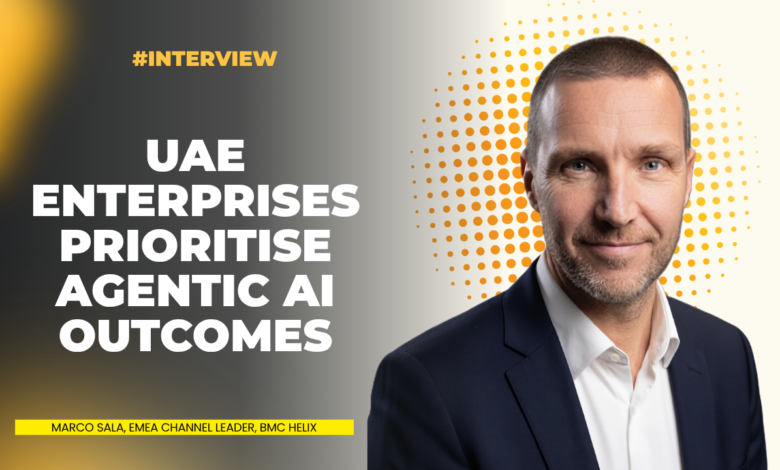
BMC Helix EMEA Channel Leader Marco Sala discusses the growing role of channel partners in helping regional organisations scale agentic AI, overcome integration and governance challenges, and turn experimentation into operational value.
As enterprises across the Middle East move from experimenting with artificial intelligence to deploying it in live environments, the focus is shifting from what AI can do to the business value it can deliver. For IT teams, this means applying agentic AI to everyday operational challenges, including incident management, workflow automation and IT service management, while ensuring that new capabilities integrate securely with existing infrastructure.
For channel partners and system integrators, the transition presents an opportunity to expand beyond traditional software implementation and licensing into advisory services, integration, governance and ongoing managed services.
Marco Sala, EMEA Channel Leader at BMC Helix, believes that regional enterprises are entering a more practical phase of AI adoption, with customers increasingly demanding measurable outcomes, operational resilience and clear accountability from their technology investments.
From experimentation to everyday IT operations
The UAE’s ambition to accelerate AI adoption is creating momentum for enterprise deployments. The government has set a target of transitioning 50% of government sectors and services towards agentic AI, reinforcing the need to move beyond isolated pilots and integrate AI into operational processes.
According to Sala, incident management, workflow automation and IT service management are among the areas where organisations are beginning to prioritise implementation. These use cases provide a practical starting point because they address recurring operational tasks and offer opportunities to demonstrate improvements in efficiency.
For channel partners, this creates a clear route into the agentic AI market. Rather than approaching AI as a broad technology transformation from the outset, partners can help customers identify specific operational challenges, assess their readiness and develop phased deployment plans.
The objective is to move from experimentation to production through defined use cases that demonstrate tangible value. Once organisations establish successful deployments, they can use the experience and results to guide further adoption.
Integration and governance remain key challenges
While interest in agentic AI is growing, deploying it across complex enterprise environments presents several challenges. Organisations must determine how AI and automation will work alongside existing systems, particularly when data is distributed across IT service management platforms, monitoring tools and configuration management systems.
Data residency is another important consideration for regional enterprises, especially those operating under regulatory or organisational requirements governing where information is stored and processed.
Sala sees these challenges as an opportunity for channel partners to provide services that extend beyond implementation. Partners can help assess data readiness, integrate existing systems and establish governance frameworks covering data residency, auditability and human oversight.
These requirements become particularly important as AI systems take on more responsibility for operational tasks. Organisations need to understand how automated decisions are made, which systems agents can access and where human approval remains necessary.
Partners that can combine technical integration expertise with a sound understanding of governance and service operations will be better positioned to support customers as deployments expand.
Proving the business value of AI
Enterprise expectations around return on investment are also evolving. Rather than measuring success solely through isolated automation gains, organisations increasingly want evidence that AI is improving wider business and operational performance.
Sala points to indicators such as reduced downtime, faster incident resolution, lower customer service costs and improved user experience as important measures of value.
This places greater emphasis on establishing a baseline before implementation and tracking performance after deployment. It also requires partners to agree on success criteria with customers at the beginning of an engagement and review progress regularly.
The approach changes the partner relationship from delivering a technology project to demonstrating sustained business outcomes. Measuring value over the service lifecycle can help organisations determine whether an AI deployment is meeting its objectives and identify areas where further optimisation is needed.
Customer success stories presented during BMC Helix’s Dubai roadshow illustrate how organisations can approach these initiatives in practice, with an emphasis on applying AI to real operational requirements.
Balancing innovation with operational resilience
For IT leaders, introducing AI cannot come at the expense of the reliability of systems and services. Organisations must continue to meet day-to-day operational requirements while managing budgets, existing workloads and the risks associated with new technology.
Sala says regional IT executives are increasingly looking at AI as a way to reduce manual work, identify potential problems earlier and enable teams to operate more proactively.
However, automation does not remove the need for safeguards. For important operational actions, organisations must retain appropriate guardrails, rollback mechanisms and human approval processes.
Phased implementation is one way to balance these priorities. Rather than committing to large-scale deployments immediately, organisations can begin with clearly defined use cases, assess results at agreed checkpoints and expand once the benefits and risks are better understood.
Channel partners can support this approach by structuring engagements in phases, providing managed services and helping customers achieve early successes that inform subsequent stages of their AI programmes.
A broader role for channel partners
As enterprises move towards production deployments, their expectations of technology partners are expanding. Licensing and implementation remain important, but customers also need expertise in integration, data residency, service and operations management, governance and change management.
They are looking for partners that can support the entire process, from initial assessment and phased deployment to ongoing optimisation and managed services.
This creates an opportunity for channel partners to develop repeatable service offerings around agentic AI and ServiceOps, combining technology implementation with operational support and continuous improvement.
Sala believes that a partner’s involvement after go-live will be an important differentiator. As customers scale their initiatives, they will need continuing support to optimise performance, maintain governance and ensure that deployments continue to deliver measurable results.
Enabling the ecosystem through the Dubai roadshow
BMC Helix is using its Dubai roadshow to help partners develop the capabilities needed to support this transition. The event features partner showcases, hands-on workshops covering incident management, workflow automation and IT service management, and updates on the company’s AI-focused product strategy and roadmap.
The aim is to give partners practical experience of the platform while helping them plan and develop repeatable service offerings around ServiceOps and agentic AI.
For partners looking to establish or expand their practices, this combination of technical enablement and strategic direction is intended to support the development of services that can be delivered consistently across customer engagements.
The wider objective is to strengthen the partner ecosystem’s ability to guide organisations through increasingly complex AI deployments, from identifying suitable use cases to scaling solutions in production.
Turning national AI ambitions into operational progress
For Sala, the UAE’s AI ambitions make execution the central priority. National initiatives, including the UAE National AI Strategy 2031, are creating momentum for broader adoption, but organisations must ensure that implementation remains secure, scalable and aligned with operational needs.
His advice to enterprises is to start with specific use cases, address governance and data residency from the outset, and measure outcomes from the beginning. For channel partners, the opportunity lies in helping customers translate these priorities into practical deployments and supporting them as their programmes mature.
As agentic AI becomes more closely integrated with enterprise IT operations, success will depend not simply on adopting the technology, but on connecting it to business objectives, maintaining appropriate controls and demonstrating sustained value.
For BMC Helix and its regional partners, the next phase is about helping organisations make that transition with a clear focus on measurable outcomes, operational resilience and long-term support.