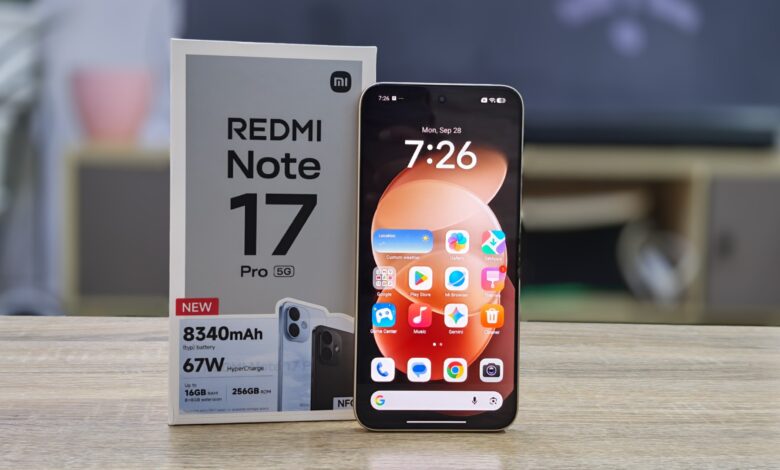
There was a time when the Redmi Note Pro name almost automatically meant one thing: value. You could spend considerably less than flagship money and still get a phone that offered a surprisingly complete package, often forcing much more expensive smartphones to justify their existence. That market has changed considerably.
Smartphones have become more expensive, specifications that were once reserved for premium devices have gradually moved into the mid-range segment, and competition around the AED 1,500 mark is now intense. A phone can no longer simply have a high-resolution display, a large amount of RAM and a big camera number printed on its specification sheet and expect to stand out.
Manufacturers increasingly have to decide what they want their smartphones to do particularly well. With the Redmi Note 17 Pro 5G, Xiaomi has made that decision very clearly. It wants this phone to last.
The most obvious manifestation of that philosophy is the enormous 9,000mAh silicon-carbon battery. But the battery is only part of the story. Xiaomi has paired it with a large 6.83-inch 1.5K AMOLED display, a 120Hz refresh rate, Snapdragon 6s Gen 4 processor, 8GB of physical RAM with another 8GB available as virtual RAM, 256GB of storage, a 50MP main camera with OIS, stereo speakers and an unusually comprehensive IP66/IP68/IP69/IP69K protection rating.

There is also Android 16 with HyperOS 3 and a lengthy software-support commitment. At AED 1,499, this is not a phone that can be described simply as an inexpensive Redmi. It sits in a segment where buyers have plenty of choices, and some of those alternatives will offer more performance or more ambitious cameras.
So the question is whether the Redmi Note 17 Pro 5G has chosen the right things to prioritise. After spending time with it, I think it has. Not because it is the most powerful phone in its class. It isn’t. Not because it has the most versatile camera system. It doesn’t. Instead, the Redmi Note 17 Pro 5G succeeds because it focuses on several things that genuinely affect how you live with a smartphone: battery endurance, display quality, durability, storage and long-term usability.
And once you understand that, the phone starts making considerably more sense.

Design: Big, Solid and Surprisingly Refined
The first thing you notice about the Redmi Note 17 Pro 5G is its size. There was never going to be any possibility of fitting a 9,000mAh battery and a 6.83-inch display into a tiny handset, and at 226g, the phone certainly makes its presence known.
It measures 163.45 x 78.27 x 8.6mm, which is actually fairly restrained considering the amount of hardware inside it. The 8.6mm thickness is particularly interesting because a battery this large could easily have resulted in a phone that felt more like a portable power bank with a screen attached to it.
Thankfully, that hasn’t happened. The Redmi Note 17 Pro 5G is a large smartphone, but it doesn’t feel excessively bulky. The rounded edges make it reasonably comfortable to hold, while the overall construction feels solid and reassuring.

You do notice the weight during prolonged one-handed use. After spending a couple of hours reading, browsing or scrolling, the 226g mass becomes apparent. It isn’t uncomfortable, but you are aware that you are holding a substantial piece of hardware.
Personally, I don’t think this is a particularly serious problem. The alternative would have been to reduce the battery capacity or make compromises elsewhere simply to save a few grams. That would have worked against the fundamental idea behind this phone.
The Redmi Note 17 Pro 5G is designed around endurance, and the weight is one of the compromises that comes with that decision. The styling itself is relatively understated. Xiaomi hasn’t tried to make the phone look like a gaming device or cover it in visual flourishes designed to attract attention from across a room. The finish is clean, the camera module is prominent without being excessively theatrical, and the overall design has a certain maturity to it.
That should also help the phone age well visually. It isn’t trying to look futuristic. It simply looks like a well-built large-screen smartphone. And that suits its personality.
Built to Survive More Than Most
If the design is relatively conventional, the durability specifications are anything but. The Redmi Note 17 Pro 5G carries IP66, IP68, IP69 and IP69K protection ratings, while the display is protected by Corning Gorilla Glass Victus 2.
The different IP ratings address different types of environmental exposure. IP68 provides protection against dust and immersion under specified conditions, while IP69 and IP69K offer protection against high-pressure and high-temperature water jets.
In practical terms, the phone has been designed to tolerate considerably more punishment than many conventional smartphones. Xiaomi has also subjected it to various durability tests involving drops, compression and bending, with SGS certification covering a claimed three-metre drop under controlled conditions.

Obviously, none of this means that you should deliberately abuse the phone. Water resistance is not permanent, and laboratory testing does not perfectly reproduce every accident that can happen in the real world. You should also follow Xiaomi’s specific guidance regarding liquid exposure.
But having this level of protection does make a difference. Phones spend their lives being carried through dusty environments, placed on restaurant tables, exposed to rain, shoved into bags and occasionally dropped. They get used at beaches, construction sites, airports, gyms and kitchens.
A smartphone doesn’t have to survive a military exercise to benefit from being more resistant to everyday abuse. For someone living in a hot and humid environment, travelling frequently or simply being less than perfect at protecting their devices, the Redmi Note 17 Pro 5G’s durability is genuinely useful.
There is also something reassuring about the philosophy behind it. Xiaomi hasn’t sacrificed everything to make this phone as thin and light as possible. Instead, it has accepted that this is going to be a substantial smartphone and used that opportunity to build something that should be able to withstand more everyday punishment. At AED 1,499, I consider that a meaningful advantage.

The Display Is One of Its Best Features
The 6.83-inch AMOLED display is another area where the Redmi Note 17 Pro 5G feels more expensive than its price suggests. The panel has a 2772 x 1280 resolution, which Xiaomi describes as 1.5K, and supports a refresh rate of up to 120Hz. It also supports 12-bit colour, Dolby Vision, HDR10+ and the DCI-P3 colour gamut.
Xiaomi quotes peak brightness of up to 3,500 nits. As always, peak brightness figures need to be treated as peak figures rather than something you should expect the entire panel to sustain continuously.
What matters considerably more is how the display performs when you actually use it. And it is very good. Text looks crisp, photographs have plenty of depth and video content benefits from the combination of AMOLED contrast and the large screen.
The 120Hz refresh rate also makes a noticeable difference to everyday interaction. Scrolling through websites, social media feeds and long documents feels smooth, while animations have the kind of fluidity that has become increasingly common even outside the premium segment.

There are smartphones with 144Hz displays, but I don’t think that is a meaningful weakness here. The difference between 120Hz and 144Hz is much less important to me than display quality, brightness, contrast and colour reproduction. Once you are using a good 120Hz AMOLED panel, the experience is already exceptionally smooth for normal smartphone use.
The Redmi’s display also performs well outdoors. The quoted 3,500-nit figure shouldn’t be interpreted as the brightness you will constantly see across the entire panel, but the screen remains readable under challenging lighting conditions.
That matters in the Gulf, where a phone can move from an air-conditioned office to harsh sunlight within seconds. Another useful feature is Wet Touch 2.0, which is designed to improve touch responsiveness when your fingers or the screen are wet. It sounds like a minor feature until you actually need it.
Suddenly being able to use a touchscreen after washing your hands or while caught in a light shower becomes considerably less frustrating. These are not features that necessarily dominate a specification sheet, but they contribute to the overall experience.

A Very Good Entertainment Phone
The large AMOLED display and stereo speakers make the Redmi Note 17 Pro 5G particularly enjoyable for watching content. Netflix, YouTube and other video services benefit from the combination of the large screen, high resolution, HDR support and AMOLED contrast.
The phone doesn’t feel like a small tablet, but it gets closer to that experience than a conventional 6.3- or 6.4-inch smartphone. The stereo speakers complement the display well. They are loud enough for watching videos, listening to podcasts and following social media content without headphones, and the stereo separation makes the experience considerably better than what you get from a single bottom-firing speaker.
Naturally, smartphone speakers still have limitations. They aren’t going to replace a dedicated Bluetooth speaker, and serious music listening is still better with headphones. But for everyday entertainment, the audio system is perfectly competent.
And this is where the huge battery begins to matter. You can settle down for a long movie or several episodes of a series without constantly thinking about how much battery you have left. That may sound trivial, but it is one of the more enjoyable aspects of using this phone.

Performance: Sensible Rather Than Spectacular
The Snapdragon 6s Gen 4 is probably the component that requires the most realistic expectations. This is a 4nm octa-core platform with a maximum CPU clock speed of 2.4GHz. The version I tested has 8GB of physical RAM, with another 8GB of virtual RAM, and 256GB of internal storage.
The distinction between physical and virtual RAM is important. The phone doesn’t suddenly have 16GB of physical memory. The additional 8GB comes from using part of the internal storage as virtual memory when required.
The 8GB of actual RAM, however, is perfectly adequate for everyday use. Apps open quickly, multitasking is generally smooth and the phone handles the usual collection of WhatsApp, Chrome, Gmail, YouTube, Instagram, Spotify, Maps and other applications without major difficulty.
The 256GB storage is equally welcome. This isn’t a phone where I would recommend buying the smallest storage configuration simply to save money. If you are going to keep a device for several years, storage becomes increasingly important. Photographs accumulate. Videos accumulate. Applications get larger. Messaging apps quietly store years of media.

Starting with 256GB gives you much more breathing room. The 256GB version also uses UFS 3.1 storage, which is faster than the UFS 2.2 storage used on the lower-capacity variant. That contributes to application loading, file transfers and general responsiveness.
Where the Snapdragon 6s Gen 4 begins to show its limitations is when you start demanding serious performance. The phone can handle gaming, but it isn’t a gaming-focused device. Popular games are perfectly playable, but demanding titles require more conservative graphics settings if you want consistently smooth performance over longer sessions.
Benchmark figures put the device in respectable mid-range territory, with AnTuTu 12 scores of just over 900,000 in testing and Geekbench 7 results of approximately 822 for single-core and 2,422 for multi-core performance. Those figures are respectable.
They are not spectacular. And that distinction matters. The Redmi Note 17 Pro 5G isn’t competing with smartphones built around Snapdragon 8-series processors. But I don’t think that makes it a poor performer. For normal smartphone tasks, the phone is responsive enough. Apps launch without excessive hesitation, scrolling is smooth and multitasking is generally comfortable.
Most people don’t spend their day running benchmark applications. They browse, message, watch videos, take photographs, navigate, listen to music and occasionally play games. The Redmi Note 17 Pro 5G handles those tasks comfortably. The important thing is simply not to buy it expecting flagship-level performance.

8GB RAM, 8GB Virtual RAM and 256GB Storage
The configuration I tested makes considerably more sense for long-term ownership than a lower-capacity model would. The 8GB of physical RAM is enough for everyday multitasking, while the additional 8GB of virtual RAM provides the operating system with additional memory resources when necessary.
But the feature I value more is the 256GB of storage. The phone’s overall design suggests that Xiaomi expects people to keep it for a while. That makes sense. The battery is huge, the physical protection is unusually comprehensive and the software-support commitment is lengthy.
If you are keeping the phone for three, four or even five years, storage becomes increasingly important. The 256GB capacity gives you the space to install large applications, store photographs and videos, download entertainment and keep years of messaging content without constantly receiving the dreaded storage-full notification.
The UFS 3.1 storage is another advantage. It isn’t something you will necessarily notice every second you use the phone, but faster storage contributes to a more responsive experience, particularly when installing large applications or moving files. For this particular phone, I would choose the 256GB version without hesitation.

HyperOS 3 Is Becoming More Mature
The Redmi Note 17 Pro 5G ships with Android 16 and HyperOS 3. Xiaomi’s software has evolved considerably over the years, and HyperOS now feels more mature and coherent than some of the company’s earlier interfaces.
It remains feature-rich. There are plenty of customisation options, Xiaomi-specific functions and ecosystem features. Some people will appreciate the flexibility, while others will still prefer a cleaner Android experience.
Personally, I find the interface reasonably easy to live with. Animations are smooth, navigation is straightforward and the 120Hz display helps everything feel responsive. AI functionality is also becoming more deeply integrated into the Xiaomi experience, including features such as Circle to Search and Gemini-related functionality.
HyperIsland provides contextual information and controls around supported notifications and activities, while HyperConnect is designed to make interaction between compatible Xiaomi devices easier. These ecosystem features become more useful if you already own other Xiaomi products.
There is also Xiaomi Offline Communication, which allows supported devices to communicate without conventional cellular connectivity under specific conditions. It isn’t something I expect most people to use every day, but it is an interesting indication of where smartphone functionality is heading. The smartphone is gradually becoming much more than a telephone.

Long-Term Software Support Is a Major Advantage
One of the most important features of the Redmi Note 17 Pro 5G may not be visible at all. Xiaomi promises four years of OS updates and six years of security updates, taking security support through to 2032. That is significant.
It changes how I view the hardware. A phone with a two-year support window can be judged primarily on what it does today. A phone expected to receive security updates for six years needs to be considered as a longer-term purchase.
And that is where the Redmi Note 17 Pro 5G’s other specifications start making sense. The 9,000mAh battery gives you considerable capacity to work with as the battery naturally ages. The durable construction reduces the risk of physical damage. The 256GB storage gives you room for years of accumulated data. The phone isn’t merely equipped for today. It has been designed with a fairly long ownership cycle in mind.
The 9,000mAh Battery Changes the Experience
This is the feature that defines the Redmi Note 17 Pro 5G. A 9,000mAh battery is enormous by conventional smartphone standards. Xiaomi uses silicon-carbon battery technology to achieve this capacity without making the phone absurdly thick. The result is a smartphone that can deliver significantly more endurance than the typical 5,000mAh device.
Xiaomi claims up to 3.5 days of battery life under its simulated light-use conditions. As with any manufacturer’s battery figure, I wouldn’t treat that as a guarantee of real-world usage. What matters more is how the phone behaves during normal use. And this is where the Note 17 Pro is genuinely different.
With a conventional smartphone, I tend to notice the battery percentage throughout the day. Navigation, photography, social media, video streaming and music can quickly turn a comfortable morning charge into an evening charging requirement. The Redmi Note 17 Pro 5G changes that equation.
A normal day involving navigation, messaging, social media, music, photography, web browsing and some video consumption doesn’t create the same anxiety about finding a charger. For moderate users, two-day operation is a realistic proposition. For heavier users, the phone can still provide considerably more breathing room than a conventional battery.
That makes a particularly big difference when travelling. Airports, taxis, trains and hotel rooms aren’t always convenient places to search for a power socket. If the phone is being used as a navigation device, camera, entertainment system, hotspot and communication tool, battery endurance becomes more than a convenience.

It becomes a practical advantage. And that is why I think the 9,000mAh battery is more important than another incremental increase in processor performance. The battery changes how you use the phone. You stop checking it quite so often.
67W Charging: Fast, But Not Exactly Fast
There is, however, a trade-off. The Redmi Note 17 Pro 5G supports 67W wired charging, and Xiaomi includes a compatible charger in the box. Under normal circumstances, 67W would be considered fast charging. But a 9,000mAh battery changes the calculation. In real world tests, it takes around 96 minutes to charge from 20 to 100 percent.
That isn’t particularly impressive compared with phones supporting 100W, 120W or faster charging systems. ut again, context matters. If your phone needs charging every evening, you want the fastest possible charging system. If your phone can comfortably last two days, you are less concerned about whether a full recharge takes an hour or an hour and a half.
The Redmi Note 17 Pro 5G also supports 22.5W wired reverse charging, allowing it to provide emergency power to another compatible device. That can be useful when travelling with wireless earbuds, a smartwatch or even another smartphone. Xiaomi also includes intelligent charging features intended to help preserve battery health over time.
Considering that the battery is one of the main reasons to buy this phone and that the software is designed for long-term use, maintaining battery health may ultimately be more important than shaving a few minutes off charging time.
Camera: The Main Sensor Does the Heavy Lifting
The Redmi Note 17 Pro 5G uses a dual-camera system comprising a 50MP main camera with OIS and an 8MP ultra-wide camera. There is also a 16MP front-facing camera. The hierarchy is immediately obvious. The main camera is where most of the photography work happens.
In good daylight, it produces detailed images with pleasing colours and respectable dynamic range. Optical image stabilisation also helps reduce the effects of hand movement, particularly when lighting conditions aren’t ideal. For everyday photography, the main camera is more than capable.
Family photographs, food, buildings, landscapes, travel photographs and social media images all look good. Xiaomi’s computational processing is also reasonably restrained. There is still processing involved, of course, but the results don’t consistently have the aggressively enhanced appearance that some smartphones produce when trying to make every photograph look spectacular.
Portrait photography is also reasonably competent. Subject separation isn’t perfect in every situation, but for casual portrait shots the results are convincing enough. The limitations become more obvious when you move away from the primary camera. The 8MP ultra-wide is functional rather than exceptional.
It is useful for architecture, landscapes and group photographs when you need a wider perspective, but fine detail isn’t in the same league as the main sensor. There is also no dedicated telephoto camera. If you photograph distant subjects regularly, you are therefore relying on digital cropping rather than optical zoom.
At AED 1,499, I would have liked to see a more ambitious secondary camera system. That doesn’t make the Redmi Note 17 Pro 5G a bad camera phone. It simply means that the camera system is best described as capable rather than exceptional.
Low-Light Photography Is More Mixed
The main camera’s OIS and computational processing help considerably in low light, but this is where the limitations of the system become more apparent. The primary camera can produce usable photographs in challenging conditions, but exposure can become less predictable when a scene contains a mixture of bright lights and deep shadows.
Night photography isn’t poor, but it isn’t consistently class-leading either. The difference between the main camera and the ultra-wide becomes particularly obvious in low light. This again reinforces the phone’s overall philosophy. The Redmi Note 17 Pro 5G isn’t a camera phone that happens to have a huge battery.
It is a long-lasting everyday smartphone that happens to have a capable main camera. Once you approach it from that perspective, the camera performance becomes easier to appreciate.
AI Photography Features Are Actually Useful
Xiaomi has also added a growing selection of AI-powered imaging features. Some of these are genuinely useful because they address problems that occur in real photographs rather than simply adding novelty effects. AI Erase Pro, for example, can help remove unwanted people or objects from a photograph.
Glare removal can also be useful when photographing through glass or dealing with strong reflections. These are features that can occasionally rescue a photograph that would otherwise be discarded. The phone also supports features such as Live Moments, Dual Video and Pro Mode, giving you additional control over how you capture content.
There is also an Underwater Mode, although this should not be confused with the phone being a dedicated underwater camera. The device’s water resistance is subject to specific conditions and limitations, and those should always be respected. The AI tools aren’t going to replace a professional editing application. But for the average smartphone photographer, having useful editing tools built directly into the phone can make a difference.
Connectivity and Everyday Features
The Redmi Note 17 Pro 5G covers the essentials well. There is 5G connectivity, dual-band Wi-Fi, Bluetooth 5.1, USB-C, an in-display fingerprint sensor and dual-SIM support. The fingerprint sensor is quick and convenient.
Given the size of the phone, having a reliable biometric system is particularly useful because you don’t always want to reach for the power button or enter a PIN. The IR blaster is another Xiaomi feature I continue to appreciate. It allows the phone to function as a remote control for compatible televisions, air conditioners and other equipment.
It isn’t a headline feature, but it is one of those little conveniences that becomes surprisingly difficult to give up once you have used it. The stereo speakers also complement the large display nicely. Taken individually, none of these features is revolutionary. Together, they contribute to the feeling that Xiaomi has tried to make this a complete everyday smartphone rather than simply a collection of impressive headline specifications.

Gaming: Capable, But Not a Gaming Phone
The Redmi Note 17 Pro can play games. The question is how demanding you intend to be. Casual titles run comfortably, while more demanding games remain playable when you use sensible graphics settings. The Snapdragon 6s Gen 4 simply isn’t intended to provide the same sustained performance as the processors used in dedicated performance-oriented smartphones.
If you push demanding games at high graphics settings for extended periods, you will eventually encounter the limitations of the hardware. Again, I don’t consider this a fundamental criticism. A smartphone needs to be judged against what it is trying to accomplish. If gaming is your primary reason for buying a phone, there are better options.
If you play for half an hour while travelling, during a lunch break or occasionally in the evening, the Note 17 Pro is perfectly adequate. And the large battery does provide one obvious benefit. You can play for longer without immediately worrying about battery drain. Naturally, sustained gaming consumes considerably more power than messaging or browsing, but starting with a 9,000mAh battery gives the phone considerably more room to work with.
The Bigger Picture: Xiaomi Has Chosen Its Priorities
The more time I spend with the Redmi Note 17 Pro, the more I think its biggest strength isn’t any individual specification. It is the philosophy behind the hardware. Xiaomi has prioritised endurance over outright performance, durability over minimal weight and practicality over trying to win every specification comparison.
The 9,000mAh battery makes the phone heavier. The Snapdragon 6s Gen 4 means performance isn’t at the top of the segment. The camera system lacks a telephoto lens. The 67W charging system doesn’t look particularly impressive beside phones offering 100W or more. But each compromise is connected to the same larger decision. Xiaomi has built a phone that should be comfortable to live with for several years.
That makes sense when you consider the combination of the large battery, physical protection, 256GB storage and long software-support commitment. This isn’t a phone designed to impress you for ten minutes in a showroom. It is designed to become the phone you stop thinking about because it simply does what you need. And I think that is a more interesting approach than it initially appears.
Is It Good Value at AED 1,499?
This is probably the most important question. At AED 1,499, the Redmi Note 17 Pro is not an automatic bargain simply because it carries the Redmi name. The price puts it into a segment where buyers can find smartphones with stronger processors, faster charging or more sophisticated camera systems.
So I wouldn’t recommend buying the Note 17 Pro simply because its specification sheet is large. You should buy it because its particular combination of features matches the way you use a phone. If battery life is one of your biggest priorities, the 9,000mAh battery is a genuine differentiator.
If you spend a lot of time watching video, the 6.83-inch AMOLED display is a significant advantage. If you travel frequently, the combination of battery endurance and durability becomes increasingly attractive. If you tend to keep smartphones for several years, the 256GB storage and six-year security commitment become important.
And if you regularly expose your phone to dust, rain or the general abuse of everyday life, the comprehensive protection is difficult to ignore. On the other hand, if your priority is maximum gaming performance, there are better choices. If photography is your primary concern, the lack of a telephoto camera and the modest ultra-wide sensor may also make you look elsewhere.
So at AED 1,499, the Note 17 Pro isn’t necessarily the best smartphone for everyone. It is, however, a very well-defined smartphone. And that makes the buying decision considerably easier.
Who Should Buy the Redmi Note 17 Pro?
The Redmi Note 17 Pro makes the most sense for someone who values endurance and reliability over outright performance. If you travel frequently, work away from a power socket, spend a lot of time watching video, use navigation extensively or simply hate charging your phone every evening, this is an unusually attractive proposition.
It is also a good choice for people who tend to keep their smartphones for several years. The combination of durability, battery capacity, 256GB storage and long software support makes the phone particularly well suited to long-term ownership.
The large display is another reason to consider it if your smartphone doubles as your primary entertainment device. Watching videos, reading documents, browsing websites and working through long emails are all more comfortable on a 6.83-inch panel.

Verdict: A Phone Designed to Keep Going
The Redmi Note 17 Pro 5G isn’t the smartphone I would recommend to someone looking for the fastest processor or the most versatile camera system at around AED 1,499. But that isn’t what Xiaomi is selling here. It is selling endurance. And on that front, the Note 17 Pro is remarkably convincing.
The 9,000mAh silicon-carbon battery changes the experience in a way that a slightly faster processor or another 50MP camera sensor simply doesn’t. You can leave home in the morning without thinking about charging. You can travel for an extended period without automatically packing a power bank. You can watch hours of video, use navigation, listen to music, take photographs and continue messaging without constantly monitoring the battery percentage.
Then there is the display, which is one of the phone’s strongest features. The 6.83-inch 1.5K AMOLED panel is bright, sharp and excellent for entertainment, while the 120Hz refresh rate makes everyday interaction feel smooth. The durability package is equally impressive. IP66, IP68, IP69 and IP69K protection, combined with Gorilla Glass Victus 2, gives the phone a level of protection that remains unusual in this category.
The 8GB physical RAM, additional 8GB virtual RAM and 256GB UFS 3.1 storage configuration also make this a sensible long-term device. You have enough physical memory for everyday multitasking, plenty of storage for years of photographs and applications, and faster storage that should help the phone remain responsive as your data grows.
The compromises are equally clear. The Snapdragon 6s Gen 4 is capable but not exceptional. Serious gamers will want more performance. The 8MP ultra-wide camera is average, and the absence of a dedicated telephoto camera limits the overall photography package. The phone is also heavy, while 67W charging is less impressive than it sounds when it has to fill a 9,000mAh battery.
At AED 1,499, those compromises need to be considered carefully. But none of them fundamentally undermines the phone. They simply tell you what the Redmi Note 17 Pro is — and what it isn’t. It isn’t a performance monster. It isn’t a camera flagship. It is a remarkably capable everyday smartphone built around one of the most useful advantages a phone can have: the ability to keep going.
For someone who values battery life, durability, a large and excellent display, generous storage and long-term usability, the Redmi Note 17 Pro 5G is a compelling package at AED 1,499. And after using it, I suspect the biggest compliment I can give it is this: It is the sort of phone you can stop worrying about.
Price: AED 1499
Product photography by Ranbir Sen
Redmi Note 17 Pro 5G AED 1499
-
Final Rating
Summary
The first thing you notice about the Redmi Note 17 Pro 5G is its size. There was never going to be any possibility of fitting a 9,000mAh battery and a 6.83-inch display into a tiny handset, and at 226g, the phone certainly makes its presence known.