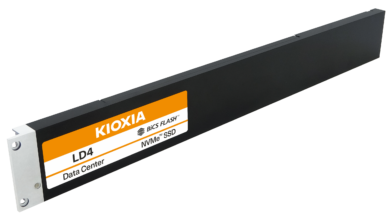
As artificial intelligence drives an explosion in enterprise data, organizations are rethinking how they store, access, and manage information at scale. Antoine Harb, Team Leader Middle East at Kingston Technology, explains how AI workloads are accelerating demand for high-performance NVMe storage, hybrid architectures, and intelligent data management strategies that balance speed, scalability, and efficiency in modern data centers.
How is AI changing enterprise storage needs and priorities?
The proliferation of AI in the tech industry has significantly changed enterprise storage requirements. This has led to the emergence of new technologies optimised to adapt to AI workloads from different angles. AI applications generate significantly larger volumes of data compared to traditional computations.
As a result, enterprise storage priorities are shifting toward solutions that can deliver not only higher capacity, but also faster data access and improved scalability. Data centers have developed their infrastructure, by upgrading storage systems with last generation enterprise-class NVMe SSDs and distributed storage architectures to favor low latency, high throughput, reliability, and scalability.
Further along the chain, hardware manufacturers like Kingston Technology respond by designing storage solutions to accommodate data centers and meet demanding AI tasks, with enterprise SSDs such as DC3000ME and DC600M ensuring fast access to large datasets and consistent performance under heavy and 24/7 read and write operations.
Organisations must ensure that their storage infrastructure can efficiently support AI training, inference, and analytics workloads while maintaining reliability, at all times.
What challenges arise when scaling storage for high-volume, fast-moving AI data?
Data grows exponentially, and the growth burst can create significant challenges in controlling and managing large volumes of information. Data centers and hardware manufacturers may struggle to keep up with increasing demand for larger-capacity drives and higher-performance storage solutions.
In addition, the challenge of metadata management lies not only in the sheer volume of data to handle, but also in the complexity of the multimodal data AI systems work with. Heterogeneous data types such (i.e., text, images, video, and sensor data) tend to gravitate toward different storage tiers and access patterns. Managing this diversity complicates indexing, retrieval, and lifecycle management, making it more difficult to maintain efficient data pipelines.
That said, the constant push for the highest possible performance can also create potential bottlenecks. Artificial intelligence workloads require extremely high throughput and very low latency, but real-world environments may struggle to maintain both simultaneously at scale. As data volumes grow, ensuring consistent performance across computers, networks, and storage layers become increasingly challenging.
Another factor is data movement and accessibility. AI workflows often involve moving large datasets between training environments, storage clusters, and inference systems. Inefficient data pipelines or limited bandwidth can slow down model development and delay insights.
The growing availability of tools that support AI applications is a major boost across many industries. However, deploying and managing these environments also requires specialized expertise in areas such as data engineering, system architecture, and performance optimization. Many organizations face skills gaps, which can slow the adoption of new technologies and make it more difficult to scale AI initiatives effectively.
On the other hand, organizations must address compliance, governance, and audit requirements when managing large volumes of data. Properly documenting, supervising, and controlling the data lifecycle. From ingestion and storage to access and deletion, it becomes increasingly complex as datasets expand and regulatory expectations evolve.
Additional challenges include cost management and energy efficiency. AI infrastructure is resource-intensive, and scaling storage systems to handle massive datasets can significantly increase operational costs and power consumption in data centers. Organizations must balance performance needs with sustainable and cost-efficient infrastructure planning.
Another important consideration is data locality and infrastructure scalability. Keeping data close to the computer resources is a process which can improve efficiency, but it requires careful architectural design to avoid excessive data movement across systems or locations.
How are high-capacity solutions evolving to support AI workloads and unstructured data?
Storage manufacturers are continuously increasing enterprise-level drive capacities to support the growing demands of AI workloads and large volumes of unstructured data. These solutions are designed to handle intensive 24/7 workloads while ensuring high performance, consistency, and reliability.
For Solid-State Drives, the evolution not only resides in the adoption of the latest PCIe Gen 5.0 interface for NVMe drives, but also in the rapidly increasing density of NAND flash chips. TLC (Triple-Level Cell) and QLC (Quad-Level Cell) technologies, allowing to store more data bits in a single cell, as well as the increasing number of vertically staked layers of memory cells within 3D NAND flash, are key elements in the evolution of SSDs.
This evolution goes hand in hand with NVMe-based drives, such as the Kingston DC3000ME, which represents a significant step forward in storage performance by delivering high sustained throughput and reduced latency—capabilities that AI operations heavily depend on. Kingston SSDs are also designed to meet strict QoS (Quality of Service) standards, providing predictable latency and consistent performance under mixed read/write workloads, which is essential for demanding enterprise and AI environments.
Alongside the development of AI-optimized drives, enterprises are also revisiting their storage tiering strategies to distribute data more efficiently across different storage layers. PCIe flash storage devices are increasingly being used as primary Tier-1 storage, helping organizations balance performance, scalability, and cost efficiency. Finally, new storage technologies are focusing on higher data density and improved power efficiency, enabling data centers to scale storage capacity while maintaining a balance between performance and energy consumption.
How do hybrid storage architectures balance cost, performance, and accessibility for AI?
In IT infrastructures, specialists often opt for hybrid storage architectures across multiple storage tiers. This approach allows efficient management of data, distributing it based on access patterns, performance requirements, and cost considerations.
The type of data plays a critical role in determining which tier it belongs to. Each dataset has a purpose, and its storage location should align with its intended use. Key considerations for storage management include cost, power consumption, performance, and accessibility.
For AI workloads, which involve dynamic, active, and real-time data constantly moving during training and inference, Tier 1 storage is essential. PCIe NVMe SSDs, such as the Kingston DC3000ME, provide high throughput, low latency, and energy-efficient performance, enabling AI applications to process large datasets efficiently. Although Tier 1 storage is more expensive, it is justified for data that is frequently accessed and performance critical.
To balance cost and performance, Tier 2 storage typically uses SATA and SAS SSDs. SATA drives, such as the Kingston DC600M, provide cost-efficient storage for warm data that is accessed periodically or partially processed. While SAS drives deliver higher performance than SATA, they tend to consume more power and cost slightly more, so they are chosen based on workload requirements.
Tier 3 storage includes hard drives (HDDs), object storage, and cloud storage solutions. HDDs tend to win the battle against SSDs when looking at the cost per GB, making them ideal for archived or cold AI datasets, though they have higher latency and power consumption.
What impact do AI-native or intelligent storage systems have on managing generative content?
AI-native or intelligent storage systems have built-in AI capabilities that can help manage content generated by AI models. These smart platforms can use autonomous AI agents to automatically classify data, tag metadata, and distribute content across multiple storage tiers. They are capable of independently sorting and organising unstructured datasets, such as images, text, audio, and video.
By reducing the need for human intervention, these systems improve efficiency, speed up data access and retrieval, and handle large volumes of data more effectively. By automatically placing active or frequently accessed generative data on high‑speed NVMe SSDs and shifting older or rarely used content to SAS or HDDs, intelligent storage systems strike a balance between performance, cost, and scalability.
These platforms also enhance AI workflows by pre‑loading datasets, speeding up ingestion and preprocessing, and anticipating I/O needs to minimise slowdowns during training and inference. On top of that, AI‑native storage provides built‑in support for data lineage, version control, and compliance, ensuring generative content is properly tracked and governed while enabling efficient model updates. Together, these capabilities help organisations scale generative AI workloads, simplify content management, and maintain strong performance across large, complex datasets.
How can efficient storage strategies help reduce energy use and operational costs from AI growth?
Thinking strategically is a key element while working towards reducing energy consumption and the associated costs. The expansion of AI workloads consumes a myriad of resources, and that is where the efficiency of implementing thoughtful storage strategies comes into play.
By using a tiered storage model, organisations can considerably allocate data to the suitable tier level. This ensures that high‑energy, high‑performance storage devices are only utilised where they provide benefit and added value; this helps reduce overall power draw.
Consolidating high-capacity storage drives and increasing data density in high performing systems also allow data centers to store more information per unit of energy, cutting infrastructure costs and supporting sustainable scaling as AI datasets continue to grow.
What steps should IT leaders take to prepare storage for expanding AI-generated data?
As a preventative measure, IT leaders should consider all the necessary points to best manage the growing load of AI in their infrastructure. Firstly, it is important to audit current storage facilities and assess their capabilities in terms of capacity, performance, and utilisation. Planning and forecasting data growth helps enterprises gain insight into how AI could expand their data volume and how best to manage it.
In addition, classifying data by type: frequently used, intermittently used, or rarely accessed is crucial. Proper data classification supports efficient storage in a hybrid infrastructure, making it easily accessible when needed. Tiered storage architecture is particularly important, as it balances cost, performance, and energy efficiency.
Strategic planning goes hand in hand with conscious data maintenance. IT leaders must optimise the data lifecycle by automating archiving, deletion, and migration of datasets. Integrating storage with built-in AI features can also help automate tedious processes, reducing manual overhead.
Security is another key consideration. Using encrypted hardware, such as the DC3000ME and DC600ME, implementing robust data retention policies, and performing audits ensures compliance with regulations like GDPR. Finally, investing in scalable, high-performance storage resources is essential. Servers, NAS systems, and storage drives should be capable of keeping up with the increasing demands of AI offering high speed, low latency, and energy efficiency, while still managing costs effectively.
Which emerging storage trend will most improve handling the AI data surge?
With the multidirectional growth of AI, the industry could see the advancement of several emerging storage solutions. We may see more intelligent and automated storage systems, for example AI-driven tools that classify and distribute data among different tiers to reduce cost and increase efficiency. This would help reduce manual management while ensuring that frequently accessed data is stored on faster storage, while less important datasets are moved to lower-cost tiers.
In addition, hardware manufacturers will continue to offer drives that support demanding workloads, focusing on delivering the highest possible speed with low latency while maintaining the stability and reliability of the system. This helps GPUs and CPUs avoid idle time during processing, considering that these are the components on which AI tasks heavily depend.
There is also an expectation that hybrid and distributed storage will continue to evolve by combining on-site infrastructure with cloud storage. As AI expands into edge computing, such as IoT devices and autonomous systems, hybrid storage is expected to extend beyond the traditional data centre. Data may be processed locally at the edge while larger datasets are stored or archived in central cloud platforms, which reduces latency and network congestion.
On the other hand, sustainability will play an increasingly important role in storage development. Modern SSDs offer higher performance per watt compared to older storage technologies. Although proper cooling remains essential, especially during intensive workloads, modern storage systems generate less heat, which helps reduce the demand for cooling in data centres.
In addition, high-density storage solutions allow organisations to store larger volumes of data in the same physical space. Higher-capacity drives and dense storage arrays reduce the number of devices required in a system, which lowers overall power consumption and cooling requirements. This approach helps organisations scale their storage infrastructure more efficiently while also reducing operational costs and environmental impact.