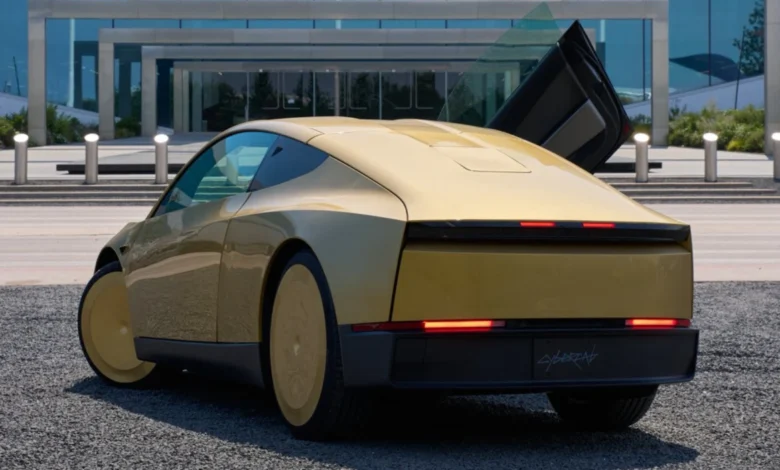
Tesla has integrated Starlink satellite connectivity directly into its Cybercab robotaxi, marking a new step in the company’s effort to maintain connectivity across autonomous vehicles and further linking Tesla’s operations with SpaceX’s satellite network.
Tesla shared images on X showing what it described as the “First Cybercab with Starlink integration.” The images show a square section integrated into the vehicle’s roofline, suggesting that the Starlink hardware is being installed as part of the vehicle rather than added externally.
Earlier Cybercab prototypes spotted on public roads had been fitted with external Starlink dishes mounted towards the rear of the vehicle. Elon Musk has also indicated that passengers could use the satellite connection for high-bandwidth activities during journeys, including watching live sports and movies, playing games and carrying out productivity tasks.
Musk previously said that “all cars will have Starlink in the future,” describing satellite connectivity as a potential way to provide high-bandwidth connectivity to billions of vehicles. For Tesla, one of the primary reasons for integrating Starlink into the Cybercab is maintaining connectivity as the autonomous fleet expands.
During Tesla’s second-quarter earnings call, Musk said satellite connectivity could help address areas where terrestrial cellular networks provide inadequate coverage. “We can’t have robotaxis getting stuck in these Bermuda Triangles of lack of cellular connectivity,” Musk said. “Starlink, with its ability to do connectivity anywhere, is actually quite important, so we don’t have robotaxis missing in action.”
Tesla AI chief Ashok Elluswamy has clarified that Starlink connectivity is not required for the Cybercab’s autonomous driving system to operate safely. The vehicle’s autonomous driving capabilities continue to rely on its onboard cameras and computing hardware. Instead, the satellite connection is expected to support functions such as navigation, customer service and fleet management. It could also provide passengers with high-speed internet access during journeys.
Tesla began Cybercab production during the second quarter at Gigafactory Texas, which has an installed annual capacity of more than 125,000 vehicles. Engineering testing on public roads also began during the quarter, while employee rides on Tesla’s Texas campus started in July.
Tesla currently operates its robotaxi service using modified Model Y vehicles and plans to introduce the purpose-built Cybercab alongside them. Unlike conventional Tesla vehicles, the Cybercab is designed without a steering wheel or pedals. Elluswamy said production rates are being aligned with expected fleet deployment requirements, while Musk has indicated that the new vehicle platform needs additional driving data before broader deployment can take place.
For existing Tesla vehicles, the Starlink integration does not currently change their connectivity capabilities. Existing models continue to use LTE and Wi-Fi, and Tesla has not announced a retrofit programme for adding Starlink hardware to older vehicles.
The Cybercab integration also highlights the increasingly close technological relationship between Musk’s companies. Tesla vehicles already use SpaceX’s Grok AI personality as a voice assistant, while SpaceX has purchased Tesla products including Megapacks and vehicles. The companies have also been linked through the proposed Terafab chip manufacturing project, while the next-generation Tesla Roadster is expected to incorporate SpaceX technology.
The growing number of connections between the companies has fuelled speculation about a potential combination of Tesla and SpaceX, although there is currently no formal merger proposal. Musk’s push to bring Starlink to vehicles also forms part of a broader view of how internet and AI traffic could evolve.
He has pointed to forecasts suggesting that AI-generated internet traffic could eventually far exceed traffic generated directly by humans. From Musk’s perspective, traditional cellular networks could face increasing pressure as connected vehicles and AI services generate greater volumes of data.
SpaceX is separately working on plans for Starmind, a proposed satellite network that could eventually process AI workloads in orbit rather than simply transmitting data between satellites and ground infrastructure. The Starlink integration therefore represents more than an additional connectivity option for the Cybercab. It could become part of Tesla’s broader strategy for keeping autonomous vehicles connected as the company expands its robotaxi operations.