Alibaba Launches Qwen3.8-Max, Its Most Powerful AI Model Yet

Alibaba has unveiled Qwen3.8-Max, the latest and most advanced model in its Qwen family, featuring 2.4 trillion parameters, multimodal capabilities and support for context windows of up to one million tokens. The company says the model delivers significant improvements in coding, reasoning, research and long-horizon task execution while ranking among the world’s top-performing AI models.
Available through Alibaba Cloud Model Studio APIs for global developers, Qwen3.8-Max will have its model weights released next week and can also be accessed through QwenWork, Alibaba’s AI-powered workplace assistant platform.
Built on the Qwen 3.5 architecture, the new model adopts a Sparse Mixture-of-Experts (MoE) design combined with a hybrid attention mechanism. Although it comprises 2.4 trillion parameters, only 95 billion are activated during inference, enabling frontier-level performance while reducing computational costs and latency compared with similarly sized dense models.
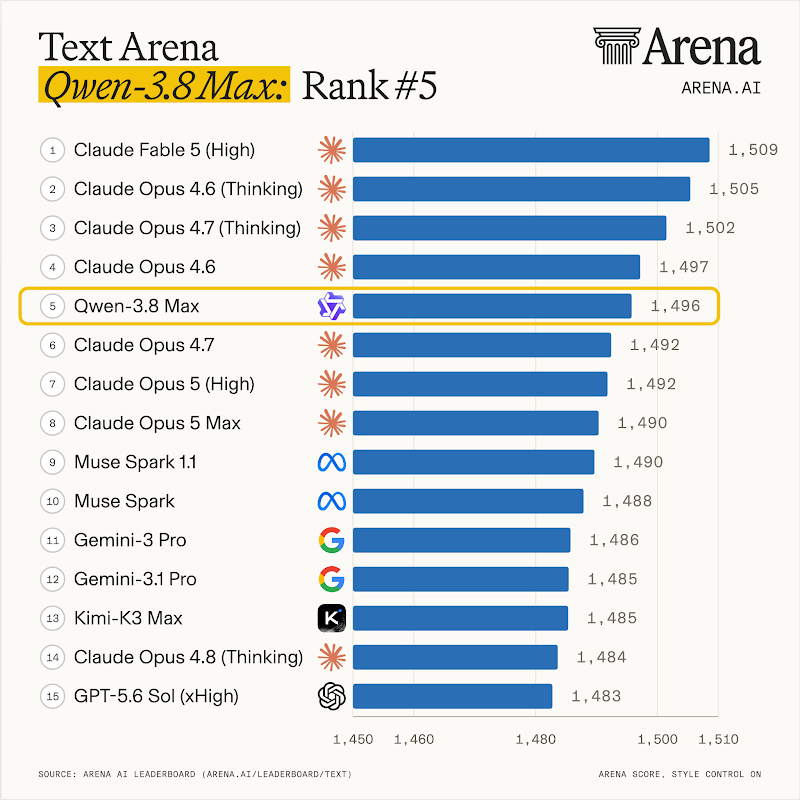
Alibaba says Qwen3.8-Max ranks fifth on Text Arena, second on Vision Arena, and fourth on Frontier Code Arena, highlighting its capabilities across language, vision and software engineering tasks.
The company demonstrated the model’s autonomous coding capabilities by assigning it a 16-day software engineering project in which it independently developed and iteratively refined an open-source agent framework called oh-my-cli. According to Alibaba, the model generated code, tested its outputs, analysed logs and incorporated user feedback without human intervention throughout the development cycle.
Beyond software development, Qwen3.8-Max is designed to support complex enterprise use cases including legal document analysis, financial research, application design, sports analytics, architectural modelling and scientific research. Alibaba also claims the model has outperformed human participants in the WWW2025 Multimodal Dialogue Intent Recognition Challenge, demonstrating advanced capabilities in analysing customer service interactions and understanding user intent.
As a multimodal foundation model, Qwen3.8-Max can process text, images and video, enabling users to convert large documents, television series or extended livestreams into searchable knowledge bases. It also supports visual AI tasks such as generating educational animations, editing videos, recreating web applications from screenshots, converting 2D floor plans into 3D visualisations and building interactive applications from natural language prompts.
To showcase its visual reasoning capabilities, Alibaba introduced RecreationBench, a benchmark that evaluates an AI model’s ability to recreate software applications without internet access or source code. According to the company, Qwen3.8-Max successfully reconstructed applications by relying solely on visual feedback and iterative interaction, highlighting its progress towards autonomous multimodal agents.