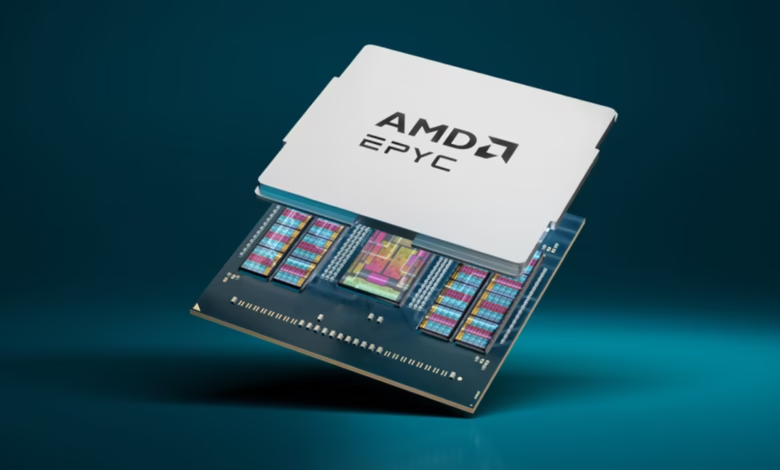
AMD has announced that its 5th Gen AMD EPYC processors are powering the host infrastructure for Google Cloud TPU 8tx, the first cloud Tensor Processing Unit (TPU) system to offer hardware-enforced confidential computing.
The expanded collaboration combines AMD EPYC processor performance, AMD Infinity Guard security capabilities and x86 software compatibility with Google Cloud’s TPU acceleration technology. The solution is designed to help enterprises run AI inference, fine-tuning and reinforcement learning workloads while protecting sensitive data and intellectual property.
With 5th Gen AMD EPYC processors supporting Google Cloud’s confidential computing architecture on TPU 8tx, organisations can deploy sensitive AI workloads in the cloud at scale while maintaining data protection.
The deployment further establishes AMD EPYC processors as a key component of accelerated AI infrastructure. Across systems powered by GPUs and custom accelerators, EPYC CPUs handle essential host processing tasks, including data preparation, workload coordination and communication with accelerators.
The integration with TPU 8tx adds hardware-based security to these capabilities, addressing the need to protect data while it is being processed by AI systems.
“The most capable AI systems need a CPU foundation that can match the demands of the accelerators they host,” said Dan McNamara, senior vice president and general manager, Compute and Enterprise AI, AMD. “Across generations of EPYC, we have built leadership capabilities in the performance, memory bandwidth and I/O that keep accelerated systems productive, backed by years of engineering collaboration with the world’s leading cloud providers. Our work with Google Cloud brings that strength to TPU 8tx, helping customers scale AI with the performance and protection their most important workloads demand.”
“When teams move AI agents into production, they need confidence that their data and intellectual property stay private, even from the underlying infrastructure,” said Mark Lohmeyer, vice president and general manager for AI and Computing Infrastructure, Google Cloud. “By pairing 5th Gen AMD EPYC processors with our 8th-generation TPU architecture inside the AI Hypercomputer, we are bringing hardware-enforced confidential computing to cloud TPUs for the first time. Customers get silicon-level data protection alongside the low-latency performance needed for modern reasoning models.”
Within TPU 8tx systems, 5th Gen AMD EPYC processors manage workload orchestration, data preparation and high-throughput communication with TPU accelerators. The infrastructure uses AMD Secure Encrypted Virtualization (SEV) capabilities built into EPYC processors. Combined with the TPU architecture, these capabilities extend confidential computing protections beyond the host CPU to connected accelerators, helping secure sensitive information as it moves between system components.
Before an accelerator receives direct access to protected memory, its identity and security configuration are verified. This process helps ensure that customer prompts, AI model weights and intermediate data remain encrypted in CPU memory and during transfers between the host processor and accelerators. Hardware isolation is also maintained during accelerator execution.
These safeguards are intended to give enterprises greater confidence when using sensitive information in reasoning and agentic AI applications.
AMD EPYC processors also support Google Cloud’s wider confidential computing portfolio. AMD SEV technologies provide workload protection across Confidential VMs, Confidential GKE, Confidential Space, Confidential Managed Service for Apache Spark and Confidential Dataflow. The TPU 8tx deployment extends this collaboration into confidential AI acceleration.
As hyperscalers, frontier AI laboratories and model developers build increasingly specialised infrastructure, the role of host CPUs remains important to overall system performance. AI accelerators rely on host processors to supply data, schedule workloads and connect AI operations with surrounding applications and services. AMD says its EPYC processors serve as the host CPU platform for more than 10 leading hyperscalers and frontier AI labs, across infrastructure using GPUs and custom AI accelerator application-specific integrated circuits (ASICs).
The processors support deployments involving AMD Instinct GPUs, Nvidia GPUs and custom silicon. This broad compatibility provides customers with an established CPU platform across different accelerator architectures, while retaining access to the wider x86 software ecosystem.
The TPU 8tx deployment builds on several generations of collaboration between AMD and Google Cloud. The companies have worked together on multiple generations of EPYC processors, supporting general-purpose, compute-intensive, storage-intensive and accelerated workloads. Their collaboration includes current Google Cloud Compute Engine C4D, N4D, H4D, Z4D and G4 virtual machines.
The partnership has also extended to enterprise security, including detailed reviews of AMD security processor firmware by Google security specialists. With TPU 8tx, the expanded collaboration brings together accelerated computing and hardware-enforced confidential computing, enabling enterprises to deploy modern reasoning and agentic AI workloads in production environments while maintaining protection for sensitive data and intellectual property.