Designing AI-Ready Data Centres Where Infrastructure and Intelligence Converge

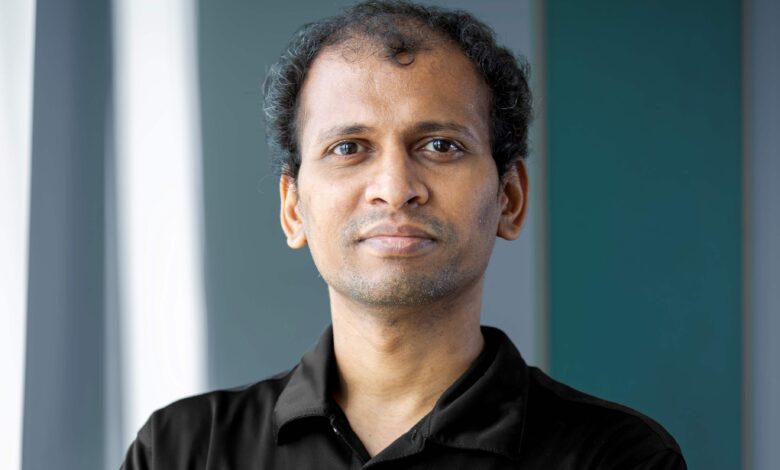
Rajkumar Vijayarangakannan, Lead of Network Design and DevOps at Zoho Corp, explains why modern AI data centres must be engineered as tightly integrated systems, the challenges of scaling legacy facilities, and why the convergence of physical infrastructure and cybersecurity is becoming essential for operational resilience.
How is the rise of AI workloads changing the design and architecture of modern data centers?
AI workloads are changing data centres from a collection of independent servers into a tightly coordinated, single-rack or multi-rack computing system. In this design, it is not just a server running GPUs; instead, the server contains a combination of GPUs, high-speed networking devices, storage, power, and cooling that must operate as one interconnected system.
The first major shift is power and cooling. AI accelerators place far greater power demand within each rack, creating concentrated heat loads that conventional data centre designs were not built to handle. This requires higher-capacity power distribution, more efficient conversion systems, and a move towards direct-to-chip or other liquid cooling approaches where air cooling becomes insufficient.
The increased weight of densely packed compute hardware and liquid cooling equipment also means that floor load-bearing capacity must be considered during facility design or retrofitting. Once these physical requirements are addressed, the network and storage architecture must also change.
Modern AI data centres therefore require co-designed architecture in which building systems and digital infrastructure are planned together from the beginning.
What are the biggest challenges in scaling infrastructure to support high-density AI compute environments?
The biggest challenge is trying to scale a conventional data centre, typically designed for around 10–20kW per rack, to support much denser AI infrastructure. Its power distribution, cooling system, floor loading, rack layout, and network cabling may all have been planned for a very different operating profile. Increasing GPU density can therefore trigger changes across the facility rather than a simple hardware upgrade.
A purpose-built AI data centre faces fewer of these constraints because high-density power, liquid cooling, structural capacity, and high-bandwidth networking can be incorporated from the design stage. The challenge is therefore not that AI infrastructure is inherently difficult to scale; it is that older facilities may lack the physical and electrical headroom to scale without major redesign.
How are power, cooling, and networking requirements evolving with AI-driven infrastructure?
AI infrastructure pushes power, cooling, and networking requirements from general-purpose capacity towards high-density, workload-specific design.
On the power side, the requirement is no longer only more megawatts but delivering much higher power safely and efficiently to each rack. Research, reference designs, and proof-of-concept work are now exploring high-voltage data centre distribution, including architecture around 800VDC. For the same amount of power, increasing the voltage reduces the current, which can reduce cable and busbar size, copper requirements, and distribution losses while simplifying the delivery of power to very dense GPU racks. However, protection systems, connectors, operating procedures, and the broader equipment ecosystem must mature before such designs become widely adopted.
Cooling is moving closer to the source of heat. Traditional air cooling remains suitable for lower-density deployments, while dense GPU systems increasingly require direct-to-chip liquid cooling or hybrid designs. This introduces coolant distribution units, piping, leak detection, and closer monitoring of temperature and flow.
Networking is evolving from simply connecting servers to coordinating large groups of GPUs. AI training produces heavy east-west traffic because GPUs continuously exchange data with one another. Networks therefore require higher bandwidth, low latency, predictable performance, and effective congestion control.
Where do you see the convergence between physical infrastructure management and cybersecurity today?
The convergence is happening because physical infrastructure is increasingly monitored and controlled through connected software platforms. Power systems, cooling equipment, generators, access controls, and environmental sensors may interact with building management systems and, in some environments, SCADA-based controls. This improves visibility and operational response, but it also expands the cybersecurity boundary beyond traditional IT systems.
A compromise of these control environments may not directly expose customer data, but it could interfere with power distribution, cooling, or other services that keep the data center operational. Wherever practical, critical SCADA and facility control systems should remain air-gapped from corporate and public networks. Where complete physical isolation is not operationally possible, connectivity should be limited through tightly controlled gateways, strong network segmentation, one-way data flows (where appropriate), and strictly governed remote access.
The key change is that physical availability and cybersecurity can no longer be managed separately. A modern data centre needs a common security approach across IT, operational technology, and facility systems while preserving strong isolation around the systems that control essential physical infrastructure.