Agentic AI Hits Hyper-Growth as US and China Dominate Global Race: GlobalData


Agentic AI is entering a hyper-growth phase as enterprises accelerate the shift from task-based automation to autonomous, decision-driven systems, with the US and China now steering the global race. As adoption moves rapidly from pilots to production, this new class of self-correcting digital workers is redefining how organizations pursue scale, agility, and end-to-end operational intelligence, says GlobalData, a leading data and analytics company.
GlobalData’s report, “Market Opportunity Forecasts to 2029: Agentic AI,” reveals that the global agentic AI market is expected to grow at a robust compound annual growth rate (CAGR) of 50.6% during 2024-2029 to reach $45.4 billion in 2029. The surge is driven by enterprise demand for autonomous decision-making, multi-agent orchestration, and scalable cloud-native AI infrastructure as organizations accelerate deployment from pilots to production-grade systems.
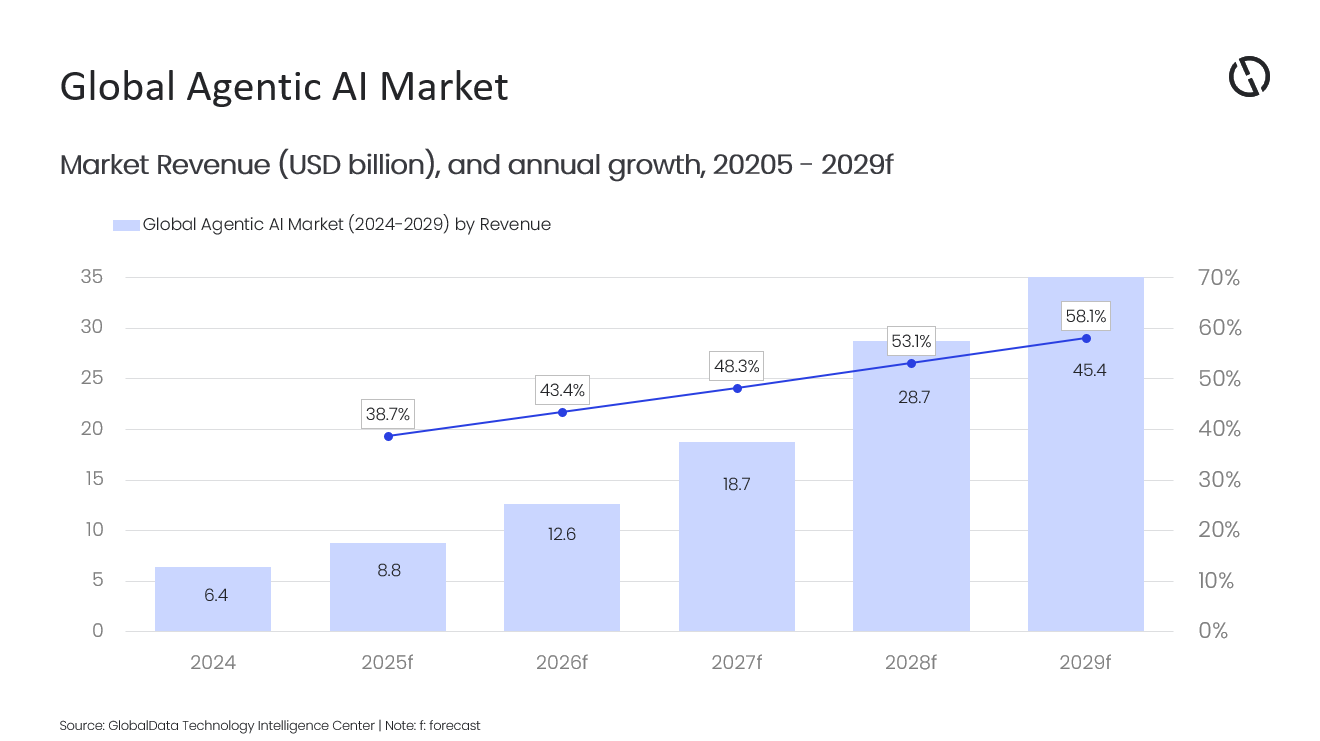
While generative AI (GenAI) transformed content creation, agentic AI is transforming action. Enterprises are moving beyond rule-based automation to autonomous systems capable of planning, reasoning, self-correction, and coordinating multi-step workflows with minimal human input. Advances in orchestration engines, long-context LLMs, and memory-driven architectures now enable agents to execute complex business processes end-to-end.
Rena Bhattacharyya, Chief Analyst and Practice Lead for Enterprise Technology & Services at GlobalData, comments, “Agentic AI is moving enterprises beyond static, rule-based automation toward systems that can plan, reason, and self-correct. This evolution matters because organizations are no longer looking for tools that simply execute tasks – they need autonomous digital workers that can handle complexity, learn from interactions, and drive real operational agility at scale.”
Asia-Pacific has become the world’s largest agentic AI market with $3.0 billion in 2025 revenue, surpassing North America’s $2.6 billion. This rapid growth is fueled by government-backed AI missions, manufacturing automation, and widespread deployment in financial services, public sector, and healthcare. China, Japan, India, and South Korea continue to build AI infrastructure at record pace, supported by national LLM programs and emerging AI innovation zones.
The US remains the global innovation hub for agentic AI, generating $2.3 billion in 2025 revenue. Early-mover enterprises and leading hyperscalers are replacing traditional RPA with goal-driven, self-adapting agent systems across core operations, ranging from IT management and customer service to supply chain and financial operations.
Rohit Sharma Lead Analyst, Technology at GlobalData, says, “Enterprises are no longer piloting agentic systems but actively retiring rule-based automation in favor of autonomous digital colleagues.” This shift is happening because early adopters are seeing clear business value, including up to 61% faster revenue growth in automated units and, in some cases, achieving 90% touchless operations across entire workflows.
Bhattacharyya concludes, “As enterprises worldwide prioritize agility, continuous decisioning, and workforce augmentation, agentic AI becomes a foundational pillar of digital transformation strategies, setting the stage for widespread mainstream adoption through 2026 and beyond.”