From Smart Factories to Digital Workplaces: How AI Is Reshaping Every Industry

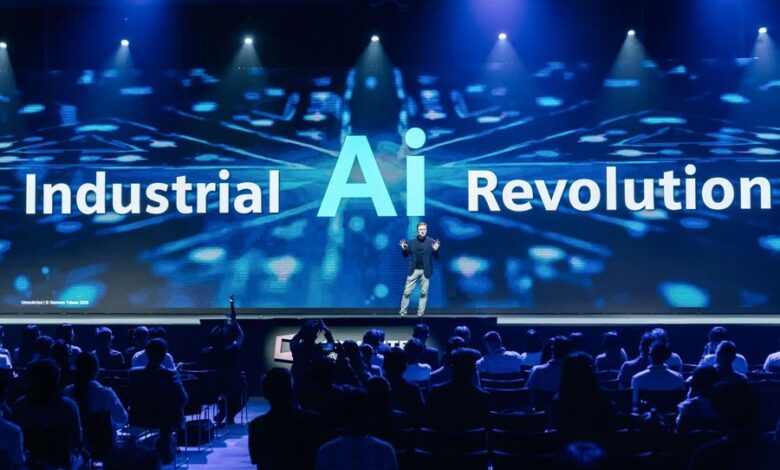
Reporting from Taipei, Taiwan: Artificial intelligence is rapidly moving beyond experimental deployments and becoming a practical tool for transforming manufacturing operations, enterprise workflows, and employee productivity. Speakers at a COMPUTEX 2026 industry forum outlined how AI is driving change across sectors, from factory floors and logistics networks to offices and customer-facing operations.
Industry executives agreed that organizations are entering a new phase of AI adoption, where success will depend less on simply deploying models and more on integrating AI into everyday business processes.
Manufacturing remains one of the most significant beneficiaries of the technology. Advances in machine vision, predictive analytics, robotics, and edge computing are enabling companies to improve efficiency, reduce downtime, and optimize production in ways that were previously difficult to achieve.

Several speakers highlighted that AI is helping manufacturers transition from reactive decision-making to proactive operations. By analyzing data from sensors, machinery, and production systems in real time, organizations can identify issues before they disrupt operations and continuously improve productivity.
At the same time, AI’s influence is extending far beyond industrial environments.
Businesses are increasingly adopting AI-powered assistants, automated workflows, and intelligent decision-support systems to streamline administrative tasks and improve employee efficiency. Rather than replacing workers, many organizations are using AI to eliminate repetitive tasks and allow employees to focus on higher-value activities.
According to industry leaders, one of the most significant shifts is the rise of agentic AI systems capable of carrying out complex tasks with minimal human intervention. These systems can gather information, execute actions, coordinate across applications, and assist employees in managing increasingly demanding workloads.
Kedar Kondap of Qualcomm described the current moment as a major turning point for the technology industry.
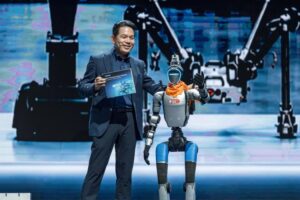
“This is the moment where AI stops being an experiment, AI now becomes real infrastructure,” Kondap said.
He explained that AI adoption remains relatively early despite widespread attention and investment. As demand for AI-generated content and services continues to rise, organizations must rethink how computing resources are distributed across cloud environments, edge devices, and connected systems.
Rather than relying exclusively on cloud-based processing, companies are increasingly exploring hybrid models that combine centralized computing with on-device intelligence. This approach helps reduce latency, improve privacy, and deliver faster responses in real-world applications.
The workplace is also undergoing significant change as AI becomes embedded within productivity tools and business applications.
Microsoft’s Mark Linton said the technology industry is preparing for what many describe as the “agentic era,” where AI systems act as collaborators rather than simple software tools.
Organizations are beginning to deploy AI agents capable of assisting with research, content creation, software development, customer support, and operational planning. These systems are expected to become increasingly integrated into daily workflows as enterprises seek new ways to improve productivity and competitiveness.
The transformation is equally visible in industrial settings, where AI-powered robotics and automation systems are becoming more sophisticated.
Across COMPUTEX 2026, exhibitors demonstrated how AI is being combined with robotics, edge computing, and digital twins to create smarter manufacturing environments. From predictive maintenance to autonomous logistics and intelligent quality control, companies are using AI to build more resilient and efficient operations.
Industry experts noted that future success will depend on connecting AI capabilities across devices, applications, and business processes rather than treating them as isolated technologies.
Qualcomm envisions a future in which AI-enabled devices work together seamlessly, allowing information and tasks to move naturally between smartphones, PCs, vehicles, and other connected systems.
As organizations continue investing in AI infrastructure, the focus is shifting from experimentation toward measurable business outcomes. The next stage of AI adoption will be defined by practical deployment, operational efficiency, and the ability to create intelligent systems that deliver real-world value.
For businesses across manufacturing, logistics, services, and knowledge-based industries, the message from COMPUTEX was clear: AI is no longer a future possibility. It is becoming a foundational technology that is reshaping how work gets done across every sector of the economy.