AI Boom Puts Data Storage at the Heart of Future Infrastructure

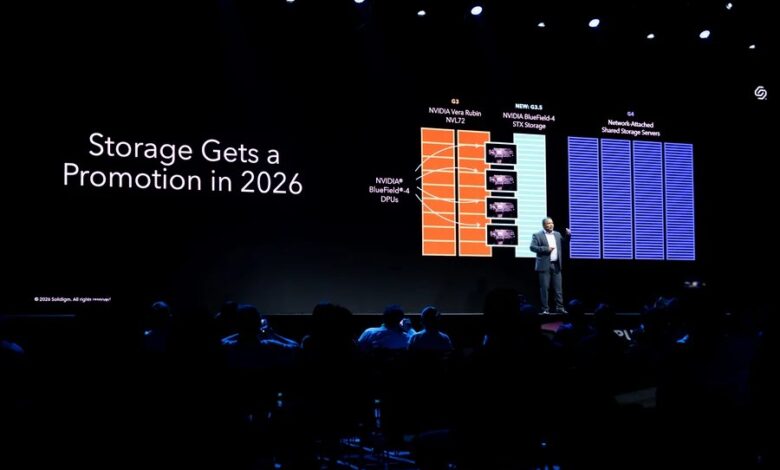
Reporting from Taipei, Taiwan: As artificial intelligence continues to reshape industries worldwide, technology leaders speaking at COMPUTEX 2026 emphasized that the success of AI initiatives will depend as much on data storage as on processing power.
During a forum focused on AI infrastructure, executives from Synology, Western Digital (WD), Solidigm, and Kioxia discussed how organizations are confronting unprecedented data growth while seeking ways to maintain security, governance, performance, and cost efficiency.
Mike Chen, Managing Director at Synology, highlighted the growing importance of data sovereignty and control as enterprises and government agencies increasingly adopt AI technologies. He noted that organizations are feeding valuable and often sensitive information into AI systems, making ownership and protection of that data a critical concern.
“Don’t fear the tool. Control the tool,” Chen said.
According to Chen, Synology’s approach focuses on keeping data closer to where it is generated, whether in industrial environments, transportation systems, or other edge deployments. By reducing the distance data must travel, organizations can lower latency, improve efficiency, and retain greater control over their information. He also stressed the role of centralized data management in helping businesses identify threats such as ransomware and recover information quickly when incidents occur.

The conversation then shifted to the growing volume of information generated by AI applications.
Ahmed Shihab, Chief Product Officer at WD, explained that modern AI systems create multiple categories of data, including training datasets, inference outputs, and user-generated interactions. Even seemingly simple AI-generated content can result in substantial backend data requirements.
Using the example of a short AI-generated video, Shihab illustrated how a relatively small output may require significantly larger amounts of supporting inference data behind the scenes.
“The more bulk storage, the more embeddings, the more embeddings, the better the AI, the better the AI, the more data and the cycle continues,” Shihab said.
To address these demands, WD advocates a tiered storage approach that combines the speed of solid-state drives with the capacity advantages of hard disk drives, enabling organizations to balance performance and economics as AI workloads expand.
Storage requirements are becoming increasingly important as enterprises move from AI experimentation to large-scale deployment.
Avi Shetty, Vice President of AI Ecosystem and Market Enablement at Solidigm, said businesses are now facing difficult decisions about what information to retain, where it should be stored, and how much data is truly necessary for long-term AI operations.
“How much do I save? Where do I save it? Do I save all of it? Do I save only a little bit of it? All those decisions translate to data growth,” Shetty said. “Storage is the foundation of AI inference.”
Shetty explained that before large language models generate responses, they must process vast amounts of contextual information, historical interactions, and supporting knowledge. This creates enormous storage demands that continue to rise as AI models become more sophisticated.
At the same time, memory technologies are facing supply constraints, increasing the need for efficient infrastructure architectures. Solidigm’s strategy focuses on creating data center environments that utilize multiple storage tiers to maximize efficiency and deliver stronger returns on investment.
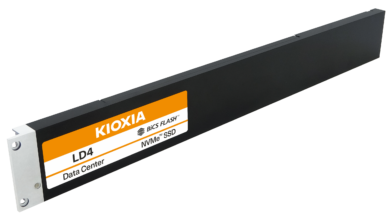
Kioxia’s presentation explored the role of solid-state drives within modern AI systems and data centers.
“AI performance depends on data, and data is enabled by storage,” said Koichi Fukuda of Kioxia. “That is why SSDs are not just components, but the key enabler of modern AI.”
Fukuda explained that as AI adoption accelerates, data centers require storage technologies capable of delivering high bandwidth, low latency, scalability, and cost efficiency. While memory technologies such as DRAM and high-bandwidth memory play important roles, SSDs often provide a balance between performance, capacity, and affordability.
“The next phase of AI will not be defined by compute alone. It will be defined by how effectively we connect compute to data,” Fukuda said.
Looking ahead, Fukuda argued that competitive advantage will increasingly come from an organization’s ability to extract value from the vast amounts of information available to it, rather than simply generating more AI outputs.
To support that objective, Kioxia is developing software technologies designed to optimize memory utilization by leveraging flash storage more effectively. One example highlighted during the session was AiSAQ, an open-source platform aimed at improving memory efficiency by shifting certain workloads from volatile memory to flash-based storage.
Across all presentations, a common theme emerged: while processors and accelerators often dominate AI discussions, data storage has become a foundational element of the AI ecosystem. As organizations deploy larger models and process growing volumes of information, storage infrastructure is increasingly being viewed not as a supporting component, but as a strategic enabler of AI innovation.