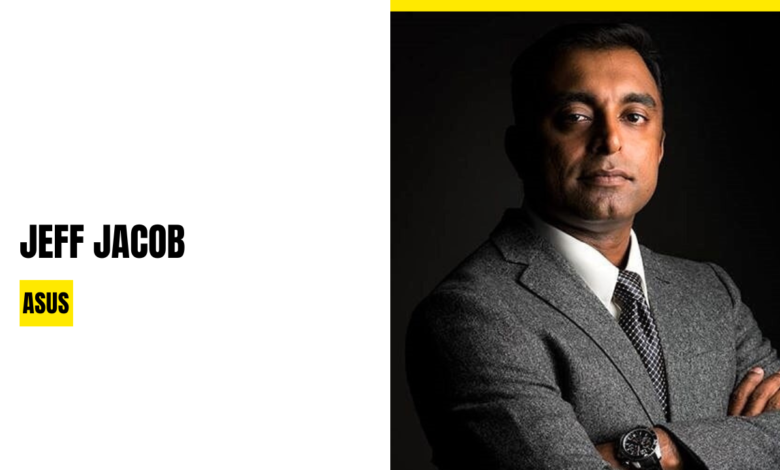
Jeff Jacob, Regional Business Team Lead – ISBG at ASUS Middle East & Africa, outlines how the company is evolving beyond its PC and gaming roots to become a key enterprise infrastructure and AI solutions provider. He discusses rising demand across sovereign AI, data centers, and high-performance computing, and explains how ASUS is supporting governments and enterprises in building secure, scalable, and energy-efficient AI ecosystems across the region.
How is ASUS evolving from a PC and gaming brand into an enterprise infrastructure and AI company?
Our evolution is a deliberate, strategic shift built on decades of engineering excellence. By separating our Infrastructure Solutions Business Group (ISBG), we are now hyper-focused on enterprise demands. Today, we don’t just sell hardware; we architect end-to-end AI ecosystems—spanning advanced GPU platforms, edge compute, and integrated data center solutions. We are the foundational infrastructure partner for the Middle East’s AI ambitions.
Which industries in the Middle East are driving demand for ASUS enterprise solutions today?
Demand is surging in the public sector, finance, energy, and healthcare. Governments are heavily investing in sovereign AI and smart cities. Oil and gas require massive HPC for predictive modeling, while banking is shifting to AI for real-time analytics. What unites them is the mandate for the secure, high-density compute environments that ASUS delivers.
How is ASUS helping sectors like banking, government, and defense address their infrastructure challenges?
In these regulated sectors, security and performance are non-negotiable. We deliver enterprise-grade architectures optimized for the world’s most demanding workloads, like NVIDIA HGX platforms. By integrating seamlessly with high-performance storage and networking ecosystems, we enable secure, air-gapped AI environments. This gives clients absolute control over data governance without sacrificing compute density.
How is ASUS supporting the region’s growing focus on sovereign AI and local AI infrastructure?
Sovereign AI is a matter of national security and economic independence for MEA governments. ASUS enables this by providing the bare-metal, GPU-optimized infrastructure required to train foundational models entirely onshore. We empower governments to meet strict data residency laws while rapidly accelerating their indigenous AI capabilities.
How do you balance the power demands of AI data centers with sustainability goals in the Middle East?
Our focus is on delivering optimized architectures that maximize computing efficiency while reducing power consumption wherever possible. This includes advanced thermal designs, efficient server platforms, intelligent workload management, and support for next-generation cooling technologies.Many customers are now evaluating infrastructure based not only on computational performance but also on power efficiency, rack density, and long-term operational costs.
We work closely with partners and customers to design solutions that support both AI growth and environmental objectives. As the region continues investing in sustainable development, energy-efficient data center infrastructure will remain a core component of every successful AI strategy.
How important are channel partners to ASUS’ enterprise growth strategy across MEA?
ASUS Channel partners are the backbone of our strategy. Enterprise AI requires complex integration across compute, high-performance storage, and facility infrastructure. We treat our partners as strategic systems integrators, equipping them with the engineering support and joint go-to-market resources necessary to guide enterprise clients through complex AI deployments.
Our objective is to grow together by creating sustainable value for customers throughout the region. We have a good mix of local partners who are capable of deploying locally and a mix of Cross Geography partners who are capable of to deploy on a global scale.
What opportunities do you see emerging from the region’s rapid AI adoption over the next few years?
The Middle East has become one of the most dynamic AI markets in the world, and we see significant opportunities ahead. Governments and enterprises are investing heavily in local compute infrastructure, while industries move from POCS to production-scale deployment driving demand for high-performance servers, storage, networking, and edge computing.
We also expect strong growth in sovereign AI, industry-specific models, smart cities, autonomous systems, and AI-powered cybersecurity, as sectors like healthcare, finance, energy, education, and manufacturing accelerate adoption in pursuit of efficiency and new digital services. For ASUS, this represents an opportunity to stand alongside our customers at every stage of their AI journey from infrastructure deployment through to long-term scalability
How important is flexibility and modularity for customers building next-generation AI data centers today?
Flexibility and modularity are among the most important requirements we hear from customers today. AI technology is evolving at a rapid pace, which means organizations want infrastructure that can scale and adapt without requiring complete redesigns every few years. Customers are looking for modular architectures that allow them to add compute, storage, networking, and GPU resources as business requirements grow, a scalable solution. At ASUS, we deliver adaptable platforms that allow our customers to confidently deploy the AI environments they need today, fully prepared to integrate the innovations of tomorrow.