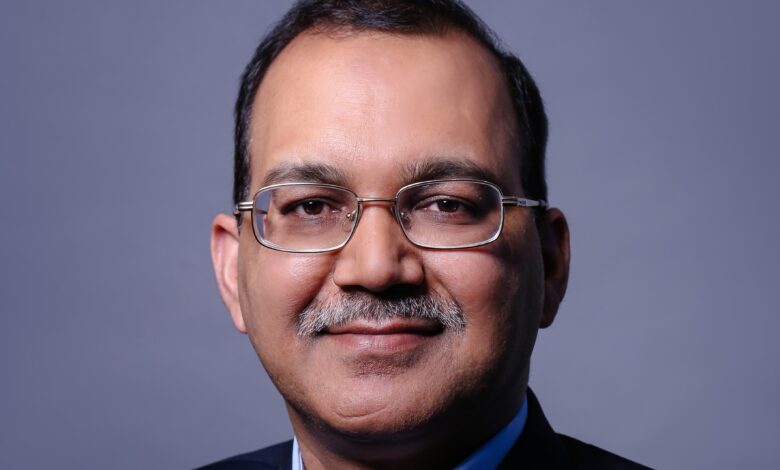
As AI workloads drive unprecedented increases in compute density, power demand and cooling requirements, Middle East data centres are being forced to evolve at a pace rarely seen in the industry. Shashank Sharma, VP & General Manager, Lenovo Middle East and Africa, discusses how operators are rethinking infrastructure design, sustainability, cybersecurity and deployment models to build AI-ready facilities capable of supporting the region’s ambitions.
How is the rise of AI workloads changing the design and architecture of modern data centers?
What is happening in the Middle East right now is not an upgrade cycle. It is a fundamental reimagining of what a data center is and what it needs to do. The facilities being built today bear almost no resemblance to what was considered state-of-the-art five years ago.
The shift is driven by density. Racks that once drew a few kilowatts are being replaced by AI-purpose-built environments operating at significantly higher loads, and the next generation is already being planned beyond that. Regional data center capacity is projected to triple by 2030.
That trajectory forces architects, operators, and vendors to rethink everything from floor layouts and power distribution to cooling philosophy and network design. The question our customers are asking is no longer whether to upgrade. It is how quickly they can do it without disrupting what they already have running.
What are the biggest challenges in scaling infrastructure to support high-density AI compute environments?
In this region, two challenges stand above the rest: power access and cooling under extreme ambient conditions.
The Middle East is racing to become an AI powerhouse in a climate that punishes infrastructure. Temperatures regularly exceed 45°C, and Gulf states depend on energy-intensive desalination for most of their water supply, meaning data centers carry a hidden carbon cost before a single server is switched on.
Delivering power reliably in a market where demand is accelerating faster than grid infrastructure can respond is one of the most pressing operational realities facing every operator building out today. Then there is the sustainability dimension. National commitments are hardening.
The UAE targets net zero by 2050, Saudi Arabia by 2060. The infrastructure being deployed to power AI ambition is being held to those commitments. Closing the gap between adoption speed and sustainable design is no longer a long-term goal. It is an immediate operational imperative.
How are power, cooling, and networking requirements evolving with AI-driven infrastructure?
The Middle East’s cooling challenge is distinct from any other region in the world. You cannot import a data center design optimized for a temperate European climate and expect it to perform in Abu Dhabi or Riyadh. The thermal and operational assumptions are fundamentally different, and with the Middle East data center construction market growing at nearly 24% annually through 2030, the pressure to solve cooling at scale is only intensifying.
Conventional cooling approaches depend on large volumes of water, much of which is lost through evaporation, a serious liability in a water-scarce environment. Closed-loop liquid cooling systems address this directly. Once filled, they reuse the same water repeatedly with virtually no loss during normal operation. Solutions like Lenovo’s Neptune liquid-cooling technology were built with exactly these conditions in mind, and what we are seeing now is that this is no longer a future consideration. It is being deployed in the region today.
On networking, as inference becomes the dominant AI compute pattern in production environments, the speed of data movement between nodes becomes as critical as raw processing power. Ultra-low-latency, high-bandwidth interconnects are non-negotiable, and designing for that from the outset is what separates facilities that scale well from those that require costly retrofits within a few years.
Where do you see the convergence between physical infrastructure management and cybersecurity today?
The numbers here are sobering. The Middle East ranked second globally for average breach costs at $7.29 million per incident in 2025, and what is particularly striking for data center operators is where the vulnerabilities are emerging. System misconfigurations alone accounted for nearly a third of all security incidents in the UAE.
As infrastructure becomes increasingly software-defined and managed through APIs and automation layers, every misconfiguration becomes a potential entry point, not just into data, but into the systems managing power, cooling, and physical operations.
Physical and cyber security can no longer be managed as separate conversations. Security has to be a design principle embedded at the infrastructure level, not a layer applied after deployment. That shift in thinking is one of the most important changes we are seeing among serious operators in the region.
What new security risks emerge as data centers become more software-defined and AI-orchestrated?
In a software-defined environment, the attack surface is no longer just servers and storage. It extends to virtualization layers, orchestration platforms, and the AI systems themselves. Adversaries are no longer only targeting data. They are increasingly targeting decision-making infrastructure.
Model poisoning, adversarial inputs, and manipulation of AI orchestration systems represent a new class of risk that traditional security tooling was not designed to address. Imagine a scenario where bad actors manipulate the automated cooling systems, triggering localized overheating to force a critical shutdown; this is the new reality.
The region’s move toward data localization and sovereign cloud mandates is a direct response to this reality. It also creates a genuine opportunity for operators and vendors who can deliver sovereign-grade infrastructure from the ground up, ensuring local compliance natively, rather than retrofitting compliance onto systems that were not built for it.
How important is real-time simulation or digital twin technology in planning and managing AI infrastructure?
At the level of complexity and capital at stake in today’s AI infrastructure projects, digital twin technology has moved from a differentiator to an operational necessity. Operators have learned, often expensively, that deploying first and optimizing later is not a viable approach when rack densities are this high and construction timelines are this aggressive.
The ability to model thermal behavior, simulate power distribution, and validate network configurations before committing to physical changes is what allows teams to move fast without building in costly mistakes. In a region with some of the most ambitious capacity targets in the world, planning with that level of precision is not a luxury. It is what responsible infrastructure deployment looks like.
How are vendors adapting to the need for faster deployment cycles in AI infrastructure environments?
The pace of AI adoption across the Gulf is among the fastest anywhere in the world. 73% of organizations in the region are already deploying AI, with budgets growing at 12% year-on-year. That creates enormous pressure on the infrastructure layer to keep pace, and the organizations leading that AI charge will only realize its value sustainably if the infrastructure beneath it is designed to endure.
The response has to be pre-validated, rack-scale solutions that collapse the time between procurement and production. Lengthy integration phases are a luxury that the current pace of adoption does not afford. For customers in this region, moving from proof of concept to live deployment in weeks rather than months is increasingly the expectation, not the exception. Our job as a vendor is to make sure infrastructure is never the reason a business cannot move at the speed it needs to.